




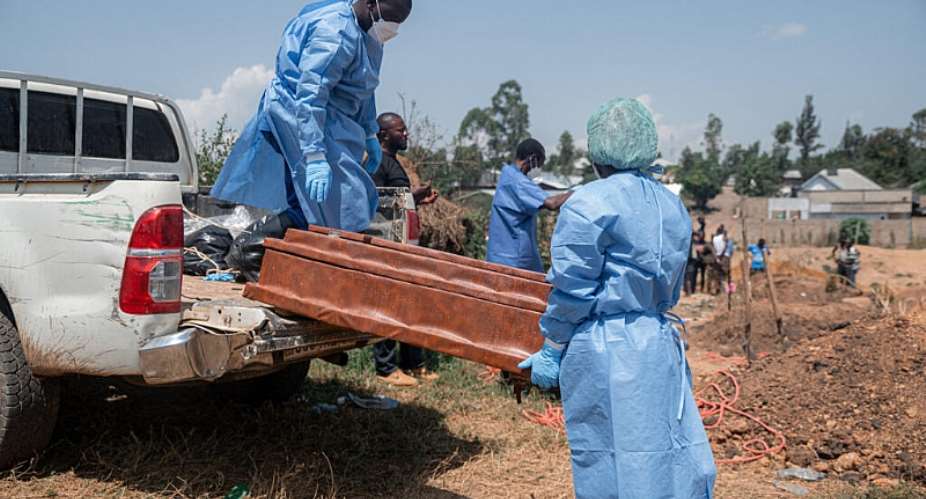
The free healthcare measure was announced on Sunday by the Congolese Minister of Health, Samuel Roger Kamba, during his visit to Ituri – the province at the epicenter of the latest Ebola epidemic.
Kamba visited the provincial capital Bunia and is due to travel to the mining town of Mongbwalu, where the epidemic started.
The government's objective is to ensure that Ebola does not relegate other health emergencies to the background.
The pilot programme in Ituri includes free medical consultations and treatment for all illnesses.
It is to be financed with the tax for health promotion which came into effect last March, as well as the mandatory health insurance announced for the coming weeks. Doctor wearing personal protective equipment tend to a patient in the red zone of the Ebola treatment centre of Rwampara General Reference Hospital in Rwampara, Ituri Province, Democratic Republic of Congo, on 12 June, 2026.
Financial incentives
Meanwhile, the fight against the Bundibugyo strain of Ebola is at its peak, mobilising significant resources in the region.
Authorities said Monday that confirmed cases have risen to 1,003 and 254 deaths have been reported.
Regarding healthcare workers, authorities have promised compensation to the families who have lost someone, as has already been done for about ten of them. For doctors involved in the response, their risk allowance will be doubled.
During his visit to Ituri, Kamba also announced that Ebola patients will soon no longer be sent to general hospitals, but to specialised treatment centres, still being established, with the aim of improving their care and limiting the spread of infection.
The government is keen to restore the public's confidence in healthcare facilities and counter the numerous misinformation campaigns on social media.
Ebola outbreak spreads in DRC as misinformation hampers response
Spreading 'fast'
The fatal outbreak is spreading rapidly in the DRC, the World Health Organization (WHO) warned on Friday.
"The outbreak remains serious" and is "evolving so fast", said Marie-Roseline Belizaire, the WHO Africa emergencies chief.
"However, I have seen a response that is growing stronger every day," she told reporters in Geneva, speaking from Bunia.
The outbreak was declared on 15 May, though transmission had been going undetected for some time beforehand.
Belizaire said the response teams were racing to keep pace with the virus, which spreads by close contact and infected bodily fluids.
The number of treatment beds available for Ebola patients had gone from zero to more than 500, she said.
And surveillance teams were now investigating nearly 400 alerts and were capable of administering more than 2,000 tests a day, she added.
Belizaire also highlighted that efforts to trace contacts of known Ebola cases had ramped up, with 75 percent of all contacts now being reached.
The WHO has said 95 percent of contacts must be traced to get on top of the outbreak.
(with newswires)

 ACFO II Semey Mawuko bows out after 37 years in GNFS
 Adwoa Safo is the rightful successor to late Apostle Kwadwo Safo — Family
 We do not recognize Akofena as leader of Kristo Asafo Mission — Kantaka family
 US cracks down on visa holders accused of abusing system and defrauding citizens
 IMANI stopped asking questions when the NDC took office – Miracles Aboagye
 Mother and son buried after Cape Coast rain disaster, NADMO orders building chec...
 Four medical laboratories shut down in Bolgatanga over regulatory breaches
 Dismiss Kennedy Agyapong from NPP — Agyenim Boateng
 Asantehene receives rousing homecoming at Prempeh Airport after Europe, North Am...


