




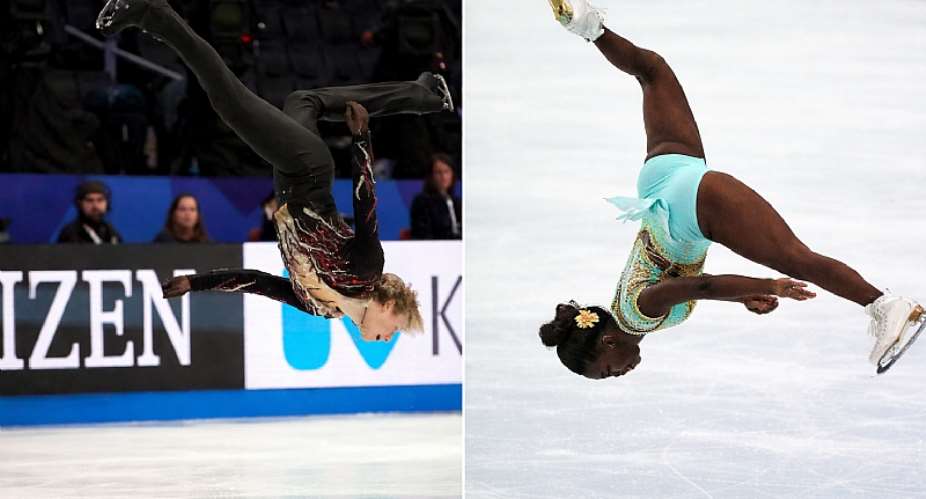
Figure skating has always lived at the intersection of artistry and athleticism. Yet, the stories of Ilia Malinin and Surya Bonaly reveal a deeper truth: progress in sport is not just about talent—it is about who is allowed to redefine the limits.
Separated by decades, culture, and circumstance, Malinin and Bonaly are bound by a shared courage to push figure skating beyond its comfort zone. Their journeys—one celebrated, the other often resisted—form a powerful narrative about evolution, justice, and the cost of being ahead of your time.
The Innovator vs. The Trailblazer
Ilia Malinin is often called the “Quad God,” a nickname earned by landing the quadruple Axel—the most difficult jump in figure skating—and performing multiple quadruple jumps in a single program. He has redefined what is physically possible, becoming the first skater to land all six types of quadruple jumps in competition. His style is unapologetically athletic, blending power with spectacle.
Surya Bonaly, however, was doing something equally revolutionary long before Malinin took the ice. In the 1998 Olympics, she performed a backflip—landing on one blade—despite knowing it was illegal and would cost her points. According to the Instagram page of Joshua Dairen, “I just wanted to show the judges… what I can do,” said Bonaly, a statement of defiance against a system that often undervalued her.
Where Malinin’s innovation is praised, Bonaly’s was penalized. And therein lies the contrast.
A Sport That Changed—Or Was Forced To
When Bonaly performed her backflip, the move was banned for being too dangerous. Judges deducted points, and her boldness was framed as rebellion rather than brilliance. Decades later, that same move has been legalized, even celebrated. The International Skating Union lifted the ban in 2024, acknowledging that somersault-type jumps are ‘very spectacular.’
Malinin has since performed the first legal Olympic backflip in nearly 50 years, thrilling audiences and contributing to Team USA’s gold medal. This shift raises an uncomfortable question: if the move is now acceptable, why wasn’t Bonaly rewarded for it?
Many have pointed out the double standard. As one analysis noted, “the punishment of Bonaly back then and the praise of Malinin today underscore a double standard.” Bonaly herself reflected on this disparity, saying simply, “I broke ice for other skaters....now everything is different.”
Style, Identity, and Resistance
Beyond technical innovation, Bonaly challenged the cultural expectations of figure skating. As a Black woman in a predominantly white sport, she often faced criticism for her powerful, athletic style—one that didn’t fit the traditional mold of delicate femininity. Her backflip wasn’t just a skill; it was a statement.
Malinin, by contrast, competes in a sport that now embraces athleticism. His explosive jumps and high-risk elements are not seen as deviations—they are the new standard. The very qualities that made Bonaly an outsider have become the blueprint for modern success. In many ways, Malinin is thriving in the world Bonaly helped create.
The Weight of Greatness
Yet, even in this evolved era, greatness comes with pressure. Malinin recently spoke about the “insurmountable pressure” and “vile online hatred” he faced at the Olympics. Despite his groundbreaking achievements, he is still navigating the mental and emotional toll of performing at the highest level.
This reminds us that progress is not linear. While the sport has grown more accepting of innovation, athletes are still burdened by expectations—just in different forms. Bonaly fought for recognition. Malinin fights to sustain it.
Legacy and Inspiration
The comparison between Ilia Malinin and Surya Bonaly is not about who is greater. It is about understanding how greatness is shaped—and sometimes limited—by the times in which it exists.
Bonaly was a pioneer who dared to defy the rules. Malinin is the beneficiary of a sport that finally caught up to her vision. Together, they represent two sides of progress: the one who breaks the door down, and the one who walks through it. Their stories challenge us to ask: How many innovators are we overlooking today because they do not fit the mold?
Conclusion: Honor the Ones Who Came Before
If Malinin is the future of figure skating, Bonaly is its foundation. Her courage to challenge the system paved the way for a new generation of athletes to be celebrated rather than constrained. As Bonaly herself put it, “I was born too early.” Perhaps the greatest tribute we can give her is not just recognition, but reflection—ensuring that the next Surya Bonaly doesn’t have to wait decades to be understood. Because true progress is not just about new heights—it is about remembering who first dared to reach them.
About The Authors:
Kalon Martez Williams (b. 1993) is a native of Little Rock, Arkansas. He attended the historic Little Rock Central High School and later earned his degree from Arkansas Baptist College, one of the four Historically Black Colleges and Universities (HBCUs) in Arkansas. A creative artist, Williams is a member of Bountiful Blessings World Fellowship under the leadership of Senior Pastor, Dr. Stephen W. Christian. He currently resides in the Little Rock area. In addition to his artistic pursuits, he enjoys serving the community and has a genuine passion for caring for dogs.
 BECE papers must be reduced to just four subjects; ten is a torture — Kofi Asare
 Mahama, appointees donate GH¢6.1m to Medical Trust Fund
 Leading member of NPP says President Mahama is genuine
 Nkwanta South two BECE candidates involved in accident recovering well — Educati...
 Teachers of Adiewoso Basic School whipped in military operation against galamsey...
 It’s not true that ex-Buffer Stock CEO was denied access to his lawyers — Deputy...
 Greater Accra Regional Minister is not performing — Kwame Owusu Danso
 Gov’t weaponising state agencies against political foes — NPP’s Kamal-Deen
 Parliament should pass procedural safeguards limiting immediate rearrest after j...
 Police arrest six men accused of impersonating security operatives in Agona Swed...


