




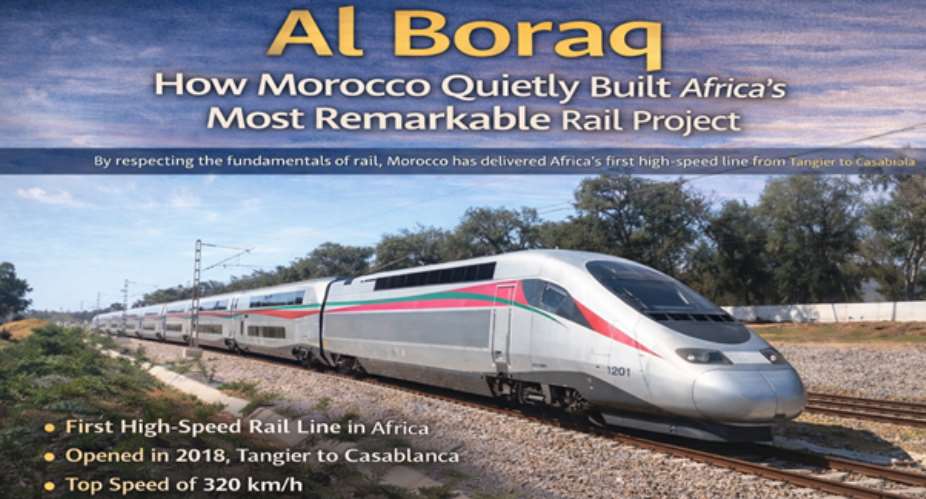
When Africa’s rail ambitions are discussed, they are often framed in the future tense: plans, announcements, feasibility studies, and promises. Morocco’s Al Boraq high-speed rail line stands out precisely because it moved beyond rhetoric into reality. It is not just Africa’s first high-speed rail line; it is one of the continent’s most disciplined infrastructure projects and perhaps its most instructive.
Commissioned in 2018, Al Boraq connects Tangier to Casablanca, covering roughly 350 kilometers, with trains operating at speeds of up to 320 km/h on the high-speed segment. What makes this project remarkable is not its speed but the method behind it. Morocco did not leap blindly into high-speed rail. Instead, it spent decades modernizing and stabilizing its conventional railway system under the Office National des Chemins de Fer (ONCF) before transitioning to high-speed operations.
Long before Al Boraq, Morocco invested consistently in track renewal, rolling stock maintenance, timetable reliability, and freight-passenger integration. By the time high-speed rail was proposed, the country already had a functioning rail culture, trained engineers, reliable data, stable institutions, and public confidence in rail transport. High-speed rail was therefore an upgrade, not a gamble.
Financing also followed a pragmatic path. The project combined state funding, concessional loans, and strategic partnerships, particularly with France, without mortgaging Morocco’s fiscal stability. Crucially, the line was designed to integrate with existing rail services rather than operate as an isolated prestige project. Passengers can seamlessly transition between conventional and high-speed trains, ensuring system-wide benefits rather than elite mobility.
The economic impact has been tangible. Travel time between Tangier and Casablanca was cut by more than half, logistics efficiency improved, and regional integration accelerated, particularly linking the industrial north to Morocco’s economic core. Yet Al Boraq has avoided the trap of being framed as a silver bullet. It is part of a broader rail strategy, not a substitute for it.
For the rest of Africa, the lesson is clear: remarkable rail projects are built on boring fundamentals. Strong institutions, continuous operations, credible data, and long-term political commitment matter more than technology alone. Morocco succeeded not because it chased speed, but because it respected sequence.
Al Boraq reminds the continent that rail transformation is possible, but only when ambition is matched with discipline.
Author: Joseph Fuseini ([email protected])

 'Stop excessive financial demands before sharing information with us' — Interior...
 EC will serve national interest, not partisan politics – Deputy Chair Dr Kwaku A...
 I expect no preferential treatment from EC for myself as President, my party or ...
 Afenyo-Markin meets management, proposes reforms to turnaround struggling ECG
 ECG management commends Afenyo-Markin for reforms during short stay as Board Cha...
 Mahama tasks new EC deputy chairpersons to uphold impartiality
 Attorney-General urges court to reject Adu-Boahene’s no-case submission
 Nyaho Medical Centre ordered to report to CID over expired data protection certi...
 Mahama swears in new Electoral Commission deputy commissioners
 PTAAM-Africa calls for government probe into alleged World Cup visa fraud


