




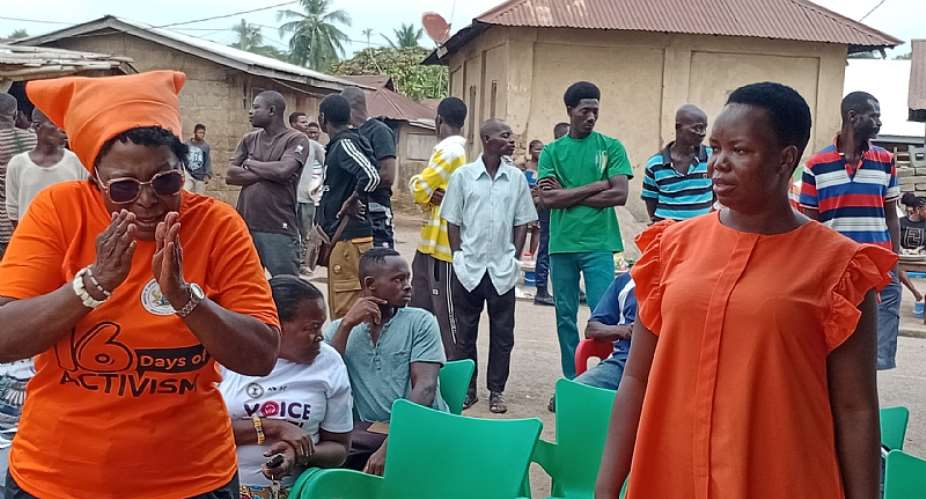
A senior officer of the Domestic Violence and Victim Support Unit, DOVVSU, has cautioned men in the Volta Region that marriage does not grant automatic sexual entitlement over their wives. According to ACP Mercy Brown, Volta Regional Coordinator of DOVVSU, the notion that husbands can demand sex from their wives at any time is unlawful and has no basis in Ghana's current legal framework.
She delivered the message at Atikpui during a community engagement organised by GLOWA under the theme Break the Silence of Sexual Violence: Women and Girls Must Lead the Change. The meeting brought together traditional leaders, women’s groups, community volunteers and young people to deepen awareness on sexual consent, survivors’ rights and the legal protections available to victims.
ACP Brown explained that the old provision under Section 42(g) of the Criminal Offences Act, which previously gave what she called a blanket consent over women’s bodies, was repealed in 2007 following intense advocacy during the drafting of the Domestic Violence Act. She noted that before the repeal, the law permitted men to have sexual access to their wives at any time after customary marriage.
She said the removal of that section means that a husband must obtain a clear agreement before initiating sexual activity with his wife. She added that some men have sex with their wives regardless of whether the woman is sick or recovering from childbirth or emotional issues, which makes coercing a spouse into sex constitutes an offence, just as it is an offence when a woman deliberately refuses basic marital responsibilities in ways that inflict emotional harm to her husband.
ACP Brown said the law recognises that domestic settings come with serious emotional issues, but spouses must learn to respect each other’s rights and mental well-being. She stressed that practices such as forcing sex on a woman who has recently delivered a baby or is sick are clear violations that can be reported to DOVVSU.
She also highlighted that DOVVSU personnel receive specialised training beyond regular police and CID instruction, especially in understanding the legal intersections between the Domestic Violence Act, the Criminal Offences Act and the Matrimonial Causes Act. This equips them to respond effectively to different forms of harm that occur in intimate relationships and to support victims with appropriate legal and psychosocial pathways.
The Atikpui session formed part of a wider awareness campaign being undertaken by Global Action for Women Empowerment, GLOWA, with support from the African Women Development Fund. The organisation is implementing a seven-month project themed Break the Silence of Sexual Violence: Women and Girls Must Lead the Change. It is being executed in Ahoe, Nyive, and Atikpui in the Ho Municipality, as well as Amedikpui and Wudese in the Agortime-Ziope District. Launched in August 2025 and expected to end in February 2026, the initiative aims to reduce sexual violence, strengthen community reporting systems and increase knowledge of sexual rights among women and girls.
The project also provides safe, confidential and trauma-informed counselling to aid recovery, boost self-esteem and reduce stigma among survivors. In each community, GLOWA is working with traditional authorities, women leaders, teachers, parents, volunteers and peer educators to create safe spaces where victims can report sexual violations without fear of judgement or retaliation.
During the Atikpui engagement, participants were taken through the legal meaning of consent, the difference between consent and submission, and the consequences for individuals who violate another person’s bodily rights. Facilitators emphasised that silence or fear-driven compliance is not consent, and community members were encouraged to support survivors to speak up.
ACP Brown noted that many violations persist because families often discourage reporting, either out of fear of embarrassment or in attempts to settle cases privately. She warned that covering up sexual violations against wives, partners, or minors obstructs justice and promotes a cycle of abuse that leaves victims unprotected and perpetrators unaccountable.
She urged community members to rely on DOVVSU’s services, stressing that the unit is mandated to investigate all complaints of sexual violations and support survivors through medical examinations, counselling, legal processes and social welfare referrals. She stated that men, too, can be victims of sexual violations and should not hesitate to seek help when abused.
The GLOWA team used the platform to educate residents about safe reporting channels, including community volunteers trained to document cases and direct survivors to the appropriate authorities. The team also encouraged young people to learn about their bodily rights early to prevent exploitation and to develop the confidence to speak up when they are violated.
The engagement ended with a call for continued collaboration among GLOWA, DOVVSU, the Social Welfare Department, traditional councils, and district authorities to ensure that the ongoing project leaves lasting structures in place. Facilitators stressed that communities must take ownership of safeguarding women and girls ensuring that knowledge, support systems and reporting channels remain active and accessible to all victims and complainants.

 Site for Adaklu District 24-hour economy market handed over to contractor
 Govt to complete over 1,000MW power expansion in Kumasi — John Jinapor
 Amin Adam made co-chair of Buwumia's Finance and Economy Committee
 NPP appoints Akosua Manu as spokesperson for gender and social protection commit...
 GHS activates national surveillance following hantavirus outbreak on Cape Verde ...
 South Africa denies xenophobia claims as Ghana pushes AU action
 Kennedy Agyapong rejects co-chair appointment by Bawumia
 Police arrest six suspects over alleged child trafficking syndicate in Kasoa
 Former Deputy AG urges GJA to resist return to ‘Culture of Silence’
 Four killed in Savannah Region road crash involving tipper truck


