




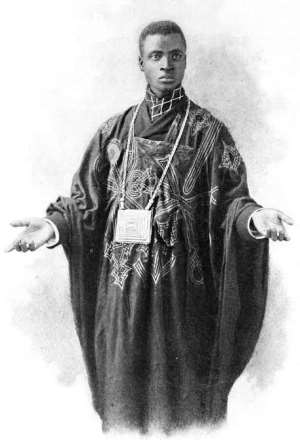
In my recent Facebook comment regarding Prince Momolu Massaquoi's presidential ambitions, I stated that I found no credible information indicating that he had publicly and officially declared his intention to run for president of Liberia. Upon further research, he made his intentions clear. Therefore, he was the first indigenous Liberian to aspire to the presidency. This information invalidates an earlier view that the late Didwho Welleh Twe was the first native Liberian to seek the presidency. My original view was in error.
Now, I would like to discuss my recent research on Prince Momolu Massaquoi, shown in the picture. He was the son of King Lahai and Queen Fatama Sandemani of the Vai tribe, born on December 6, 1869, in the Gallina Territory. This area, which overlapped Sierra Leone and Liberia, was active during the Transatlantic Slave Trade. He received further education in the US. Under President Edward Howard, he served as a district commissioner in the Liberian hinterland. He delivered the 1921 independence Day Celebration Oration, which critically discussed Liberia's conditions and called for the integration of the native and Americo-Liberian groups. It also advised the government to allow native chiefs to serve in the legislature and to impose the hut taxation. The Americo-Liberians did not favor the integration, and the chiefs serving in the legislature. Therefore, they criticized the speech. But the King administration implemented the hut taxation, which created hardship for the native majority.
From 1922 to 1929, Massaquoi served as Liberian Consul General in Germany. As other analysts have expressed, this position made him the first native Liberian to serve as a diplomat to a modern European country. Moreover, the appointment was important, for before the World Wars, Germany was Liberia's major trading partner. He occupied the position a year after World War 1. But Nazism had started in Germany a year after his arrival in the country. It may have been difficult for him as a Black person at a time when the country engaged in the doctrine of "pure race". While the King administration had a repressive native policy, one of King's vice presidents was Henry Too Wesley, a Grebo, the first native VP.
Upon Massaquoi's return to Liberia, President King appointed him Postmaster General. For the 1931 election, Massaquoi expressed his intention for the presidency. Nevertheless, as my comment indicated, his friend, President Edwin Barclay, was said to have betrayed him. Barclay, who was King's secretary of state and later president upon King's and Vice President Allen Yancy's resignation, ran in that election instead. Barclay won by defeating Thomas Faulkner of the People's Party. Yet the Barclay government accused and arrested members of the Bambo Society, a secret group of Vai tribe men, of an assassination attempt on Barclay for the presumed betrayal. The administration also "barred Massaquoi from holding public office and [purged] his name from the country's history". Massaquoi died in 1938.
His son, Nathenial Varney Massaquoi, worked in the Tubman government as secretary of education. His daughters, Fatima Massaquoi and Fasia Jansen, became an educator and a singer-songwriter, respectively. His grandson, Hans Massaquoi, served as a journalist in Germany and the US.
What caused King’s and his vice president’s resignation? Domestic advocacy, involving Didwho Welleh Twe, Thomas Faulkner, and international criticism of the president’s and his vice president’s participation in the Fernando Po crisis, forced their resignation. According to the League of Nations investigation, King and Yancy engaged in the forced labor and “slavery” of native Liberians in the cocoa plantation in Fernando Po, a Spanish colony in West Africa. Barclay’s harsh reaction to natives who testified against the government led to the Sasstown War of the 1930s. The administration, with US military support, burned Sasstown’s villages and killed chiefs, women, and children. However, the battle brought international attention to Juah Nimely, a Sasstown chief and warrior. He and his warriors refused to surrender to the government. He became a national hero and a source of pride for his native people.
Barclay ruled Liberia for 14 years, from 1930 to 1944, becoming the second president to govern the country for over a decade.
Why did the government stop Massaquoi from campaigning for the election? Sources suggest that his native royalty and popularity in the Liberian hinterland presented a threat to the Americo-Liberian elite. He appeared to have a friendly relationship with Barclay. In fact, Massaquoi later left to live in Sierra Leone after his stay in Germany. Barclay sent a delegation to bring him back to Liberia. It seemed that Barclay wanted to use him to support Barclay's bid for the 1931 election. Many Liberians were unhappy about Barclay becoming president upon King's resignation. They viewed that the move violated the Constitution regarding succession, as the presidency should have gone to the Speaker of the House of Representatives, not to the Secretary of State. However, the action was by precedent. In 1900, President William Coleman resigned, and his vice president, Jacob Ross, died in office. But the legislators bypassed House Speaker Robert Marshall and declared William Garretson Gibson, the secretary of state, as president.
Know also that Barclay kept members of the Bambo Society in prison until Tubman became president in 1944. Tubman freeing them was a significant reason Baclay left the True Whip Party and helped found the Independent True Whip Party (ITWP), which challenged Tubman in the 1955 election.
Despite Barclay's popularity, particularly in Montserrado County and his selection of Nettie Brownell as VP standard bearer, Tubman defeated him unmercifully. Brownell, a Grebo and famous lawyer from Maryland County, served as attorney general under Barclay. He became popular among the natives when he represented the jailed members of Twe’s Reformation Party. The election results indicated that Tubman received 99.5% of the total votes cast, while Barclay received 5%. Perhaps the embarrassment of the loss affected Barclay's health. He died six months later.
But history repeated itself. As happened to Massaquoi, the Tubman administration, after the election, charged the ITWP with an assassination attempt on Tubman's life and jailed key members of the party, minus Barclay.
Why was Barclay not jailed? Tubman married Barclay's niece, Antoinette Padmore. Barclay brought Tubman to prominence by appointing him associate justice of the Supreme Court and selecting him as his successor to the presidency. Hence, imprisoning Barclay would have been politically unwise and affected Tubman’s family. But the regime soldiers killed David Coleman, the opposition party chairman, and his son, John. Tubman went on to rule for twenty-seven years without open opposition.
In another repeat of history, in the late 1960s, the Tubman administration accused Ambassador Henry Fahbulleh, another son of the Vai tribe of royalty, of an assassination attempt on Tubman's life. The government alleged that Fahbulleh, in collaboration with some native superintendents, planned to kill Tubman, exterminate the Americo-Liberians, and make Fahbulleh president. It jailed Fahbulleh and the superintendents. Although Tubman later freed the superintendents, Fahbulleh remained in prison until Tubman died in 1971. William Tolbert, who succeeded Tubman, released Fahbulleh upon taking office.
Before his imprisonment, Fahbulleh served as the Liberian ambassador to Kenya and Sierra Leone during Tubman's presidency. At Fahbulleh’s court trial in Monrovia, Attorney-General James A.A. Pierre called him an ungrateful Liberian for wanting to become president, meaning that Fahbulleh should have been thankful to the government for the ambassadorship.
Why was it difficult to find pertinent information on Massaquoi's political ambitions? An analyst's view below explains.
Massaquoi gained immense popularity among the tribal and disadvantaged majority, who saw him as the potential first "tribal African president". His popularity directly threatened the ruling Americo-Liberian elite. The political accounts suggest that his friend and rival candidate, Edwin Barclay, felt threatened by Massaquoi's momentum. As a result of the political rivalry, Massaquoi was allegedly imprisoned through judicial manipulation and subsequently barred from holding public office. His name was then systematically expunged from official Liberian written history, which explains why credible information on his political party or presidential declaration has been so challenging to find", as the ruling elite forcibly suppressed his political campaign.
What does this story tell us? It shows man's inhumanity to man. The Americo-Liberians, descendants of enslaved Black Americans and Caribbeans, took advantage of the natives who welcomed them to the land by excluding them from citizenship of the new nation, Liberia, and suppressing them from becoming president of Liberia. It also demonstrates a politically behavioral pattern: like Massaquoi, Didwho Welleh Twe served as a district commissioner in the hinterland. He delivered the 1944 independence Day oration. Twe was a friend of President Tubman. However, when Twe expressed his desire to become president, the Americo-Liberian elite used the political machinery to suppress his desire by accusing and harassing him. They forced him into exile and jailed key members of his party. Consequently, Tubman ran unopposed in the 1951 election. Apparently, as Pierre indicated, the elite felt that Massaquoi, Twe, Fahbulleh, and other educated natives should have been happy to work in the government and not want to become president. Additionally, the elite utilized the system against each other in their infights for political dominance, as seen in the Barclay-Tubman contest in 1955.
For more information, read "An Indigenous Liberian Quest for the Presidency: Momolu Massaquoi and the 1931 Election" by Raymond J. Smyke in the Liberian Studies Journal, Volume 30, Issue 2, 2005. Also, see Momolu Massaquoi on Wikipedia. Watch "An African Prince in Nazi Germany," a video about Hans Massaquoi on YouTube. Read "The Evolution of Privilege" by Gus Liebenow. "Witness to History: The 1951 Presidential Election in Liberia" and "Witness to History Part 2: Presidential Election of 1955" by Dagbayonoh Kiah Nyanfore II. You can read his upcoming book, "Victory over Difficulties," for a historical account of Liberia. You can email him at [email protected] for notification of publication.
Editor’s note: Dagbayonoh Kiah Nyanfore II is a Liberian writer and historian. He can be reached at the email address mentioned in the article.

 Twin brother of late CLOGSAG executive Isaac Bampoe Addo also dies
 Over 800 farmers to receive compensation for Accra-Kumasi Expressway — Brigadier...
 Mahama summons security, port agencies to answer major drug seizures linked to G...
 78-year-old father appeals to IGP to help find his missing son
 Mahama tells banks to offer long-term credit for purchase of locally assembled c...
 Mahama announces regulations for electric vehicle charging stations in Ghana
 Make OSP independent — Kissi Agyebeng
 IEAG petitions Mahama to remove SOAAG representatives from GMA, GPHA boards
 GBA has become ‘ventilating association’ for NPP – Dafeamekpor
 NDC will cover its failure with 'fake news' ahead of 2028 elections – Osahen Afe...


