




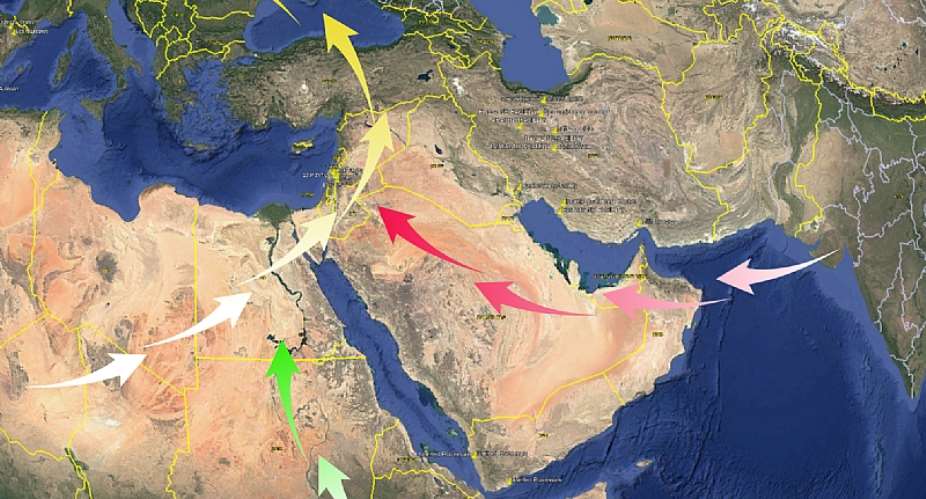
The creation of a continuous economic corridor connecting India, Oman, Saudi Arabia, Africa, and Europe represent one of the most transformative ideas of the 21st century. It is a project that transcends geography it redefines global trade, regional integration, and industrial development across three continents: Asia, Africa, and Europe.
A New Artery of Global Commerce
For centuries, maritime routes dominated the flow of goods between Asia, Africa, and Europe. While effective, sea transport is slow, costly, and highly vulnerable to geopolitical risks, congestion, and environmental constraints. The establishment of a high-speed rail and logistics corridor, originating in India, crossing the Arabian Peninsula through Oman and Saudi Arabia, and branching toward Africa and Europe, replaces weeks of oceanic transport with hours of land-based precision logistics.
Through the Indo-Gulf Submarine Tunnel a 380 km undersea link between India and Oman goods will flow directly into the Gulf’s heart, connecting to high-speed cargo networks through Riyadh, Amman, and Haifa, with branches extending toward Egypt, Sudan, and East Africa, as well as northward into Turkey and continental Europe.
This creates a tri-continental rail bridge, effectively turning the Middle East into the central logistics hub of the Eastern Hemisphere.
Economic Acceleration Across Three Continents
1. Asia From Production to Global Distribution
India becomes the launchpad of continental trade. Its vast manufacturing and agricultural industries will gain direct, fast-track access to European and African markets.
Products that once took 14 - 20 days to reach their destination by ship will arrive within 36 to 48 hours via high-speed rail moving at over 300 km/h.
This reduces logistics costs by up to 60%, increases the competitiveness of Indian exports, and encourages foreign investment in production zones located along the new transport arteries. Regions such as Andhra Pradesh, Gujarat, and Tamil Nadu will evolve into mega-industrial corridors, serving Asia’s gateway to Africa and Europe.
2. The Gulf Becoming the Economic Crossroads
Oman and Saudi Arabia become the central junction of the Indo-Gulf corridor, transforming their economies from oil-based to trade-and-technology-oriented systems.
Oman’s ports in Qalhat and Duqm will act as the entry gate for Indian goods, while Saudi Arabia’s NEOM, Riyadh, and AlUla regions will function as logistics and manufacturing hubs connected to Europe and Africa.
This transformation aligns perfectly with Vision 2030 goals, promoting diversification, job creation, and renewable energy infrastructure.
The Gulf, for the first time, will not just be a supplier of energy it will be the bridge between continents, the transit backbone of global logistics, digital data, and smart industrial production.
3. Africa The New Frontier of Industrial Growth
Africa will benefit profoundly from this new connection.
By linking the IMEC route to African railway networks through Egypt, Sudan, Chad, Kenya, and Ghana the continent gains unprecedented access to global markets.
Fresh agricultural produce, minerals, and industrial goods can move northward to Asia and Europe with speed and reliability.
This connectivity stimulates industrial clustering in African cities, increases exports, and attracts investment into infrastructure, agro-processing, and manufacturing.
Ports like Mombasa, Dar es Salaam, and Lagos could connect directly to the corridor via integrated railways, effectively making Africa a core supplier in the new Eurasian - African value chain.
The Transformation of Global Supply Chains
The transition from maritime shipping to high-speed rail transport fundamentally alters global supply economics.
Current Model:
- Cargo ships travel from Mumbai to Rotterdam or Lagos via the Suez Canal requiring 14 - 20 days.
- Seasonal delays, high fuel costs, and geopolitical risks add uncertainty and expense.
Future Model:
- Goods depart India by train, reach Oman in 40 minutes via the undersea tunnel, cross the Gulf and Levant in 36 hours, and arrive in Europe or Africa in less than three days.
This land-based continuity removes dependence on volatile maritime chokepoints like the Suez Canal or the Strait of Hormuz. It introduces precision logistics comparable to aviation, with the cost efficiency of rail.
Strategic Industrial and Commercial Hubs
Each corridor node India, Oman, Saudi Arabia, Jordan, Israel, Egypt, and Turkey will host industrial, agricultural, and technological hubs.
- India: Manufacturing and export logistics.
- Oman: Trade facilitation, hydrogen energy, and ship maintenance.
- Saudi Arabia: AI-based logistics and green industry.
- Jordan: Finance and customs integration.
- Israel: Technology, digital infrastructure, and Mediterranean ports.
- Africa: Agro-industrial development and resource-based manufacturing.
Together, these hubs create a regional value chain that integrates supply, production, and consumption into one continuous network.
Socioeconomic and Developmental Impacts
- Job Creation: Millions of direct and indirect jobs across all three continents.
- Poverty Reduction: Affordable transport and trade stimulate local markets.
- Education and Skills: New technical academies across the corridor train a generation of engineers and digital workers.
- Food Security: Rapid delivery of agricultural products reduces waste and supports sustainable urban supply.
- Peace through Prosperity: Economic interdependence encourages stability, collaboration, and regional trust.
The Strategic Meaning of Integration
This corridor is more than a trade route it is the physical manifestation of global cooperation.
It replaces isolation with interdependence and competition with collaboration. The Indo-Gulf - Africa - Europe connection will allow goods, knowledge, and innovation to flow seamlessly between emerging and developed economies.
It will also catalyze the synchronization of African, Gulf, and Asian rail networks, fostering standardization, regional trade, and shared infrastructure investments.
The Indo-Gulf - Africa - Europe corridor embodies the future of intelligent globalization.
It shortens time, reduces costs, empowers nations, and transforms three continents into one continuous economic space.
By connecting India’s innovation, the Gulf’s logistics, Africa’s resources, and Europe’s markets, this project will redefine the world’s trade geography.
It is not merely a railway it is a bridge between civilizations, a new chapter in human progress where distance, delay, and division give way to connectivity, cooperation, and growth.
By: Samuel Shay, Entrepreneur and economic advisor for the Abraham Accord

 New DStv sports package will save subscribers over Ghc500 monthly – Sam George
 Your past prescriptions never helped developing countries - TOR MD tells IMF
 Crude Distillation Unit turnaround was funded from TOR's internally generated fu...
 Trump offers $1 million for tipoffs leading to vote fraud conviction as midterms...
 UN cites 'ethnic cleansing' concerns around Israel's Palestinian displacement op...
 UCC-UTAG demands clearer boundaries for GTEC’s regulatory role to avoid interfer...
 Mahama congratulates Lula da Silva on ‘well-deserved’ re-election as Brazil Pres...
 Mahama arrives in Moscow to push for Russia-Ukraine ceasefire at Russia–Africa S...
 'Irresponsible media coverage is hurting Obuasi SHTS abuse probe' – Gender Minis...
 Foreign Affairs Ministry seeks names of evacuees allegedly shortchanged in GH¢5,...


