




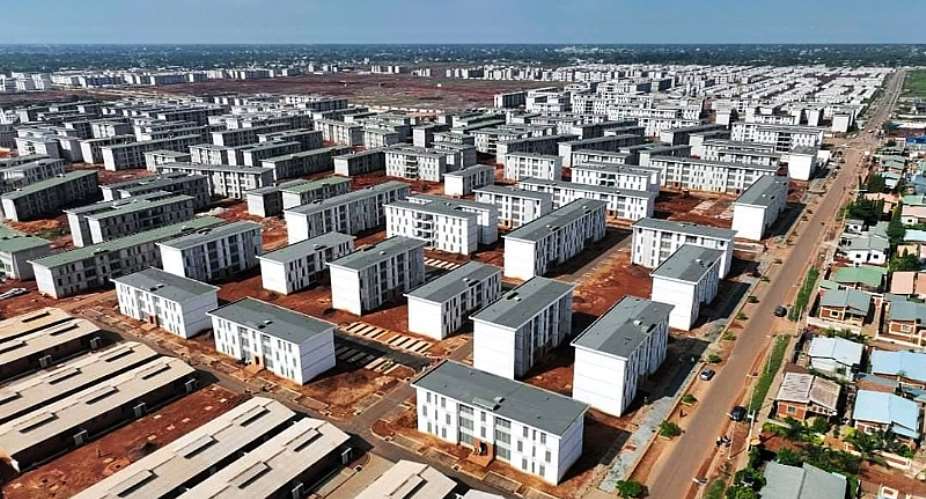
West Africa is facing a profound housing crisis. Rapid urbanization, demographic growth, weak infrastructure, land tenure issues, and limited finance capacities have created a large gap between housing supply and demand. Below I examine some successes, failures, and structural problems, with case studies of Tema (Ghana) and Shagari (Nigeria), including aspects of privatization or the decline of public housing.
The Regional Context
The region-wide housing deficit is very large. For example, the WAEMU (West African Economic and Monetary Union) region is estimated to have a deficit of about 3.5 million housing units, and must build 250,000 houses annually just to catch up with population growth and urbanization.
Financing is a major bottleneck. Mortgages are rare or expensive; many low‐income households cannot access formal finance. Sometimes innovative schemes (regional refinancing, bonds, more flexible mortgages) are being tried.
Informality is huge. Slums and informal housing are widespread; many people live in wooden structures or other substandard dwellings lacking basic services. Regulations are weak, titles unclear, and much housing is “self‐built” over time.
Case Study: Tema, Ghana
Progresses:
Tema Community 22 Pilot Housing Project (NHMF): In 2020 President Nana Akufo‑Addo commissioned a gated housing estate of 204 units (mix of 1, 2, and some 3 bedroom units) in Tema Community 22, as a pilot under the National Housing Mortgage Fund (NHMF). The aim was to bridge Ghana’s large housing deficit (2 million units). It includes decent infrastructure: roads, drains, fencing, and utilities. This pilot has components like affordable mortgages (caps on interest), rent‐to‐own schemes, and partnerships with banks.
Also, in Tema, there are land allocations and planned housing units by Tema Development Corporation (TDC) for workers in other towns (e.g. plans for 200 housing units in Ho) indicating attempts at expanding public or public‐associated housing supply.
Failures / Challenges:
Maintenance & Public Assets Decay: The “White House” building in Tema (Tema ‘White House’ / “Tema White House” a government building housing decentralized departments) has been falling into disrepair: structural cracks, corroded reinforcements, fungal‐infested walls, roof leaks, and partly unusable floors. Despite its iconic status, it has seen little renovation since construction.
Rent costs & overcrowding / inadequate housing for low‐income households: Many people in Tema (and elsewhere in Ghana) rely on wooden or makeshift structures. Rents for such poor housing (often with no adequate utilities) are high relative to quality. Eg in Tema some wooden structures rent for GH₵100–250/month, though many lack basic amenities.
Scale is inadequate: While the pilot projects are positive, the magnitude of the deficit (millions of homes needed) far outstrips what has been built.
Regulatory challenges, land issues: Issues with land acquisition, property rights, documentation, and regulation hamper both supply and affordability. Also some sectors of housing policy/regulation have failed (e.g. COVID exposed failures in housing policy: lacking regulation, basic services, proper enforcement) in Ghana.
Case Study: Shagari Low Cost Housing, Nigeria
The Shagari Low Cost Estates (Kaduna, Nigeria, in Barnawa / Barnawa “Shagari Estate”):
Progresses & Legacy:
Built under President Shehu Shagari (around 1979), the Shagari Estate was intended to provide low‐cost housing. It had one, two, and three bedrooms.
Many of the original houses were well built; even four decades later, some of them are still standing. Residents report that the construction was robust.
Failures / Decline:
Aging infrastructure, decline in maintenance: Over time, many of the original houses have either been significantly renovated or demolished and replaced; few of the original ones remain in original form. Decades of under‐maintenance have taken a toll.
Privatization / Sale Effects: Many houses were sold off; owners have modified, redeveloped or replaced them. What was originally a public or government‐subsidized estate has moved toward private ownership and incremental redevelopment. Some of that has positive aspects (owners’ improvements), but also negative: loss of uniformity, sometimes loss of initial affordability, and possible displacement of lower income occupants.
Affordability drift: The original prices (e.g. one bedroom at N6, 000; three bedroom at N14, 000 at the time) are long since surpassed by current values; the estate no longer functions fully as low‐cost housing in practice.
Privatization / Sale of Public / Government Housing
Privatization (“sale” or “transfer to private individuals or firms”) of government or public housing have had mixed outcomes in West Africa:
Potential Positives:
Transfers can mobilize private finance and/or individual capital, shifting maintenance responsibilities from government to homeowners. This can lead to better upkeep in some cases.
It can foster home ownership culture, allow people to invest in their property, adapt it to their needs, and benefit from asset appreciation.
Major Risks / Failures:
Reduced affordability: When houses are sold off, subsequent owners may sell or redevelop them in ways that increase costs, making units inaccessible to low income households.
Loss of public control: Government loses ability to allocate housing as a public good; priorities shift.
Deferred maintenance and closure of public rental stock: Under privatization, public rental housing is often not replaced, so low‐income people lose options.
For example, in Tema, the rent‐controlled public housing of the Tema Development Corporation used to serve many; research (e.g. Asabere, 2007) shows that the rental housing stock had very low returns under public management (nominal returns only 3%, negative in real terms during periods of inflation), and that rent control discouraged investment in maintenance. That was one justification for privatization of much of this stock.
The Gap Between Promise and Reality
Many governments in West Africa have ambitious policies, targets, or pilot
projects, but struggle with scaling up. Key obstacles include:
- Financing constraints
Insufficient public funds.
Weak mortgage markets: high interest rates, short tenors, risk aversion by banks.Lack of long‐term finance instruments or refinancing.
- Land and tenure issues
Disputes over land rights, unclear titles, and multiple claims slow down or prevent housing developments.
Cost of land often very high near urban cores, driving up prices.
- Regulation and bureaucracy
Lengthy approval processes, many overlapping regulatory bodies.
Sometimes regulations that raise costs (building codes, setback requirements, parking, etc.) may be mismatched to income levels.
- Infrastructure provision
Housing sometimes built without adequate water, sewage, roads, drainage, and electricity. This undermines habitability and sustainability.
Maintenance of infrastructure and public buildings often neglected.
- Maintenance and lifespan
Public housing / public buildings deteriorate if maintenance budgets are lacking. Iconic buildings fall into disrepair (e.g. Tema “White House”).
- Mismatches of supply and demand
Often housing built is not affordable for low income households (too big, too expensive, in undesirable locations).
Or housing is available but in areas far from jobs, services, increasing transport burdens.
- Political will and continuity
Many housing initiatives recognized as priorities but suffer from stop-start implementation, changes in government, shifting policy priorities.
What Success Looks Like / Emerging Good Practices
Pilot projects with well thought‐through financing (mortgage or rent‐to‐own) and partnerships (public + private banks etc.). The Tema Community 22 project is a good example of trying to combine affordability with infrastructure.
Regional approaches: for instance the WAEMU Affordable Housing Finance Project, using a regional mortgage refinancing company CRRH‑UEMOA, has helped scale access to loans, mobilize capital (including via bonds), and delivered thousands of homes.
In many places, enabling policies: clarifying land titles, simplifying approval processes, encouraging incremental building, and better regulation to balance safety with cost. Focus on upgrading existing informal settlements (rather than demolitions) in many places to improve conditions without displacement.
Shagari, Tema and Privatization: Implications
The Shagari Estate shows that when public low‐cost housing is built with quality, some elements can last long; but over time, without proper maintenance and policy to keep them affordable, many such estates drift toward private, more expensive ownership.
Tema’s experience shows both promise (new housing supply, pilot schemes) but also warning in how government buildings can decay, and how housing provision for low income groups (wooden structures) remains poor.
Privatization is appealing to reduce burden on government, but risks losing control over affordability, and risks that those with less income are excluded.
Conclusion
West Africa’s housing challenge is enormous. While there are bright spots of progress (pilot housing projects, regional financing, some successful public estates), the failures lack of scale, affordability, poor maintenance, regulatory bottlenecks loom large.
For real progress, policies must:
Prioritize scaling up successful pilots.
Ensure adequate financing mechanisms for both developers and homebuyers (low interest rates, long tenors, risk sharing).
Secure affordable land and clarify tenure.
Invest in infrastructure and maintenance.
Keep public housing or affordable stock available, and regulate privatization to ensure low‐income inclusion.
By Mustapha Bature Sallama
Medical / science communicator
International Conflicts management and Peace building
Alumni Gandhi- King Global Academy, United State Institute of Peace USIP
[email protected]
+233-555-275-880

 PURC increases electricity and water tariffs effective July 1
 GWL charges customer over GH¢74,000 for illegal reconnection
 Interior Ministry suspends Kantanka Security Services licence over Adwoa Safo sh...
 Torrential rains wreak havoc in Central Region as 18 killed, hundreds affected, ...
 Police invite Nana Kwadwo Safo Akofena over Kwabenya shooting incident
 Biakoye NPP Vice Chairman commends Agbodza, demands urgent fixing of deteriorati...
 Pregnant mother of three hospitalised after alleged assault by husband
 Senior student allegedly slaps Junior repeatedly over missing mobile phone at Nc...
 There was no gun in Adwoa Safo’s car, I saw more than 30 bullet holes on her car...
 NPP Bantama Chairman, Vice Chairman arrested after clash over constituency album...


