




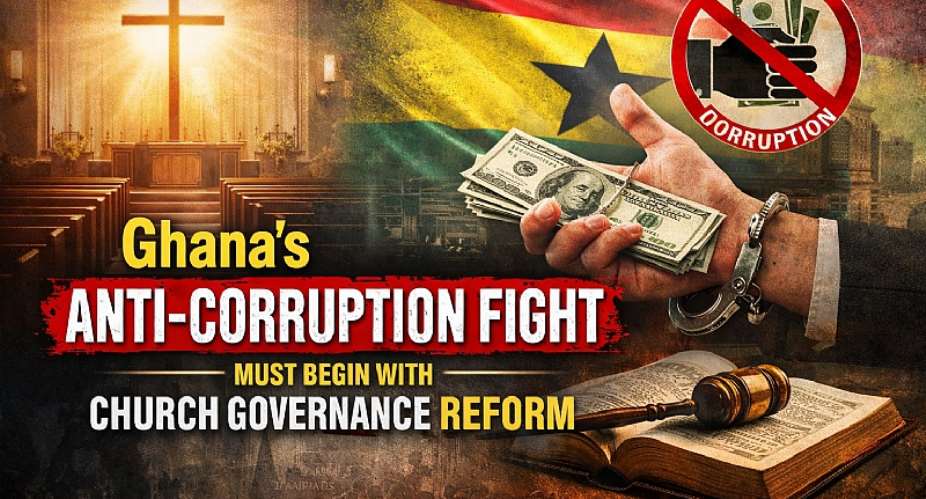
Corruption is not only a political problem; it is also a moral and institutional problem. In Ghana, faith institutions shape conscience, community behaviour, leadership expectations, and public trust. If churches and other faith bodies preach righteousness but operate without transparent governance, they weaken the very values they ask the nation to uphold. This article argues that Ghana’s anti‑corruption fight must begin with church governance reform because the institutions that teach morality must also practise accountability.
Ghana’s national fight against corruption has traditionally focused on politicians, public servants, procurement systems, and political party financing. These are critical battlegrounds. As I argued recently in a publication on the Modern Ghana website concerning Article 55(5) and internal party democracy, strengthening political accountability is central to Ghana’s governance architecture.
Yet Ghana continues to overlook a deeper truth: No nation can defeat corruption if its most influential moral institutions remain unaccountable. Judgement must start from the faith community. Here, “the church” refers broadly to Christian, Islamic, Traditional, and other faith‑based organisations that shape the moral foundations of Ghanaian society. These institutions mould how citizens understand right and wrong long before they encounter the state. If the spaces that shape conscience operate without transparency, the entire anti‑corruption effort becomes fundamentally weakened.
A society cannot demand accountability from its politicians when its moral authorities do not model it. The Bible offers a clear framework for institutional accountability. “Judgement must begin at the house of God” (1 Peter 4:17), reminding us that moral leadership requires moral discipline. When Christ declared, “Render unto Caesar what is Caesar’s, and unto God what is God’s” (Matthew 22:21), He affirmed that spiritual institutions are not exempt from civic responsibility. Transparency is therefore not a threat to faith — it is a biblical mandate.
The question is whether spiritual institutions can continue to command moral authority while resisting the basic disciplines of governance, disclosure, and accountability. If Ghana is serious about changing its national culture, then faith institutions must become the first schools of transparent leadership.
The Unseen Power Centre
Faith institutions in Ghana are among the most powerful actors in public life. Millions attend services weekly. Billions of cedis flow through their systems annually. Their leaders influence elections, public discourse, and national values.
Many churches operate without audited accounts, transparent procurement systems, independent oversight, conflict‑of‑interest rules, or member accountability mechanisms. When institutions that preach morality function without transparency, they unintentionally legitimise secrecy. What becomes normal in the church becomes normal in society.
The Economic Cost of Corruption — and the Gains Transparency Could Deliver
Ghana is reported by anti‑corruption advocates to lose an estimated $3 billion every year to corruption. Using Ghana’s projected nominal GDP of about $113.49 billion, that figure is equivalent to roughly 2.6% of GDP. Even if estimates vary, the scale of the loss is large enough to affect public services, investment, and national development.
If Ghana reduced corruption by even 30%, based on the estimated $3 billion annual loss, the country could potentially retain close to $900 million annually. Against a projected nominal GDP of about $113.49 billion, that retained amount would be equivalent to roughly 0.8% of GDP. International experience suggests that stronger transparency, public reporting, and institutional accountability can support investor confidence, improve public finance, and contribute to growth. For Ghana, such gains could mean:
- more resources retained for national development every year
- more fiscal space for infrastructure, education, and healthcare
- reduced pressure on taxation and borrowing
Transparency is not just a moral imperative. It is an economic growth strategy.
Lessons from the Past
Historically, faith‑based institutions in Ghana set high standards for discipline and accountability. Mission schools such as Mfantsipim, Wesley Girls’, Adisadel, PRESEC, and St. Augustine’s were known not only for academic excellence but also for strong governance.
These institutions operated with structured oversight, audited accounts, and clear leadership frameworks. They produced individuals who were not only educated but principled.
Today, however, many such standards have weakened. Institutions that once modelled accountability have become less consistent in practising it.
The Shift to Founder‑Centred Models
Over time, many churches have moved away from structured governance to founder‑centred systems with minimal checks and balances. In such systems:
- financial control is often centralised
- oversight mechanisms are weak or absent
- members are encouraged to comply but not question
- transparency is sometimes misinterpreted as interference
This creates environments where large financial resources are managed without the safeguards expected in other sectors. It also erodes the moral authority these institutions once held.
What Ghana Can Learn from Europe’s Church Governance Models
Some faith institutions in countries with church tax or public‑law religious systems — notably Germany, Switzerland, and Austria — operate with formal reporting, professional accounting, and stronger oversight expectations. These systems show that religious organisations can maintain spiritual purpose while adopting sound governance principles.
In such systems, churches may be subject to audited financial statements, professional accounting, annual reporting, elected councils, decentralised oversight, and procurement controls. Ghana does not need a church tax system. But it urgently needs the governance principles behind these models: openness, accountability, independent oversight, and responsible stewardship.
A Practical Path to Reform
Faith institutions in Ghana can begin with basic governance reforms that are standard in any organisation entrusted with public money and public confidence:
- Annual audited financial statements
- Independent audit committees
- Digital payment systems to reduce cash handling
- Annual General Meetings (AGMs) where members review accounts
- Clear procurement and conflict‑of‑interest policies
- Defined allocations for social impact and welfare
These are not radical changes. They are the minimum standards expected of any institution that manages public trust and public resources. But Ghana can go further.
Examples of Corporate Governance Models for Churches
Different churches may adopt different governance structures depending on their size, theology, legal status, and history. The goal is not to turn the church into a corporation, but to ensure that spiritual leadership is supported by transparent administration, accountable stewardship, and clear decision‑making.
- Trustee Board Model: Trustees hold legal and fiduciary responsibility for church assets, approve budgets, oversee audits, and ensure compliance. The pastor focuses on spiritual leadership while trustees protect the institution and its resources.
- Elder or Council Model: A council of spiritually mature elders, deacons, and qualified lay leaders provides collective oversight. Decisions are not left to one individual but are tested through prayer, counsel, and documented approval.
- Congregational Accountability Model: Members receive annual reports, review audited accounts, approve major transactions, and participate in structured meetings. This model gives contributors visibility over how church resources are used.
- Hybrid Governance Model: Spiritual, financial, welfare, and administrative functions are separated. Pastors lead doctrine and ministry; trustees oversee assets; finance committees manage budgets; and welfare committees administer member support.
- External Audit and Advisory Model: Larger churches can appoint external auditors, legal advisers, and independent governance advisers to review accounts, procurement, employment practices, risk management, and succession policies.
A healthy church may combine these models. What matters is that authority is not concentrated in one person or one family, finances are independently reviewed, members receive meaningful information, and leaders understand that accountability strengthens ministry rather than weakens it.
Case Studies: Aligning UK Church Governance Models with Ghanaian Church Bodies
The case studies show that Ghanaian churches already have governance systems similar to respected UK church models. The problem is not that Ghanaian churches lack structures. The problem is that these structures are not always used strongly, openly, or consistently.
- Anglican churches in Ghana already have synods, bishops, boards, and committees. They need stronger financial reporting, audits, and member communication.
- Methodist Church Ghana already has conferences, directorates, internal audit, legal affairs, and advisory teams. It needs better reporting to ordinary members and stronger review of major projects.
- Presbyterian Church of Ghana already has elders, committees, finance structures, and reporting systems. It needs to make audit summaries and committee reports easier for members to see.
- Catholic churches in Ghana already have diocesan and parish structures, including finance councils. They need active, skilled finance councils and regular financial updates to members.
| Church Tradition | What Already Exists in Ghana | What Needs Improving |
| Anglican | Synods, bishops, boards, and committees | Publish accounts and strengthen audits |
| Methodist | Conference, directorates, audit, and legal systems | Improve local reporting and review of major projects |
| Presbyterian | Elders, committees, finance department, and reporting systems | Share reports and audit summaries with members |
| Catholic | Diocesan and parish structures, including finance councils | Make finance councils active, skilled, and transparent |
Main point: Ghanaian churches do not need to copy the UK exactly. They already have similar governance foundations. What they need now is better transparency, stronger audits, clearer reporting, and less concentration of power in individuals or families.
Biblical Principles for Charity Oversight
Church charity must be governed as a holy trust. In Acts 5:1–11, Ananias and Sapphira sold property, kept back part of the proceeds, and pretended to give the full amount. Their sin was not that they retained part of their property, but that they lied before God and the community. This shows that deception around offerings, charity funds, and religious giving is not a small administrative matter; it is a spiritual failure that damages trust.
The early church also provides a positive governance model. In Acts 6:1–6, when complaints arose over the distribution of food to widows, the apostles did not ignore the concern or personalise the funds. They appointed reputable, Spirit‑filled, wise people to oversee distribution. This teaches that charity work should have clear responsibility, fair process, and trusted oversight.
Other biblical principles reinforce the same point. Paul says that stewards must be found faithful (1 Corinthians 4:2). Proverbs teaches that dishonest scales are an abomination to the Lord (Proverbs 11:1). James calls true religion the care of orphans and widows in their distress (James 1:27). Jesus warns that acts of charity must not be done for public praise but before God (Matthew 6:1–4). Together, these passages show that church charity must be honest, discreet, compassionate, and accountable.
In practical terms, churches should separate charity funds from general church funds, record all welfare donations, use welfare committees instead of one‑person control, apply clear eligibility rules, protect the dignity of beneficiaries, audit charity funds, and report to members in simple terms. Charity should not be used to control the poor, reward favourites, enrich leaders, or build personal empires. It should uplift members, protect the vulnerable, and prepare God’s people to live faithfully on earth while keeping their hope fixed on heaven.
1. Churches Can Be Structured as Trusts
Under a trust model:
- the church becomes a trust
- trustees hold fiduciary responsibility
- members become beneficiaries
- misuse of funds becomes a breach of trust
This introduces legal accountability, not just internal discipline, and separates spiritual leadership from financial stewardship.
2. Trusteeship Introduces Professional Oversight
Trustees can include accountants, lawyers, governance experts, finance professionals, and respected community leaders. Their role is to protect assets, oversee finances, and ensure compliance, mirroring European governance models.
3. Group Insurance Schemes for Member Welfare
Instead of constant fundraising for funerals and emergencies, churches can adopt group insurance policies covering:
- funerals
- health emergencies
- disability
- life insurance
- education support
This reduces financial pressure on members and eliminates opportunities for mismanagement.
4. Professional Administration
Faith institutions should adopt:
- professional finance officers
- internal auditors
- procurement officers
- HR policies
- asset registers
There is no reason churches should operate below the standards of schools, NGOs, or corporate bodies.
5. Succession Planning Must Not Become a Family Affair
One of the most sensitive governance questions facing churches is succession. Too often, leadership transition is treated as a private family matter, where the spouse, child, relative, or close associate of a founder is presumed to be the natural successor. This approach weakens institutional integrity. The church is not a family inheritance, a personal estate, or a dynastic enterprise. It is a spiritual body entrusted with public confidence, member contributions, and a God‑centred mission.
Succession planning should therefore be handled as a corporate governance strategy. Every church should have a written succession policy approved by trustees or an independent governing council. Such a policy should define eligibility, spiritual maturity, leadership competence, financial integrity, conflict‑of‑interest rules, and transparent appointment procedures. It should also separate pastoral calling from asset control, ensuring that no individual or family captures the institution.
A God‑centred ministry must place stewardship above bloodline, competence above entitlement, and accountability above sentiment. Where a founder’s relative is genuinely qualified, that person should be assessed through the same transparent process as everyone else. Where they are not, the church must have the courage to choose the person best equipped to protect its mission. In this way, succession becomes an act of faithful stewardship, not family preservation.
This principle is firmly rooted in Scripture. Paul teaches that stewards must be found faithful (1 Corinthians 4:2), while Jesus’ parable of the talents shows that those entrusted with resources must account for how they manage them (Matthew 25:14–30). Peter also instructs church leaders to shepherd God’s flock willingly and not for dishonest gain, nor as domineering rulers, but as examples to the people (1 Peter 5:2–3). Moses’ appointment of capable, trustworthy leaders in Exodus 18:21 further shows that leadership should be based on character, competence, and fear of God, not family entitlement. These passages support a model of church governance where stewardship belongs first to God, is exercised for the benefit of the people, and is protected through accountability.
A Call to Action for Church Leaders
Church leaders must now move from good intentions to measurable reform. The call is not for the state to control the church, nor for spirituality to be reduced to bureaucracy. The call is for pastors, bishops, elders, trustees, imams, traditional leaders, and faith‑based administrators to recognise that accountability is part of worship, stewardship is part of discipleship, and transparency is part of moral leadership.
Every church and faith institution should commit to simple but serious steps: publish annual accounts, appoint independent audit committees, separate pastoral authority from financial control, introduce conflict‑of‑interest policies, professionalise administration, report regularly to members, protect member welfare, and adopt succession policies that serve the mission rather than personal or family interests.
If the church wants Ghana to change, the church must be willing to change first. Let every pulpit that preaches righteousness also practise accountability. Let every offering basket be supported by transparent records. Let every leader who speaks against corruption build systems that prevent it. This is how faith institutions can recover moral authority, strengthen public trust, and become true partners in Ghana’s national renewal.
Conclusion
Ghana cannot defeat corruption by focusing solely on government institutions. The culture that enables corruption is shaped long before individuals enter public office. If churches lead in transparency, citizens will be better equipped to demand accountability from government, undocumented cash practices may decline, public trust can grow, and Ghana could retain more resources for national development over the next decade.
The benefits of stronger church governance are therefore both spiritual and practical. Proper governance protects offerings and tithes from misuse, gives members confidence that resources are serving mission and welfare, strengthens leadership succession, reduces conflicts of interest, and preserves the moral authority of faith institutions. It also creates a culture where accountability is normal, financial discipline is expected, and stewardship is understood as service to God and society. When churches model these values, they help shape citizens who expect the same standards from schools, businesses, traditional authorities, public officials, and the state.
Dr. James Kwegyir Aggrey once said, “If you educate a woman, you educate a nation.” In the same spirit: If you reform the church, you reform the nation. A transparent church creates a transparent nation — and a more prosperous one.
Kwadwo is a specialist in Law, Finance, Financial Crime, Governance and Regulation. He has worked with banks and financial institutions in the United Kingdom, Switzerland and The Netherlands.
Kwadwo has appeared on TV3 and contributes to Ghana Broadcasting Corporation programmes such as News, Business Link, Market Avenue and Talking Point.
He studied Political Science and Philosophy at the University of Ghana, obtained a Graduate Diploma in Law and LLM from the University of Law (formerly College of Law), and holds a postgraduate degree in Financial Strategy from Saïd Business School, University of Oxford.


 Contractors begin construction of 120-bed trauma hospital at Bole – Kwakye Ofosu...
 Gov’t procurement must prioritise local farmers for school feeding – Dr. Ato For...
 Vacate by October 4 or face demolition – KMA warns Abrepo Junction occupants
 Star Oil and GOIL assure no fuel price increase for new window
 Diesel will not hit GH¢22 at pumps – NPA CEO assures
 Ghana records 3,876 cybersecurity incidents in seven months – Communications Min...
 “We never knew life was going to be hard like this in Ghana; we can’t even get j...
 $1.17bn GoldBod gave BoG is repayment, not new money’ – Dr. Gideon Boako
 Baffour Awuah didn’t help his case if he ignored EOCO’s invitation – Appiah Danq...
 Carlos Queiroz leaves Black Stars role after poor AFCON qualifying start


