




Abstract
Small scale mining has always been part of life in Ghana, but its illegal form known as galamsey has grown into one of the country’s biggest problems. Galamsey gives work to many people, yet still it destroys rivers, forests and farms, leaving communities struggling to survive. This paper looks at the laws that guide small scale mining in Ghana, from the days of traditional mining, through the colonial period, the Small Scale Gold Mining Law of 1989, and the Minerals and Mining Act, 2006 (Act 703) as amended by Act 995. It explains how weak enforcement, corruption, political interference and the role of foreigners, especially some Chinese nationals, have made the laws less effective. The paper also shows, through recent court cases such as Republic v Fynn and Republic v Domotey and Others, that Ghana’s courts are ready to punish offenders when cases are well presented. The courts have given long prison terms and heavy fines, showing that they are not the weak link in the fight. The real problem is poor enforcement and selective justice, since many foreigners are deported instead of being put on trial. The paper argues that solving the galamsey problem needs strong enforcement, freedom from political interference, the setting up of special environmental courts, and better job opportunities for rural communities. With these steps, Ghana can protect the environment while also supporting its people to make a living in lawful ways.
1.0 Introduction
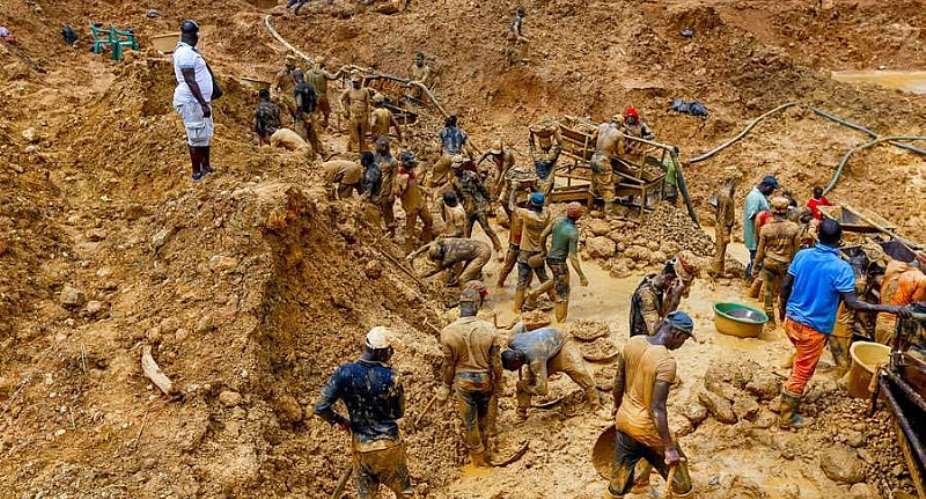
In Ghana today, the word galamsey stirs strong emotions. It brings to mind images of muddy rivers turned brown, excavators tearing through fertile farmlands and forest reserves, and young men with shovels and pans panning for gold in the scorching sun. To many communities, galamsey is both a curse and a livelihood. It is a curse because it destroys water bodies, forests, and farmland, leaving behind pits that swallow cattle and sometimes even children. Yet, it is also a livelihood, because thousands of Ghanaians survive on small-scale mining, whether legal or illegal.
The challenge is not simply about whether mining is legal or illegal. It is about law, livelihoods, justice, and survival. On one side, Ghana’s Constitution imposes a duty on citizens to protect and safeguard the environment[1], which can inarguably be construed to be encapsulated under Article 33(5)[2]. On the other side, the same Constitution commits the state to protect citizens’ rights to work and to earn a living[3]. How do we reconcile the need for environmental protection with the urgent reality of unemployment, poverty, and rural survival?
This essay explores these questions by looking at small-scale mining and the law in Ghana. It begins with a historical overview of mining, examines the current legal framework, and then discusses the rise of galamsey as a national crisis. It considers why the law has struggled to address the problem and looks at the role of the courts, constitutional principles, and human rights. Finally, it proposes reforms that could help Ghana strike a balance between economic survival and environmental justice.
1.1 Historical Background of Mining in Ghana
1.1.1 Pre-Colonial and Indigenous Mining
Long before colonial powers arrived, indigenous communities in what is now Ghana were engaged in artisanal gold mining. Oral histories and archaeological evidence suggest that the people of Adanse, Obuasi, and Dunkwa-on-Offin were already mining gold centuries ago[4]. Mining was often community-based, with chiefs or traditional authorities overseeing access to gold-bearing land.
Gold was not only an economic asset; it was also cultural and political. Chiefs used gold to demonstrate wealth and power. It was central to traditional regalia, festivals, and rituals. Gold also shaped trade. By the 15th century, Portuguese traders had established contact with coastal communities, drawn by the rich supply of gold. This early gold trade is why Europeans named the region the “Gold Coast”.
1.1.2 Colonial Mining Laws and Concessions
With colonisation came new mining laws and systems that disrupted indigenous control. The British colonial administration introduced mining concessions, granting rights over large tracts of land to foreign companies. The Minerals Ordinance of 1905 was one of the key instruments, which was passed to prevent indigenes from dealing in gold and any other ventures associated with gold[5].
Indigenous miners, who had long worked freely on their land, now faced restrictions. Many were pushed out of productive areas as large companies like Ashanti Goldfields gained control. Colonial laws criminalised indigenous mining practices, branding them as “illegal” despite their centuries-old existence. Yet, small-scale mining persisted underground, sustained by local demand for gold and the lack of alternative livelihoods.
1.1.3 Post-Independence Mining Policy
After independence in 1957, the state vested minerals in itself, under Article 257(6) of the 1992 Constitution, meaning all minerals are owned by the state, held in trust for the people[6]. In practice, however, mining was dominated by large-scale companies, both state-owned and foreign.
By the 1980s, the government recognised the persistence of small-scale mining and began to formalise it. The Provisional National Defence Council (PNDC) enacted the Small-Scale Gold Mining Law, 1989 (PNDC Law 218). For the first time, Ghana officially recognised small-scale mining as a legal activity, allowing citizens to apply for licenses to mine in designated areas[7].
This was a turning point. It showed that the state could no longer ignore the thousands of Ghanaians engaged in artisanal mining. However, the law was limited. Licences were not easily available, designated lands were inadequate, and bureaucracy discouraged compliance. Many miners continued to operate outside the law, giving rise to what we now call galamsey.
1.1.4 Evolution to the Minerals and Mining Act, 2006 (Act 703)
The next major reform came with the Minerals and Mining Act, 2006 (Act 703), which consolidated mining laws in Ghana.[8] Act 703 maintained state ownership of minerals[9] but created clearer processes for both large-scale and small-scale mining. It provided that small-scale mining could only be undertaken by Ghanaians in designated areas and with proper licenses[10].
Despite this legal framework, enforcement remained weak. Many small-scale miners saw licensing as expensive, bureaucratic, or corrupt. Others operated in areas not designated for small-scale mining, often with the backing of local politicians or chiefs. The gap between law and practice widened into the full-blown galamsey crisis of the 2010s.
2.0 Galamsey as a National Crisis
By the early 2010s, galamsey had become a household name. News reports showed rivers like the Pra, Ankobra, and Offin turning brown from mining waste. Forest reserves were invaded, farmlands destroyed, and communities left without drinking water. The government responded with military task forces, such as Operation Vanguard launched in 2017[11].
However, despite arrests, equipment seizures, and political declarations, galamsey persisted. The reason lies partly in the law and partly in politics. Laws exist, but they are often undermine by weak enforcement, corruption, and political patronage. Chiefs and local leaders sometimes protect galamsey operators because of the of their pecuniary interest or revenue they bring to communities. Politicians have been accused of shielding operators who are party financiers. Thus, galamsey sits at the intersection of law, politics, economics, and survival.
2.1 The Legal Framework for Small-Scale Mining in Ghana
The main law that regulates mining in Ghana today is the Minerals and Mining Act, 2006 (Act 703), which has been amended by the Minerals and Mining (Amendment) Act, 2015 (Act 900) and the Minerals and Mining (Amendment) Act, 2019 (Act 995). Together, these tripartite legislations form the backbone of Ghana’s mining regime.
2.1.1 Ownership of Minerals
Article 257(6) of the 1992 Constitution clearly states that all minerals in their natural state are the property of the state, held in trust for the people of Ghana[12]. Act 703 repeats this principle, placing minerals under the control of the President, who holds them in trust for the people. This means that even if gold is found on stool land, family land or any land whatsoever within the jurisdiction of Ghana, the mineral belongs to the state and not the landowners.
2.1.2 Licensing Small-Scale Miners
Act 703 recognises two broad categories of mining: large-scale mining and small-scale mining. Section 81 of the Act allows Ghanaians, who are 18 years or older, to apply for a small-scale mining license. Only Ghanaians can legally do small-scale mining, and the license must be issued by the Minerals Commission on behalf of the Minister responsible for Lands and Natural Resources[13].
The law further requires that small-scale miners operate only in designated areas. These are areas demarcated and reserved by the Minister for small-scale mining under section 90 of Act 703[14]. This means that even if someone has a license, they cannot mine just anywhere; they must mine in a legally designated zone.
2.1.3 Duration and Conditions of License
A small-scale mining license is granted for up to five years and may be renewed for another five years. The licensee must also comply with conditions relating to environmental protection, health, and safety[15]. The Environmental Protection Agency (EPA) plays a key role by ensuring that small-scale miners undertake environmental impact assessments (though in practice, this is rarely enforced).
2.1.4 Prohibited Activities
The law forbids foreigners from engaging in small-scale mining. Section 83 of Act 703 is explicit: only citizens of Ghana can obtain a small-scale mining license[16]. This is important because in recent years, many foreign nationals, particularly Chinese, have become heavily involved in galamsey operations, often in violation of the law.
2.1.5 Offences and Penalties
The 2019 amendment (Act 995) significantly increased penalties for illegal mining. Offenders can face a minimum of fifteen years imprisonment and not more than twenty-five years or to a fine of not less than ten thousands of penalty units and not more than fifteen thousand penalty units[17]. This was a response to the growing crisis of galamsey and the need to make the law a stronger deterrent.
3.0 Understanding Galamsey
The term galamsey is a corruption of the phrase “gather them and sell.” It refers to unlicensed, informal, and illegal small-scale mining. While small-scale mining itself is not illegal (once properly licensed), galamsey simply refers to those operating outside the law.
3.1 Some CommonCharacteristics of Galamsey
- Lack of license: Galamsey operators do not go through the licensing process.
- Unregulated sites: They often mine in undesignated areas, including riverbeds, farms, and forest reserves.
- Destructive methods: Galamseyers frequently use mercury, cyanide, and heavy machinery without regard to environmental laws.
- Community involvement: In many rural areas, entire communities depend on galamsey, with women and children participating in washing, panning, or carrying loads.
3.2 Why Galamsey Persists
Despite being illegal, galamsey has flourished for several reasons:
- Economic survival: With limited jobs, many rural youth see galamsey as their only source of income.
- Quick profit: Unlike farming, which takes months, mining can produce gold and cash within days.
- Weak enforcement: State agencies often lack the resources or political will to clamp down.
- Corruption: Reports suggest some security officials, customs and politicians benefit financially from protecting galamsey operators[18].
- Customary interests: Some chiefs and family heads see galamsey as a way of asserting traditional rights over land, despite the Constitution vesting minerals in the state.
3.3 Galamsey and Foreign Involvement
One of the biggest developments in the past decade has been the influx of foreign nationals into galamsey, especially from China. Despite the law barring foreigners, many entered into joint ventures with local operators. With their financial muscle, they introduced excavators and other heavy machinery, turning galamsey into large-scale destruction[19].
4.0 Key Legal and Enforcement Challenges
- The Licensing Bottleneck
Many small-scale miners complain that the licensing process is bureaucratic, slow, and expensive. It can take months, even years, to obtain a license from the Minerals Commission. Some also argue that the areas officially designated for small-scale mining are too limited, pushing miners into undesignated areas. This disconnect between law and practicality creates a fertile ground for galamsey.
- Weak Enforcement Institutions
Although Ghana has multiple institutions such as Minerals Commission, the EPA, the Forestry Commission, and the Police tasked with enforcing mining laws, coordination is weak. Agencies sometimes work at cross purposes. Enforcement exercises, like Operation Vanguard, are often short-lived and lose momentum once political attention shifts.
- Political Interference
Perhaps the most sensitive challenge is political patronage. Local politicians and traditional leaders are sometimes accused of protecting galamsey operators who fund political campaigns or community projects. This undermines enforcement and makes the law appear selective.
- Corruption and Complicity
Enforcement officers have been accused of taking bribes to allow galamsey operations to continue. There are also reports of seized equipment mysteriously “disappearing” after being impounded by state agencies. This erodes public trust and emboldens illegal operators.
- Foreign Involvement
The involvement of foreign nationals has made enforcement more complex. Foreigners often have access to capital, equipment, and political connections that make them difficult to prosecute. While some arrests have been made, many cases are quietly dropped, fuelling public perception of selective justice.
- Socio-Economic Pressures
Beyond law enforcement, galamsey is tied to poverty and unemployment. Rural communities often lack alternative livelihoods. Without deliberate government policies to provide jobs, simply criminalising galamsey can be seen as unfair. The law thus finds itself stretched between punishment and compassion.
Environmental and Social Impacts of Galamsey
The destructive environmental consequences of galamsey are perhaps the most visible reminder of its impact. Communities across Ghana have seen rivers polluted, farmlands destroyed, and forests cleared. The effects go far beyond the physical landscape; they strike at the very foundation of Ghana’s economy, public health, and future sustainability.
a. Water Pollution
Illegal mining often involves washing ore in rivers and using chemicals like mercury and cyanide to separate gold. Rivers such as the Pra, Ankobra, Offin, and Birim have been heavily polluted. Reports from the Ghana Water Company show that treatment costs for water have skyrocketed because of high levels of turbidity and heavy metal contamination[20]. In some areas, entire water treatment plants have been shut down because the water is too polluted to treat[21].
The Constitution of Ghana imposes a duty on citizens to protect and safeguard the environment under Article 41. Yet, galamsey undermines the efforts of Ghanaian citizens in achieving this constitutional mandate, leaving many communities without access to safe drinking water. The Environmental Protection Agency Act (Act 490) also empowers the EPA to regulate such pollution, but enforcement remains inconsistent.
b. Destruction of Farmland and Forests
Galamsey operations often take place on farmlands, leading to the destruction of cocoa farms, cassava fields, and oil palm plantations. In many communities, farmers wake up to find their land taken over by miners who pay little regard to agricultural livelihoods. Ghana’s cocoa industry, a backbone of the economy, has been threatened by galamsey as cocoa farms are converted into mining pits[22].
Forest reserves are also under severe threat. Various report from media outlets indicates an incursion into protected areas such as the Atewa Forest Reserve, which is a key biodiversity hotspot[23]. Galamsey not only removes trees but also destroys ecosystems and wildlife habitats.
c. Health Hazards
The use of mercury is a major health hazard. Mercury poisoning affects miners and their families, especially women and children involved in ore washing. Long-term exposure leads to kidney failure, neurological disorders, respiratory diseases, cardiovascular issues and birth defects[24]. Communities downstream of galamsey sites also ingest mercury-contaminated fish and water. Recently, forensic Histopathologist and former Head of Pathology at KNUST, Prof Dr. Paul Poku Sampene Osei, has revealed that from his ongoing research, at least 500 cases of spontaneous abortions in Ghana can be linked to high levels of heavy metals in placenta caused by illegal mining (galamsey) activities[25].
Particularly, dust from galamsey sites contributes to respiratory problems. Uncovered pits become breeding grounds for mosquitoes, increasing the risk of malaria. In short, galamsey is not just an environmental crime; it is a public health crisis.
- Social Disruption
Illegal mining has also caused social tensions. Clashes occur between galamseyers and licensed mining companies, between miners and farmers, and even between different galamsey groups. In some cases, violence has led to deaths and destruction of property. Traditional authorities are often divided; some chiefs support galamsey for the income it brings, while others oppose it for the destruction it causes.
Communities experience both hope and despair. On one hand, galamsey provides jobs and income in areas with few opportunities. On the other, it brings insecurity, environmental ruin, and a breakdown of traditional farming lifestyles.
4.1 The Role of the Courts
Ghana’s courts has shown firmness in applying the Minerals and Mining Act, 2006 (Act 703), as amended by Act 995, against illegal mining operators. Far from being reluctant, the courts have demonstrated their readiness to convict and impose deterrent custodial sentences when prosecutions are diligently pursued.
In Republic v Fynn[26], the Tarkwa Circuit Court convicted a 20-year-old welder for conspiracy to commit crime to wit illegal mining and for engaging in illegal mining under section 99(2) of Act 995. Despite the accused’s defence that he was merely “easing himself” at the site, the Court held that the prosecution had proved its case beyond reasonable doubt through eyewitness testimony and corroborating evidence. He was sentenced to five years’ imprisonment in hard labour for conspiracy, and fifteen years’ imprisonment plus a fine of 10,000 penalty units (or five years in default) for illegal mining, with sentences to run concurrently.
Similarly, in Republic v Domotey & 5 Others[27], also decided at Tarkwa, six accused persons were arrested for mining with an illegal dredge on the River Ankobra. They were charged with conspiracy and illegal mining under section 23(1) of Act 29 and section 99(2) of Act 995. The Court rejected their defence that they had merely gone to retrieve a sunk boat and convicted them on both counts. Each was sentenced to five years’ imprisonment for conspiracy and fifteen years’ imprisonment in hard labour plus a fine of 10,000 penalty units (or five years in default) for illegal mining, with sentences to run concurrently.
These recent decisions illustrate that the courts are not the weak link in the fight against galamsey. Once cases are properly prosecuted and evidence is led, the judiciary has consistently imposed severe sentences in accordance with Act 995, affirming its commitment to deterrence and the rule of law. Although it is manifestly clear that some illegal miners were convicted, many others-Chinese foreigners- were deported instead of being tried, leading to accusations that Ghana applies the law selectively when foreigners are involved[28].
5.0 Policy and Legal Reform Options
The persistence of galamsey despite decades of legal reforms shows that law alone is not enough. Ghana must rethink its approach by combining strong legal frameworks with practical policies that address the root causes of illegal mining.
- Strengthening Enforcement of the Law on Foreigners: One of the most glaring weaknesses in Ghana’s fight against illegal mining is the uneven application of the law when it comes to foreign nationals. It is notoriously known that foreigners, especially Chinese nationals, fuel galamsey by partnering with locals and providing the excavators and heavy machinery that devastate rivers and forests. However, despite the visible role they play, many escape true accountability.
Figures from the Ghana Immigration Service reveal that between 2009 and 2022, over 1,600 Chinese nationals engaged in illegal mining were arrested and repatriated to their home country[29]. In addition, thousands more left voluntarily in the wake of mass arrests. The disturbing trend, however, is that while many Ghanaians and West African nationals have been jailed for similar offences, most of these foreign offenders are simply deported without facing trial. Deportation alone cannot serve as a sufficient deterrent, particularly when the economic incentives of illegal mining remain high.
The Fourth Estate’s investigative reporting truly underscores this imbalance. For example, in May 2021, three men—two Ghanaians and a Nigerian—were convicted by the Koforidua Circuit Court for illegal mining and sentenced to five years imprisonment each. The Nigerian was also ordered to be deported after serving his sentence. Similarly, in June 2021, three Ghanaians were jailed 15 years each and fined for the same offence. According to Ghana Prisons Service data obtained under the Right to Information Act, 220 people were jailed for illegal mining offences between 2016 and 2020, while the majority being Ghanaians and other Africans.[30]
However, as of July 2021, only two Chinese nationals were in Ghana’s prisons, despite the hundreds arrested in connection with galamsey between 2013 and 2020[31].
The contrast is striking: while ordinary Ghanaians face imprisonment and fines, well connected foreign offenders are shielded by diplomatic calculations and quietly deported. This imbalance weakens the credibility of the state’s enforcement regime and emboldens others to re-enter the country illegally, as seen in the repeated arrests of Chinese nationals in mining areas even after mass deportations.
If the government is truly committed to ending galamsey, foreigners must be made to face the full rigours of Ghana’s mining and criminal laws, as the amended Minerals and Mining Act, 2019 (Act 995) now prescribes.
- Establishing Special Environmental Courts: Enforcement of mining laws often suffers from delays in the ordinary courts. Ghana could follow the example of other jurisdictions such by creating special environmental courts or divisions within the High Court to handle mining and environmental offences. This would ensure speedy trials, consistent penalties, and greater public confidence.
- Tackling Political Interference: This is perhaps the most difficult reform. Galamsey thrives because of political patronage. A genuine commitment is needed from political leaders across the divide to treat galamsey as a national crisis, not a partisan issue. Strong institutional independence for the Minerals Commission and EPA would also reduce political influence.
- Providing adequate job & Alternative Livelihoods: Ultimately, illegal mining is driven by poverty and unemployment. Legal reforms must be combined with economic alternatives. Government should invest in skills training, agribusiness, and rural development programmes. If young people have viable options, the attraction of galamsey will definitely diminish.
- Public Awareness and Citizen Participation: Environmental destruction from galamsey affects everyone. Civil society, traditional authorities, and the media must be involved in public education campaigns. Communities should be empowered to monitor and report illegal mining activities. Citizens can only support the law when they understand its importance to their survival and future.
6.0 Conclusion
The challenge of galamsey is one of Ghana’s greatest governance and legal tests. On paper, the law is clear: minerals belong to the state, only Ghanaians can legally mine on a small scale, and illegal mining attracts heavy penalties. In reality, however, enforcement has been weak, corruption widespread, and politics deeply entangled.
This essay has shown that galamsey is not only a legal issue but also an economic, social, and human rights concern. It threatens water, farmlands, and forests. It undermines public health and destroys livelihoods. It pits the right to work against the right to a clean environment. It exposes the limits of law when politics and poverty collide.
By strengthening enforcement, and tackling political interference, Ghana can turn the galamsey crisis into an opportunity for sustainable development. The law must be both firm and fair: firm against those who abuse the environment for selfish gain, and fair in providing legal pathways for poor miners seeking survival.
The future of Ghana’s rivers, forests, and communities depends on how the nation addresses galamsey. It is a challenge that requires courage, political will, and the rule of law. If Ghana succeeds, it will not only save its environment but also prove that law, justice, and livelihoods can coexist in harmony. The judiciary has made clear in decisions such as Republic v Fynn and Republic v Domotey & 5 Others that it is prepared to impose heavy custodial and financial penalties on illegal miners. The persistent challenge lies not with judicial reluctance, but with weak enforcement, political patronage, and selective application of the law to foreigners. Until these bottlenecks are addressed, the full deterrent power of Act 995 will not be realised.
Written by: Darlington Amofa, Esq. | [email protected]
[1] Constitution of Ghana, 1992, Article 41(k)
[2] Ibid
[3] Ibid., art 24(1)
[4] David Amaldi, ‘A Study of Pre-Colonial and Contemporary Methods of Gold Mining in Ghana’ (December 2015) International Scholars Journals, Frontiers of Library, Information and Computer Sciences Vol 1(1) 27–42 https://www.internationalscholarsjournals.com/articles/a-study-of-precolonial-and-contemporary-methods-of-gold-mining-in-ghana.pdf accessed 29 September 2025.
[5] David Asumda, Francis situma and Kariuki Muigua, ‘Ghana’s Regultory Framework and sustainability in the Mining sector’ (2024) 4(1) UCC Law Journal 158-189 https://doi.org/10.47963/ucclj.v4i1.1550
[6] Constitution of Ghana, 1992, art 257(6).
[7] Small-Scale Gold Mining Law, 1989 (PNDC Law 218), ss. 1 and 2.
[8] See the long title of the Act 703.
[9] Minerals and Mining Act, 2006 (Act 703), s. 1.
[10] Ibid., s 83(1)(a).
[11] Government of Ghana, Operation Vanguard Press Release, 2017; see also https://www.graphic.com.gh/news/general-news/operation-vanguard-launched-to-wipe-out-galamsey.html accessed on 28 September 2025.
[12] Constitution of Ghana, 1992, art 257 (6).
[13] Minerals and Mining Act, 2006 (Act 703), s. 82
[14] Ibid., s 89.
[15] Ibid., ss. 84 and 85
[16] Ibid., 83
[17] Minerals and Mining (Amendment) Act, 2019 (Act 995), s. 99.
[18] Marcena Hunter & Gideon Ofosu-Peasah, Gold evolving in Ghana (Global Initiative Against Transnational Organized crime, June 2025)
[19] Crawford, G., Agyeyomah, C., Botchwey, G., & Mba, A. (2016, May). The Impact of Chinese involvement in small-scale gold mining in Ghana (Policy Brief 33110). International Growth Centre. https://www.theigc.org/sites/default/files/2016/08/Crawford-et-al-2016-Policy-brief.pdf accessed on 29 September, 2025
[20] https://www.myjoyonline.com/gwcl-seeks-280-water-tariff-hike-blames-galamsey-for-rising-costs/ accessed on 29 September 2025.
[21] GWCL, Proposals for Review of Aggregate Revenue Requirement and Tariff (April 2022) 53 https://www.gwcl.com.gh/wp-content/uploads/2020/05/2022-GWCL-Tariff-Proposal17033.pdf accessed 29 September, 2025.
[22] Boakye, R (2020). Assessment of the Effects of Illegal Small-Scale Mining on Cocoa Farming and Livelihood Birim North District. University of cape Coast. Retrieved from https://ir.ucc.edu.gh/xmlui/bitstream/handle/123456789/6648/BOAKYE%2c%202020.pdf?sequence=1&isAllowed=y accessed on 29 September, 2025
Nunoo, Isaac and Owusu, Victor and Ashiagbor, George and Owusu Ansah, Mercy, The Trade-off between Cocoa and Small-Scale Gold Mining: A Spatial and Socio-Economic Analysis. http://dx.doi.org/10.2139/ssrn.5249600 accessed on 29 September, 2025
[23] ‘Nature Under Attack: The Long Fight To Protect Ghana’s Atewa Forest’ The Ghanaian Chronicle, https://thechronicle.com.gh/nature-under-attack-the-long-fight-to-protect-ghanas-atewa-forest/#google_vignette accessed on 29 September, 2025.
[24] Awewomom, J., Benjamin, B. K., Osei, F. E., Azanu, D., Opoku, F., Sackey, L. N. A., & Akoto, O. (2024). A review of health hazards associated with exposure to galamsey-related pollutants. HSI Journal (2024) Volume 5 (Issue 2):726-734.
[25] ‘Research links 500 spontaneous abortions to galamsey-related placental contamination’ MyJoyOnline (27 September 2025) https://www.myjoyonline.com/research-links-500-spontaneous-abortions-to-galamsey-related-placental-contamination-prof-sampene/#google_vignette accessed on 29 September2025
[26]Republic v Fynn (B1/20/2022) [2023] GHACC 1024 (Circuit Court, Tarkwa, 20 July 2023) (GhaLII)
[27]Republic v Domotey & 5 ors (B1/22/22) [2023] GHACC 1026 (Circuit Court, Tarkwa, 31 August 2023) (GhaLII)
[28] ‘1,641 Chinese illegal miners repatriated between 2009 and 2022’ Ghana Broadcasting Corporation (GBC) https://www.gbcghanaonline.com/general/1641-chinese-illegal-miners-repatriated-between-2009-and-2022/2022/?utm_source=chatgpt.com#google_vignette accessed on 30 September, 2025.
[29] ‘Only two Chinese citizens in Ghana’s prisons despite hundreds arrested for illegal mining’ The Fourth estate (July 2022) https://thefourthestategh.com/2022/07/only-two-chinese-citizens-in-ghanas-prisons-despite-hundreds-arrested-for-illegal-mining/ accessed on 30 September, 2025.
[30] Ibid.
[31] Ibid
 Korle Bu Teaching Hospital to introduce IVF and Corporate Clinic before end of 2...
 Accra West: Sarpeiman, Medie and other areas to experience power outages on Sund...
 Accra West: Faulty transformer causes outage Pokuase Amanfrom and surrounding ar...
 Restoration of Akosombo turbines not automatic solution to current dumsor — Mira...
 We have enough capacity to meet electricity demand — Energy Minister
 May 2: Cedi maintains value, sells at GHS12.15 on forex market, GHS11.20 on BoG ...
 2024 outages not due to transformer overloads — Energy Minister defends past com...
 US to withdraw about 5,000 troops from Germany
 Rebels take key military base in Mali's north
 Middle East war's impact on shipping hitting refugee aid: UNCHR



Comments
Good work done bro 🫡