




BACKGROUND
Damongo, the capital of the Savannah Region, has become a symbol of tradition and a beacon of Ghana’s decentralization agenda in recent years. Nestled in the heart of Northern Ghana, Damongo is more than just an administrative capital; it is a town steeped in history, culture, and the enduring authority of traditional leadership. When a Paramount Chief in this region makes a pronouncement, it resonates far beyond the confines of chieftaincy, influencing governance, the economy, and the daily lives of ordinary people.
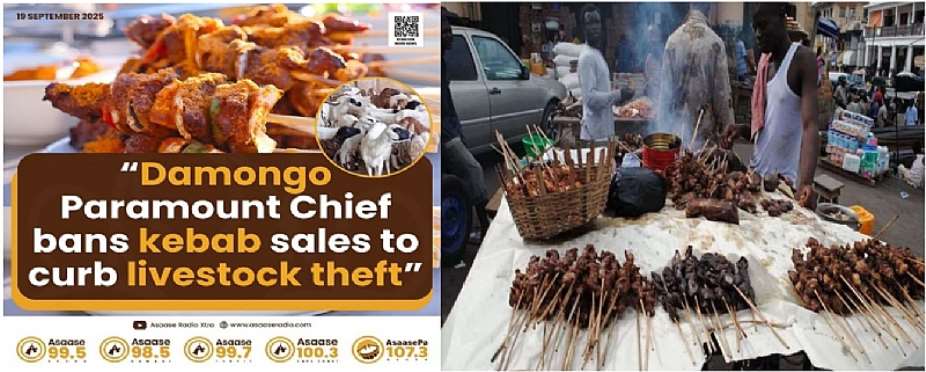
The recent decision by the Paramount Chief of Damongo to ban kebab sales as a measure to curb rampant livestock theft has sparked national debate. While the move reflects a deep concern for the welfare of livestock owners and the broader community, it also raises important questions about balancing cultural practices, sustaining small businesses, and preventing crime. To fully appreciate the weight of this decision, one must first understand Damongo’s role in Ghana’s historical trajectory and socio-economic development tapestry.
A BRIEF HISTORY OF DAMONGO
Damongo is widely known as the traditional seat of the Gonja Kingdom, home to the revered Yagbonwura, the Overlord of the Gonja people. The Gonja Kingdom, established in the 16th century, has long stood as a bastion of tradition and authority in Northern Ghana. Damongo is therefore not just another town; it is the heartbeat of Gonja identity and culture.
Over time, Damongo has evolved from being a purely traditional seat to becoming a modern regional capital after the creation of the Savannah Region in 2019. This transition has positioned the town as a hub for governance, commerce, and development projects in Northern Ghana. It is also home to important institutions, including the Mole National Park—the country’s largest wildlife reserve—which attracts both domestic and international visitors.
Economically, livestock rearing has always been central to life in Damongo and surrounding communities. Goats, sheep, and cattle are not merely animals; they are assets that serve as a store of wealth, a source of nutrition, and a means of livelihood for families. The rise of livestock theft in recent years has therefore struck at the very heart of this lifeline, sparking frustration among herders and prompting traditional leaders to act decisively. It is against this backdrop that the Paramount Chief’s ban on kebab sales must be understood. In Damongo, where tradition and economy intertwine, such a decision is not just a cultural decree but also a socio-economic intervention.
THE RATIONALE BEHIND THE BAN
Livestock rearing forms a major backbone of the local economy in Northern Ghana. For families, animals such as sheep, goats, and cattle represent both livelihood and financial security. Unfortunately, increasing cases of livestock theft have caused serious losses for herders, threatening peace and stability.
The kebab industry, a vibrant micro-enterprise in Ghana, has been identified as one of the outlets through which stolen animals are quickly disposed of. By banning kebab sales, the eminent Paramount Chief seeks to cut off this “ready market” and reduce the incentive for theft.
Causes of the Livestock Theft
The surge in livestock theft in Damongo cannot be dismissed as mere opportunism. It is the product of deeper socio-economic and structural issues:
- Rising Unemployment and Poverty: A major driver of livestock theft is the lack of jobs, particularly among the youth. For many young people who face limited access to education and formal employment opportunities, the temptation to steal livestock—valued as ready cash in the local economy—becomes difficult to resist.
- Weak Security Systems in Rural Communities: In many parts of Damongo, herders leave animals to graze in open fields or roam freely, a centuries-old practice. With limited community patrols and insufficient police presence in remote areas, thieves often operate with minimal risk of being caught.
- High Demand for Meat Products: The popularity of kebab, both locally and nationally, has inadvertently created a ready market for stolen animals. Once slaughtered and spiced, the origin of the meat becomes almost impossible to trace. This demand chain fuels theft, as stolen livestock can be turned into quick profits overnight.
- Organized Theft Networks: Reports from locals suggest that some thefts are not isolated incidents but the work of organized groups that move animals across districts, and sometimes across borders. These syndicates exploit gaps in local policing and weak market regulation.
- Limited Deterrence Through Law Enforcement: Cases of livestock theft, when reported, often drag in the justice system or end with minimal punishment. The lack of swift and harsh consequences emboldens thieves and discourages victims from seeking justice.
The Broader Implications
While the decision demonstrates strong leadership, it also risks unintended consequences. Hundreds of young people, women, and small-scale traders depend on kebab sales for their daily income. A sudden ban could push these individuals into economic hardship. Moreover, it risks creating underground networks for meat sales, which may worsen the very problem it seeks to address. The implications of livestock theft and, by extension, the ban on kebab sales are far-reaching, touching on peace, livelihoods, and local economies:
- Threat to Livelihoods and Food Security: For families in Damongo, a goat or sheep is not just food; it is a form of savings and insurance. Livestock is often sold to pay school fees, hospital bills, or fund major household expenses. Theft, therefore, robs families of their economic safety net and increases vulnerability.
- Disruption of Small Businesses: Kebab vendors and butchers form a significant part of the informal economy in Damongo. By banning kebab sales, the Paramount Chief risks crippling small businesses, pushing traders and food vendors into financial distress. Women, who dominate small-scale food vending, may be disproportionately affected.
- Erosion of Community Trust and Peace: Livestock theft often breeds suspicion within communities. Neighbors begin to distrust one another, and conflicts can easily escalate into violent confrontations. Over time, this erodes social cohesion, a key pillar of community life in northern Ghana.
- Impact on Traditional Authority and Governance: While the Chief’s intervention demonstrates responsiveness, the long-term effectiveness of such bans will test the credibility of traditional authority. If theft persists despite the ban, it could weaken the influence of traditional rulership, which has historically been a stabilizing force in Damongo.
- Economic Ripple Effects: The kebab business is connected to multiple value chains—from livestock rearing and transportation to spice sellers, charcoal producers, and food vendors. A ban on kebab sales could set off ripple effects, stalling economic activity across several sectors.
- Public Health and Regulation Concerns: Ironically, the crackdown on kebab sales may drive meat trade underground, where hygiene standards are poor and regulation is weak. This could expose consumers to food-borne diseases and undermine public health goals.
THE WAY FORWARD: SUSTAINABLE SOLUTIONS
The Chief’s decision has brought urgency to an overlooked problem. Yet, banning kebab sales should be treated as a temporary measure, not a permanent solution. What is needed is a collective, holistic approach:
- Strengthen Community Security: Chiefs, opinion leaders, and watchdog committees should work with the police to establish patrols and intelligence-sharing systems. Community vigilance, guided by traditional authority, can serve as a strong deterrent.
- Introduce Livestock Identification Systems: Ear-tagging, branding, or affordable digital tracking would make animals traceable. With support from the Ministry of Food and Agriculture, such a system would close avenues for thieves to resell stolen animals.
- License and Regulate Meat Vendors: Instead of banning kebab sales, introduce a vendor licensing system. Sellers should show proof of legal meat sourcing, ensuring accountability while protecting livelihoods.
- Promote and Expand Youth Livelihood Programs: Government schemes such as NEIP’s Edwumawura program could be extended to Damongo, offering youth skills training, agribusiness opportunities, and access to micro-credit. Tackling unemployment is critical to reducing theft.
- Leverage Technology and Innovation: Mobile apps for reporting theft, digital livestock trading platforms, and affordable tracking devices developed with universities and tech startups could transform livestock management.
- Stiffer Laws and Swift Prosecution: Livestock theft should be treated as a serious economic crime. Swift prosecution and stiffer penalties will deter offenders while restoring public confidence in justice.
- Education and Awareness: Chiefs, religious leaders, and schools should spearhead campaigns highlighting the dangers of theft to community stability. Public education will foster collective responsibility in protecting livestock.
- Collaboration Between Chiefs and State Institutions: Traditional leaders must continue to exercise moral authority but in strong partnership with police, district assemblies, and agricultural officers. When traditional and state institutions work together, solutions are more effective and credible.
CONCLUSION
The livestock theft crisis in Damongo is not just a local challenge; it is a national concern that cuts across security, economics, and culture. The Paramount Chief’s decision highlights the urgency of the problem but should be viewed as an interim step.
The Paramount Chief’s intervention has brought urgency to an issue, but the ban on kebab sales should be seen as a temporary measure, not a permanent solution. Ghana must act decisively through smarter policies, community vigilance, and economic empowerment to protect the livelihoods of herders, sustain small businesses, and safeguard peace.
What Ghana needs is a holistic, collaborative approach: smart regulation, community vigilance, youth empowerment, and cultural leadership. If these steps are taken, Damongo will not only defeat livestock theft but also stand as a shining example of how tradition and modern governance can walk hand in hand to secure livelihoods, sustain businesses, and build peace.


 NACOC Boss reveals how 'smart' suspected drug traffickers are diverting proceeds...
 Minerals Commission defends termination of Northern Ashanti Mines lease over US$...
 Northern Ashanti Mines says moves to reassign disputed concession began before l...
 'Was I facing union problems everyday when I was in charge, compare and contrast...
 Ablakwa will be prosecuted in 2029 under Bawumia – Kwadwo Poku warns
 Ghana deports South Korean man wanted over $3.6bn cocaine haul
 Minority threatens vote of censure on Ablakwa if fails to resign over South Afri...
 Ghana targets 70% local fuel supply by 2028 — MD
 UEW students express shock as SRC spending reveals over GH¢574,000 blown on camp...
 Judicial independence does not shield judges from scrutiny, accountability — Jus...


