




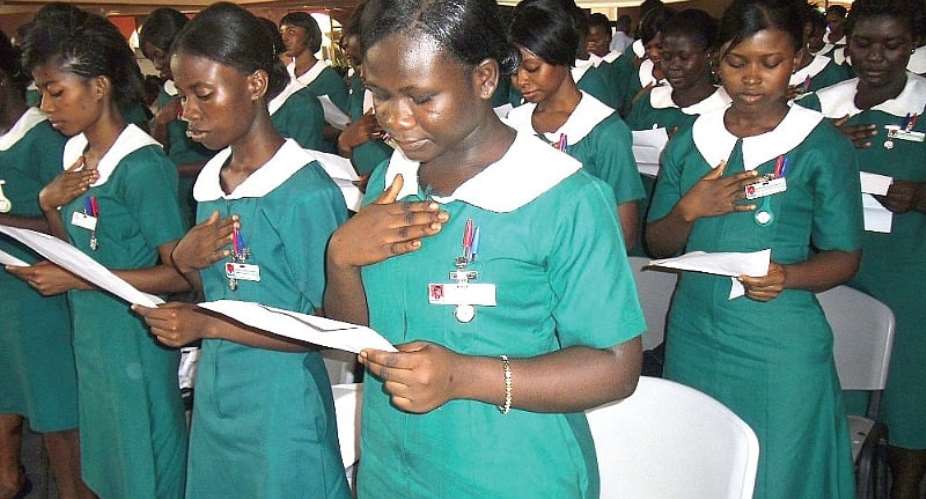
One of the most persistent and troubling issues in Ghana’s healthcare sector is the government’s inability to recruit health professionals after training them in the various health training institutions. For over a decade, this problem has continued unabated, leaving thousands of qualified nurses, midwives, and allied health professionals at home, unemployed, and disillusioned.
The case of the Alliance of Health Professionals is particularly striking. Some of its members have remained without postings since 2012, during the last NDC administration. More than ten years on, their situation remains unresolved. This raises important questions: why has this issue persisted across different governments, and why have the country’s health needs not justified their employment? Successive administrations have failed to provide clear answers.
It is both unreasonable and unfair to expect poor parents—who often make painful sacrifices to see their children through these expensive training schools—to endure the heartbreak of unemployment for their wards after graduation. Many of these families take on debt or sell their limited resources, believing that training in the health professions guarantees employment. Instead, they are confronted with a government that has consistently failed to absorb these graduates.
What makes this situation even more paradoxical is that Ghana’s health facilities remain understaffed. In both rural and urban areas, complaints of inadequate nurses and other professionals persist. If the health sector cannot engage all trained professionals, then the government should, at the very least, develop alternative strategies. One such approach could be to establish structured bilateral agreements with countries that urgently need nurses and allied health staff. Such exchange programmes would not only provide employment but also earn Ghana much-needed foreign exchange.
Unfortunately, both the NDC and NPP share blame for this chronic failure. Instead of working toward long-term solutions, both parties have turned the frustrations of unemployed health professionals into political campaign material. The previous NPP government further deepened mistrust when selective recruitment practices were reported, with allegations that postings were influenced by political connections or, in some cases, outright monetary payments. Such practices are deeply unjust and erode public confidence in governance.
Adding to the frustration is the fact that health training institutions continue to sell admission forms each year, producing more graduates for a system that has not absorbed many of their predecessors. This creates the impression of a cycle that benefits institutions financially but fails to consider the bleak future awaiting many students after graduation.
The government of Ghana—past, present, and future—owes its people clear answers and immediate action. Why should a country with inadequate healthcare provision leave thousands of trained professionals unemployed? Why must parents make heavy financial sacrifices for an outcome that offers neither hope nor opportunity?
This is not just about the welfare of graduates; it is about the future of healthcare delivery in Ghana. Both major political parties have had their turn at leadership, and both have failed to resolve this issue. The time has come for a genuine, non-partisan commitment to a lasting solution. Anything less would be a continued betrayal of the sacrifices of parents, the aspirations of young professionals, and the health needs of the nation.

 Korle Bu Teaching Hospital to introduce IVF and Corporate Clinic before end of 2...
 Accra West: Sarpeiman, Medie and other areas to experience power outages on Sund...
 Accra West: Faulty transformer causes outage Pokuase Amanfrom and surrounding ar...
 Restoration of Akosombo turbines not automatic solution to current dumsor — Mira...
 We have enough capacity to meet electricity demand — Energy Minister
 May 2: Cedi maintains value, sells at GHS12.15 on forex market, GHS11.20 on BoG ...
 2024 outages not due to transformer overloads — Energy Minister defends past com...
 US to withdraw about 5,000 troops from Germany
 Rebels take key military base in Mali's north
 Middle East war's impact on shipping hitting refugee aid: UNCHR


