




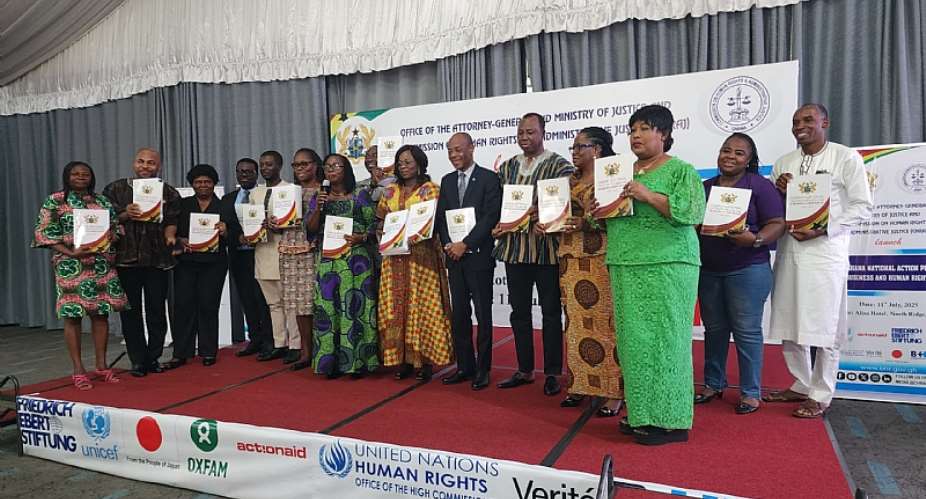
Ghana has taken a bold step in advancing corporate accountability and protecting individual freedoms with the official launch of its National Action Plan (NAP) on Business and Human Rights.
The initiative, spearheaded by the Office of the Attorney General and the Ministry of Justice and the Commission on Human Rights and Administrative Justice (CHRAJ), is designed to prevent, mitigate, and remedy the adverse human rights impacts arising from business and corporate activities within the country.
At the launch event, Joseph Akanjolenur Whittal, Commissioner of CHRAJ, emphasised the significance of the NAP, describing it as a pivotal document that will serve as a national reference point for mobilising efforts to safeguard human rights across all sectors of the Ghanaian economy.
“The NAP was developed through extensive consultations across the country and with a diverse range of demographics and societal groups,” Whittal stated. “Ghana now joins only four other African countries to have successfully developed and adopted such a framework. This is a landmark moment.”
The Commissioner explained that the plan, once effectively implemented, can positively transform the lives of Ghanaians by institutionalising responsible business conduct and preventing corporate-related human rights violations. He underscored the necessity for multi-sectoral collaboration to ensure that the objectives outlined in the plan are fully realised.
“The successful implementation of the NAP will require a collective effort from all stakeholders, government, businesses, civil society, and citizens alike,” he said. “It is essential that Ghanaians read and familiarise themselves with the document. It is laid out in clear matrices outlining short-, medium-, and long-term strategies.”
Whittal called on the government to go beyond symbolism by committing real resources to the plan’s implementation. “We are urging the state to put its money where its mouth is. The NAP has highlighted gaps that need to be addressed. Budgetary commitment is key,” he asserted.
Representing the Minister for Justice and Attorney General, Hon. Dominic Akuritinga Ayine, Chief State Attorney Dr. Sylvia Adusu also delivered a strong endorsement of the plan, noting its crucial role in integrating human rights protection into Ghana’s business environment.
“This plan is not just about policies, it is about people,” Dr. Adusu said. “It seeks to ensure that every business, from small-scale traders to large multinational corporations, respects the rights of individuals, especially those in vulnerable situations.”
She reiterated that the NAP is designed to anticipate and prevent human rights abuses while simultaneously promoting accountability and legal remedies for victims. Dr. Adusu further reminded the public that Ghana’s legal system provides mechanisms to seek redress.
“The courts of Ghana are open to all, and they are capable of addressing human rights issues. We have a dedicated Human Rights Court, and institutions like the Special Rapporteur on the Rights of Persons with Disabilities (SRAJ) offer reporting channels for victims,” she explained.
Dr. Adusu encouraged citizens to be vigilant, proactive, and unafraid to report violations. “Human rights are not just the responsibility of institutions; they are the duty of every citizen. If you witness abuse, speak up. The state stands ready to act.”
The launch of the NAP comes at a time when global attention is increasingly focused on the responsibility of corporations to respect human rights. The plan aligns with the United Nations Guiding Principles on Business and Human Rights, and it positions Ghana as a continental leader in human rights-centred economic governance.
The comprehensive document sets out clear responsibilities and expectations for both public and private sector actors. It lays down actionable steps to ensure businesses integrate human rights considerations into their operations from employment practices and environmental sustainability to consumer protection and anti-corruption efforts.
Development of the plan was made possible through technical and financial support from a host of international development partners and organizations, including the United Nations Development Programme (UNDP), the Government of Japan, the Friedrich Ebert Stiftung (FES), Oxfam Ghana, ActionAid, UNICEF, Verité, and the Office of the High Commissioner for Human Rights (OHCHR).

 ‘We have turned the tide’ – Ato Forson says Ghana is ready to take off
 Sammy Gyamfi refuses to file defence, hides behind technicalities — Lawyers
 Osahen Afenyo-Markin vows to pursue case against Sammy Gyamfi despite high court...
 Let us all be mentors to our younger generation - Mahama
 Court stops Osenase homecoming over security concerns
 Supreme Court dismisses Solomon Asamoah's bid to stop Sky Train trial
 GRA denies imposing new 20% tax on Netflix, Google and Amazon subscriptions
 Police arrest 16 suspects, seize 209 rounds of ammunition at Gbane mining site
 ‘Mahama has lost his moral high ground’ – Dr Zaato on Affi Agbenyo’s EC appointm...
 Cassava, hemp could offer alternatives to plastics – Zanetor challenges scientis...


