




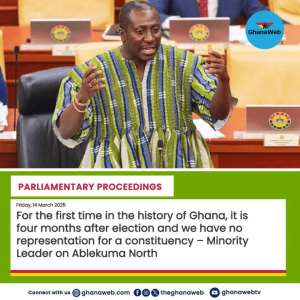
The issue of parliamentary representation has once again taken center stage in Ghana, as the Ablekuma North constituency finds itself without representation four months after the 2024 elections. This unprecedented situation echoes the plight of the people of Santrokofi, Akpafu, Likpe, and Lolobi (SALL), who were denied representation in Parliament for four years under the Akufo-Addo-Bawumia administration. These cases highlight systemic flaws in Ghana’s electoral processes and raise urgent questions about fairness, political motives, and the role of the Electoral Commission (EC).
The SALL Saga: A Denial of Representation
In the lead-up to the 2020 general elections, the people of SALL were excluded from voting for a parliamentary representative due to the creation of the Guan District. While they participated in the presidential election, they were inexplicably left out of the parliamentary vote. This decision, overseen by the Jean Adukwei Mensa-led EC, effectively disenfranchised the people of SALL, leaving them without representation in Ghana’s 8th Parliament.
Critics argue that this exclusion was politically motivated, aimed at ensuring that the New Patriotic Party (NPP) secured a parliamentary seat in the Oti Region through Peter Amewu. The Minority Leader at the time described the situation as “a deliberate act of disenfranchisement, a travesty of justice that undermines the very principles of democracy.” For four years, the people of SALL were left voiceless in Parliament, a glaring anomaly in Ghana’s democratic history.
Ablekuma North: A New Chapter in the Representation Crisis
Fast forward to 2024, and the Ablekuma North constituency finds itself in a similar predicament. Four months after the elections, the constituency remains without a Member of Parliament due to unresolved disputes over the election results. Both the National Democratic Congress (NDC) and the NPP have laid claim to victory, leading to a legal and procedural deadlock.
The Electoral Commission’s inability to finalize the results has left constituents frustrated and voiceless in Ghana’s 9th Parliament. The micro Minority Leader’s recent remarks highlight the urgency of resolving this impasse, stating, “The people of Ablekuma North deserve better. Their voices must be heard, and their representation restored.”
The Role of the Electoral Commission
The Jean Adukwei Mensa-led EC has faced significant criticism for its handling of both the SALL and Ablekuma North cases. Allegations of bias, lack of transparency, and procedural lapses have marred the Commission’s reputation. Legal experts and civil society groups have called for reforms to ensure that the EC operates independently and upholds the principles of fairness and accountability.
As legal practitioner Martin Kpebu aptly stated, “The Electoral Commission’s role is to safeguard democracy, not to undermine it. These cases demand answers and accountability.”
A Message to the Micro Minority Caucus Leader
The leader of the micro minority caucus Alexander Afenyo-Markin must take a moment to reflect on the trajectory of his leadership and the consequences of his actions. Hypocrisy and arrogance have no place in a democracy that thrives on accountability, humility, and service to the people. The recent developments in Ablekuma North and the historical disenfranchisement of SALL should serve as a wake-up call, not an opportunity for political posturing.
It is imperative that the caucus leader abandons any semblance of self-righteousness and instead focuses on fostering unity and inclusivity. The people of Ghana deserve leaders who prioritize their welfare over personal or partisan interests. Failure to heed this call for humility could result in further erosion of the caucus's influence, potentially leading to a complete absence of representation come 2028.
As the saying goes, “Pride comes before a fall.” The micro minority caucus leader Alexander Afenyo-Markin must recognize that arrogance alienates, while humility builds bridges. The time to act is now—before the caucus is reduced to irrelevance in the political landscape of Ghana. Leadership is not about dominance; it is about service, and the people of Ghana are watching closely.
A Call for Accountability and Reform
The denial of representation to SALL and the ongoing crisis in Ablekuma North underscore the need for urgent reforms in Ghana’s electoral processes. Key recommendations include:
1. Legislative Clarity: Amendments to electoral laws to prevent the exclusion of communities from parliamentary representation.
2. Independent Oversight: Strengthening the independence of the EC to ensure impartiality in its operations.
3. Judicial Expediency: Fast-tracking election-related disputes to minimize delays in representation.
As Ghana continues to navigate these challenges, the voices of disenfranchised communities like SALL and Ablekuma North serve as a reminder of the importance of representation in a democracy. The nation must act decisively to uphold the principles of fairness, accountability, and inclusivity in its electoral processes. The people of Ghana deserve better, and the time for action is now.
Retired Senior Citizen
Teshie-Nungua

 Korle Bu Teaching Hospital to introduce IVF and Corporate Clinic before end of 2...
 Accra West: Sarpeiman, Medie and other areas to experience power outages on Sund...
 Accra West: Faulty transformer causes outage Pokuase Amanfrom and surrounding ar...
 Restoration of Akosombo turbines not automatic solution to current dumsor — Mira...
 We have enough capacity to meet electricity demand — Energy Minister
 May 2: Cedi maintains value, sells at GHS12.15 on forex market, GHS11.20 on BoG ...
 2024 outages not due to transformer overloads — Energy Minister defends past com...
 US to withdraw about 5,000 troops from Germany
 Rebels take key military base in Mali's north
 Middle East war's impact on shipping hitting refugee aid: UNCHR


