




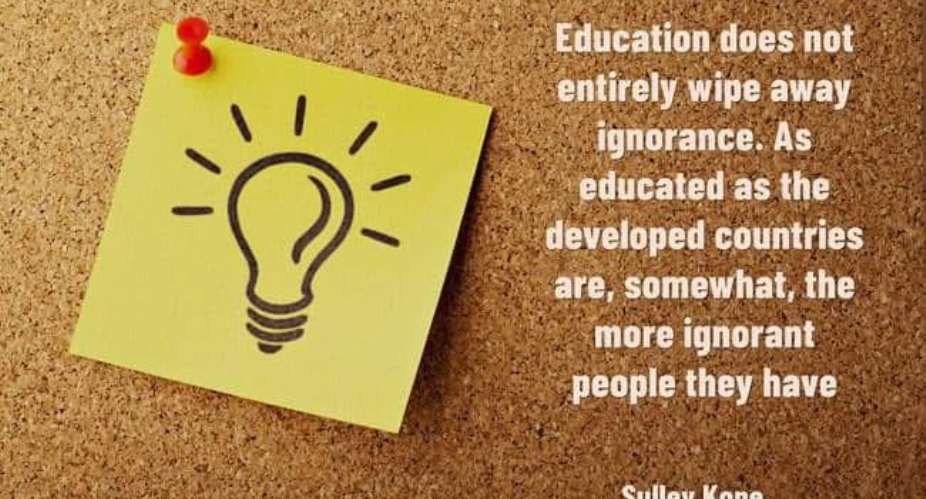
Education is often hailed as the cornerstone of progress, the key to unlocking human potential, and the antidote to ignorance. It is widely believed that through education, societies can eradicate misinformation, superstition, and irrationality, paving the way for enlightenment and development. However, the reality is far more nuanced. While education undoubtedly plays a critical role in advancing societies, it does not entirely eliminate ignorance. In fact, in some cases, the more educated a society becomes, the more complex and pervasive forms of ignorance emerge. This paradox is particularly evident in developed countries, where high levels of education coexist with significant pockets of ignorance.
The Illusion of Complete Enlightenment
At first glance, it seems counterintuitive to suggest that education does not fully eradicate ignorance. After all, education equips individuals with knowledge, critical thinking skills, and the ability to question assumptions. It empowers people to understand the world around them, make informed decisions, and contribute meaningfully to society. Yet, despite these benefits, ignorance persists, even in the most educated societies. This is because ignorance is not merely the absence of knowledge; it is a multifaceted phenomenon that can manifest in various forms, some of which are exacerbated by the very systems designed to eliminate it.
The Paradox of Specialization
One of the reasons education fails to entirely wipe away ignorance is the increasing specialization of knowledge. In developed countries, education systems are designed to produce experts in specific fields. While this specialization drives innovation and progress, it also creates silos of knowledge. Individuals may become highly knowledgeable in their chosen fields but remain largely ignorant about other areas. For example, a brilliant physicist may have little understanding of political science, or a renowned economist may lack basic knowledge of environmental science. This compartmentalization of knowledge leads to a fragmented understanding of the world, where individuals are experts in narrow domains but remain uninformed about broader issues.
Moreover, the sheer volume of information available in the modern world makes it impossible for anyone to be fully informed about everything. Even the most educated individuals must rely on others for expertise in areas outside their own. This reliance creates opportunities for misinformation and ignorance to thrive, as people may accept claims without fully understanding them or critically evaluating their validity.
The Dunning-Kruger Effect and Overconfidence
Another factor contributing to ignorance in educated societies is the Dunning-Kruger effect, a cognitive bias in which individuals with low ability in a particular area overestimate their competence. Ironically, this effect is often more pronounced among those with some level of education. For instance, someone with a basic understanding of a complex topic may feel confident in their knowledge, even though their understanding is superficial or incomplete. This overconfidence can lead to the spread of misinformation, as individuals may confidently assert opinions or beliefs that are not grounded in evidence.
In developed countries, where access to information is abundant, the Dunning-Kruger effect can be particularly damaging. The internet and social media platforms allow individuals to share their opinions widely, regardless of their expertise. This democratization of information has its benefits, but it also means that ignorance can be amplified and disseminated on a massive scale. Educated individuals, believing themselves to be well-informed, may inadvertently contribute to the spread of ignorance by sharing inaccurate or misleading information.
The Role of Confirmation Bias
Confirmation bias, the tendency to seek out and interpret information in a way that confirms preexisting beliefs, is another barrier to eliminating ignorance. Education can equip individuals with critical thinking skills, but it does not always inoculate them against cognitive biases. In fact, educated individuals may be more adept at rationalizing their beliefs and dismissing evidence that contradicts them. This is particularly evident in polarized societies, where individuals on opposite sides of an issue use their education to reinforce their positions rather than engage in open-minded dialogue.
For example, in debates about climate change, vaccination, or economic policy, educated individuals on both sides often cite studies and data to support their views. However, they may selectively focus on information that aligns with their beliefs while ignoring or dismissing evidence that challenges them. This selective use of knowledge perpetuates ignorance, as it prevents individuals from fully understanding complex issues and considering alternative perspectives.
The Illusion of Knowledge in the Digital Age
The digital age has transformed the way we access and process information, but it has also created new challenges in the fight against ignorance. The internet provides unprecedented access to knowledge, but it also inundates users with misinformation, fake news, and pseudoscience. In developed countries, where internet penetration is high, individuals are constantly exposed to a barrage of information, much of which is unreliable or misleading.
Paradoxically, the abundance of information can lead to a false sense of knowledge. People may believe they are well-informed simply because they have access to vast amounts of information, even if they lack the skills to critically evaluate it. This illusion of knowledge can be more dangerous than outright ignorance, as it leads individuals to make decisions based on flawed or incomplete information.
The Persistence of Cultural and Social Ignorance
Education systems in developed countries often focus on academic and technical knowledge, but they may neglect cultural and social education. As a result, even highly educated individuals may remain ignorant about the experiences, histories, and perspectives of marginalized groups. This cultural and social ignorance can perpetuate stereotypes, discrimination, and inequality.
For example, a person with advanced degrees in science or engineering may have little understanding of systemic racism, gender inequality, or the challenges faced by immigrants. This lack of awareness can lead to insensitive or harmful behavior, even if it is unintentional. In this way, education that is narrowly focused on academic achievement can fail to address deeper forms of ignorance that have significant social consequences.
The Role of Education Systems in Perpetuating Ignorance
Ironically, education systems themselves can contribute to ignorance. In many developed countries, education is often driven by standardized testing and measurable outcomes, which prioritize rote memorization over critical thinking and creativity. This approach can produce individuals who are skilled at passing exams but lack the ability to think independently or question authority.
Furthermore, education systems may reflect and reinforce societal biases, perpetuating ignorance rather than challenging it. For example, history curricula in some countries may gloss over or omit uncomfortable truths about colonialism, slavery, or war, leaving students with a distorted understanding of the past. Similarly, science education may fail to address controversial or politically charged topics, leaving students ill-equipped to engage with complex issues.
The Way Forward: Rethinking Education
To address the paradox of education and ignorance, it is essential to rethink the purpose and structure of education. Rather than focusing solely on academic achievement, education systems should prioritize critical thinking, empathy, and lifelong learning. This includes teaching students how to evaluate information critically, recognize their own biases, and engage with diverse perspectives.
Additionally, education should be more holistic, addressing not only academic knowledge but also cultural, social, and emotional intelligence. By fostering a deeper understanding of the world and the people in it, education can help reduce ignorance in all its forms.
Education is a powerful tool for combating ignorance, but it is not a panacea. In developed countries, where education levels are high, ignorance persists in complex and often subtle ways. The paradox of knowledge and ignorance highlights the need for a more nuanced understanding of education and its limitations. By addressing the root causes of ignorance and rethinking the purpose of education, societies can move closer to the ideal of true enlightenment. However, as long as human cognition, societal structures, and information systems remain imperfect, ignorance will continue to exist, even in the most educated societies.
Sulley Kone
+233244805619

 BECE papers must be reduced to just four subjects; ten is a torture — Kofi Asare
 Mahama, appointees donate GH¢6.1m to Medical Trust Fund
 Leading member of NPP says President Mahama is genuine
 Nkwanta South two BECE candidates involved in accident recovering well — Educati...
 Teachers of Adiewoso Basic School whipped in military operation against galamsey...
 It’s not true that ex-Buffer Stock CEO was denied access to his lawyers — Deputy...
 Greater Accra Regional Minister is not performing — Kwame Owusu Danso
 Gov’t weaponising state agencies against political foes — NPP’s Kamal-Deen
 Parliament should pass procedural safeguards limiting immediate rearrest after j...
 Police arrest six men accused of impersonating security operatives in Agona Swed...


