




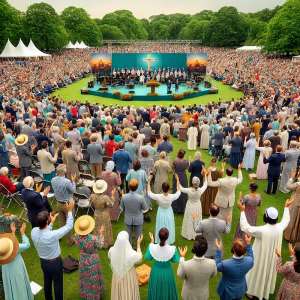
Many faith-based organisations hold annual conventions to reflect on the birth of Christ and celebrate their faith. These gatherings, often called "Christmas Conventions," have become a tradition in many Christian communities. However, there is growing conversation around renaming these events as "Christ Conventions" to better reflect the true focus of the gathering.
The name "Christmas Convention" carries with it certain cultural and secular connotations that can overshadow the central spiritual purpose of the event. By shifting the focus back to Christ through a more intentional naming convention, the event can better serve its purpose.
The origin of "mas" and its implications
The word "mas" in "Christmas" comes from the Latin word massa, which refers to a celebratory feast or festival. Over time, "mas" has come to represent the broader, more commercialised celebrations associated with Christmas. While many still view Christmas as a religious holiday, it cannot be denied that secular and commercial elements, such as gift-giving, parties, and decorations have taken precedence in modern celebrations. In this context, the inclusion of "mas" in a convention title may inadvertently shift attention away from Christ and toward these more worldly, festive aspects of the season. The term "Christmas Convention" may be associated with cultural festivities that are not central to the spiritual purpose of the gathering.
Why the change to Christ Convention?
Renaming the event "Christ Convention" carries several advantages, all aimed at refocusing the gathering on Christ himself. Here is why dropping "mas" can make a meaningful difference:
Prioritising Christ as the central focus
By renaming the convention, there is a clear and unmistakable emphasis on Christ. The term "Christ Convention" removes any ambiguity about the purpose of the event, making it clear that it is a gathering dedicated to honouring, worshipping, and reflecting on the life and teachings of Christ.
The Bible reminds us of the centrality of Christ in all things, especially in worship. Colossians 1:18 says, "And He is the head of the body, the church; He is the beginning and the firstborn from among the dead, so that in everything He might have the pre-eminence." A "Christ Convention" ensures that Jesus remains at the forefront, reinforcing His supremacy over the event.
Distancing the event from secular and pagan connotations
"Mas," with its roots in feasting and celebration, can evoke images of the secular elements of Christmas that have little to do with the spiritual significance of Christ’s birth. By removing "mas," the event distances itself from these connotations and remains focused on the spiritual purpose of gathering in Christ’s name.
The Bible warns against conforming to worldly influences in our worship and devotion. Romans 12:2 states, "Do not conform to the pattern of this world, but be transformed by the renewing of your mind." A "Christ Convention" helps believers maintain a sacred focus on Christ, free from the distractions and secularism that often accompany modern Christmas celebrations.
Emphasising the spiritual significance of the event
A "Christ Convention" is not just a festive gathering; it is a sacred occasion where believers come together to deepen their faith, learn from the Holy Bible, and worship Christ. The removal of "mas" helps to refocus the event on what truly matters: the reverence and celebration of Christ’s life, teachings, and sacrifice.
In John 4:23, Jesus says, "Yet a time is coming and has now come when the true worshippers will worship the Father in the Spirit and in truth, for they are the kind of worshippers the Father seeks." By renaming the convention, organisers emphasise the spiritual nature of the event, fostering an atmosphere of true worship.
A clearer, more Christ-centered message
In a time when Christmas has become so entwined with materialism and cultural festivities, it is important for faith-based events to stand out as places of true worship and reflection. The name "Christ Convention" sends a clear message to attendees and the community at large that the event is solely about Christ. It removes the risk of people associating the convention with the commercial and cultural aspects of Christmas that often distract from the true meaning of the season.
In Matthew 6:33, we are called to "seek first his kingdom and his righteousness." Renaming the event "Christ Convention" helps fulfill this biblical mandate by seeking Christ above all other distractions. It places Jesus at the centre of the celebration, where He belongs, ensuring that the focus of the gathering remains pure and spiritually enriching.
Pragmatically, Christians are called to imitate the Lord Jesus Christ by adhering to what is prescribed in the Bible. Since the celebration of Christmas is not mentioned in the Bible, it may be more prudent to choose "Christ Convention" over "Christmas Convention." This assertion can be examined from both linguistic and pragmatic perspectives, supported by biblical examples.
From a linguistic standpoint, the word "Christmas" is derived from "Christ" and "mass," the latter referring to a celebratory feast with origins that extend beyond Christian tradition. The term "mass" has historical roots in Latin (missa), which evolved over time to represent religious ceremonies but has also taken on secular and cultural meanings in modern society. By using "Christmas," the focus can unintentionally shift to these cultural and secular aspects, as opposed to solely centring on Christ.
On the other hand, "Christ Convention" clearly places emphasis on Christ as the central figure. The word "convention" signifies a gathering or assembly, and when paired with "Christ," it indicates a gathering specifically dedicated to worshipping and honouring Him. This linguistic clarity ensures that the event's purpose is not diluted by other associations, thereby making "Christ Convention" a more focused and spiritually aligned term.
Pragmatically, the actions and practices of Christians should align with biblical teachings. In 1 Corinthians 11:1, Paul urges believers to imitate him, just as he also imitates Christ. This imitation involves following the example of Christ and adhering to what the Bible teaches. Since the Bible does not mention Christmas or its observance, some Christians may question the relevance of celebrating a holiday that has evolved to include non-biblical, and sometimes secular elements.
The Bible does, however, emphasise the importance of gatherings in the name of Christ. Matthew 18:20 says, "For where two or three are gathered in my name, there am I with them." A "Christ Convention" directly aligns with this biblical principle, focusing on Christ as the reason for the gathering, while "Christmas Convention" may carry the risk of emphasising the holiday's broader cultural aspects.
Thus, from a pragmatic standpoint, "Christ Convention" ensures that the gathering remains faithful to the biblical call to focus on Christ, free from the worldly influences that may be associated with "Christmas."
From both linguistic and pragmatic perspectives, "Christ Convention" offers a clearer, more biblically grounded approach than "Christmas Convention." Linguistically, it avoids the cultural and secular associations of "Christmas," while pragmatically, it ensures that the gathering aligns with biblical teachings by placing Christ at the centre. By choosing "Christ Convention," Christians can remain faithful to their calling to imitate Christ and honour Him in all aspects of their worship.
What is the way forward?
The clergy all over the world are therefore entreated to repent and phase out the use of "Christmas Convention." They are encouraged to wholeheartedly promote the name of Jesus Christ by adopting "Christ Convention" instead.
In essence, renaming a "Christmas Convention" to "Christ Convention" is more than just a linguistic change. It is a powerful declaration of the event’s purpose, and a reminder of what believers are truly celebrating (i.e. the birth, life, and teachings of Christ). As Colossians 3:17 reminds us, "And whatever you do, whether in word or deed, do it all in the name of the Lord Jesus." By making this shift, organisers can ensure that Christ remains at the centre of the gathering.
The writer is a lecturer/coordinator at the GCTU Language Centre and university chaplain.

 Korle Bu Teaching Hospital to introduce IVF and Corporate Clinic before end of 2...
 Accra West: Sarpeiman, Medie and other areas to experience power outages on Sund...
 Accra West: Faulty transformer causes outage Pokuase Amanfrom and surrounding ar...
 Restoration of Akosombo turbines not automatic solution to current dumsor — Mira...
 We have enough capacity to meet electricity demand — Energy Minister
 May 2: Cedi maintains value, sells at GHS12.15 on forex market, GHS11.20 on BoG ...
 2024 outages not due to transformer overloads — Energy Minister defends past com...
 US to withdraw about 5,000 troops from Germany
 Rebels take key military base in Mali's north
 Middle East war's impact on shipping hitting refugee aid: UNCHR


