




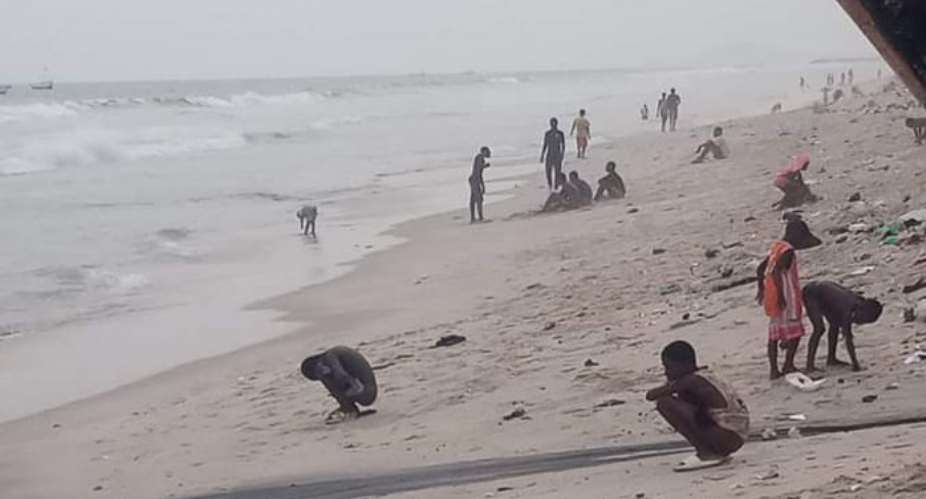
Residents of Chorkor, a coastal community in Accra, are grappling with the challenges of open defecation, posing significant health risks to the community. The lack of access to sanitary facilities has forced many to resort to defecating in the open, contaminating the environment and exposing residents to diseases.
Many residents in the community practice open defecation, posing serious health risks to all. A major obstacle to proper sanitation is economic constraints and poverty. Many families lack the financial resources to build or access safe and private toilets, forcing them to resort to open defecation. The cost of constructing a toilet or connecting to a sewer system is prohibitively expensive for many, leaving them with few options.
According to Naa Dedei a resident of Chorkor "Life is tough here. I earn a small income from selling fish at the market, but it's barely enough to feed my family. We struggle to make ends meet, and there's never enough for extras like sanitation facilities. We can't afford to build a toilet or connect to a sewer system. It's too expensive. We've tried to save up, but other priorities like food and rent come first. Poverty is the root of all our problems. If we had more resources, we could improve our living conditions, including sanitation".
Furthermore, the lack of affordable and accessible sanitation facilities in the community means that individuals are often left with no choice but to defecate in the open. Addressing the root causes of open defecation requires a comprehensive approach that includes economic support and affordable sanitation solutions for all.
Despite laws and regulations, the practice persists, putting residents' health and environment at risk. The Public Health Act, Environmental Sanitation Act, and Local Government Act seem to be mere paper tigers, unable to stem the tide of open defecation.
According to the UN Ghana Water Sanitation and Hygiene (WASH) support programme, sanitation in Ghana is very poor, with only 25% having access to basic service, about 57% using shared or public facilities and 18% still defecating in the open defecation. According to the World Health Organisation (WHO), 7,653 deaths were caused by WASH-related illness in 2019, 21 people per day, almost one person every hour dying from preventable WASH-related diseases.
Chorkor's residents are frustrated and desperate. They lack access to safe and private sanitation facilities, forcing them to resort to open defecation.
As the crisis deepens, open defecation poses serious health risks, and the environmental consequences are dire. Chorkor's struggle highlights Ghana's larger sanitation crisis, which demands urgent attention and action.
Despite efforts by the government to improve sanitation, Chorkor remains one of the areas struggling with this basic necessity. The community's inadequate waste management and lack of toilet facilities have created an environment where open defecation has become the norm.
"We are forced to defecate in the open because there are not enough toilets available," said Akua, a resident of Chorkor. "It's a shameful and uncomfortable experience especially for we the ladies, but we have no choice."
The stinking smell of human waste stays in the air, a constant reminder of the community's struggle. The lack of access to sanitary facilities has created an environment where disease-carrying flies and mosquitoes thrive, exacerbating the risk of waterborne disease
The situation has serious implications for public health, as the contamination of water sources and soil can spread diseases like cholera, diarrhea, and typhoid fever.
The residents of Chorkor urge the government and stakeholders to prioritize their plight and provide the necessary infrastructure to end open defecation in the community.
Mr. Allotey, a resident of Chorkor also said practicing open defecation is motivated by choice. He said is a habit and an enjoyable outdoor activity. He continued that practising open defecation serves as food to the fishes. Some residents also said that they know that their act has led to improper waste management and also attracted a lot of diseases to them but is lack of toilet facilities at their homes that makes them defecate at the seashore.
Residents of Chorkor are pleading with the government to address the crisis. They included that the government should increase monitoring and enforcement of regulations to discourage them from practicing open defecation. And also be educated about keeping the seashore clean.
Residents are also pleading with the government to construct enough public toilets for them so that a change in behavior can be achieved which will bring a cleaner and safer seaside environment for the Chorkor community and it's visitors.
BY Christiana Wiafe,
Student of the University of Media Art and Communication/Institute of Journalism ( UNIMAC - GIJ)

 Allow the law to deal with defilement perpetrators - Director tells families
 Gov’t to develop policy for Ghanaian sign language in education
 Two Ada SHS students plead guilty to assault, slapped with 12-month bond
 Enlistment: GAF begins documentation, body selection from September 28
 Violent rainstorm rips off roofs, displaces residents in Krachi Nchumuru
 Ghana risks EU gas market access over methane emissions
 Tumu landlord gives road encroachers 2-week ultimatum to relocate for road const...
 Serbian President Aleksandar Vucic resigns
 Tigray TV station hit by drone, rebels advance in north Ethiopia
 Swiss reject plan to toughen neutrality


