




Radio from its birth in the 20th century has evolved till 21st century of our time and beyond. Traditionally radio was from the gathering era (where radio acted as a social magnetic box that drew family, communities to a sound box). This gathering era is synonymous to fruits and seeds picking and gathering era in the period of the hunting age. Today, the gathering around a radio box has taken a different format and a shift in newness of what is now known as ‘content sharing’, by individuals, and communities across human diversities through all types of new technological enablers are able to gather in an unseen telesteria spaces induced by technological innovations, radio content could be edited into ‘bites’ for sharing, re-commenting, and re-packaging for sharing. Today, digital innovations have simply made radio communally more dynamic with a positive future.
The exciting feature of the 21st Century radio is also the shift in content ownership of socio-cultural diversity. The monopolistic content ownership by an editor has broken down to a strong citizen-journalism. radio contents ownership is constructively diluted. The new features of radio have been possible due to how innovativeness and digitization efforts has complemented each other in radio enhancement for usage and commercialization.
My concern today, as the World celebrates Radio Day, is not about the contention between Digitization and Digitalization since both remain resourceful to society but simply to evaluate the impact of technological innovation within the radio space and its relation to society, development and the future. At the core of every human innovation should be the critical social assessment of usage and diverse impact. Hence, World Radio day should interrogate the impact of radio innovations on different cultural spectrums and map out implications and challenges for the future.
Digital Innovations in Radio Space:
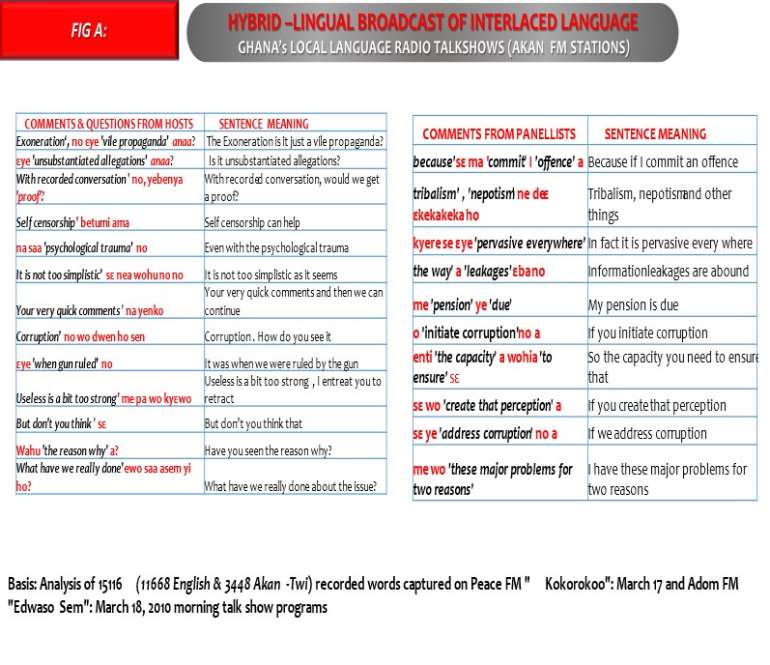
Digital innovation within the radio environment has introduced possibilities. Just to name a few; Facebook, smartphones listening experiences, radio live content-streaming both in audio and video. In addition, the podcast has also induced strong radio forums that aids diverse human engagement and development. As much as society hails innovations in radio development for promoting diversity and accessibility, there remains a cognitive draw back in societies where l individual cultural adaptations of hybrid lingual practices have taken over the public interest. One of the cardinal values associated with radio is the value of public interest, thus using radio to promote and protect public interest within a particular public sphere. which if not checked could bleak the future of radio access and diversity usage. For radio to act as a public interest-arena, radio needs to create a space for articulation of expressions and dialogue. The vehicle through which radio articulation can be affected is through a language, a language that is accessible and comprehensible by all. Without such a language, radio spaces remain to fail in its public interest values and limitations to freedom of expression and participation. An example of radio space failing to some extent on its public interest responsibilities is the local language (Akan) Radio Talk -Shows programme in Ghana. The local Radio Talk Shows in Ghana has evolved into a space of hybrid language of a bit of this and a bit of that (a bit of English language and bit of Local language (Akan). This doesn’t seem to be peculiar to only Akan language radio spaces but common to other local language radio spaces in Ghana. Such radio spaces are not only a threat to participation but gives birth to cognitive lingual cyborgs who are only half-baked in the articulation of national narratives and discourses. The table below in fig. A shows examples of consistent interlaced Akan-local language by Radio hosts and panelists on Radio Talk - Show. Certainly, a recipient who is equipped with the cognitive tools of processing the language on the interlaced radio talk-show is likely to articulate the content comprehensively but those who are less equipped in the lingual strength will articulate the radio content poorly.
INNOVATIONS, PARTICIPATION AND FUTURE:
Technological innovations have brought radio closer to the community than never before. However, due to the lingual packaging of radio content, it is to a larger extent hampering diverse access to segments of the radio landscape in Ghana. Radio presenters has resulted to an extreme interlacing of English and Local languages in their content and programme disseminations. I certainly support cultural hybridity since there is a cohesive strength in cultural plurality but multiculturalism shouldn’t create lingual monopolistic inhibitions. Lingual heterogeneity should encourage freedom of expressions, and rights to equal participation. An innovative radio landscape is therefore supposed to enhance cultural efficiency and lingual accessibility. Unfortunately, radio-consumer participation in public discourse on the Ghanaian Radio Talk-Shows is not effectively promoting freedom in articulation due to the consistent lingual code-switching from the hybrid lingual spaces. Perhaps the question to be asked is: How can a recipient or a consumer of radio content from an innovative radio platform appreciate an interlaced hybrid content she or he is not fluent in? Ghanaian broadcasters allude to the fact that their local language programme content comprises circa 70% local content (local language) and 30% English language. The discussion here seeks to draw attention to Ghana’s local language radio talk-show programming and the future
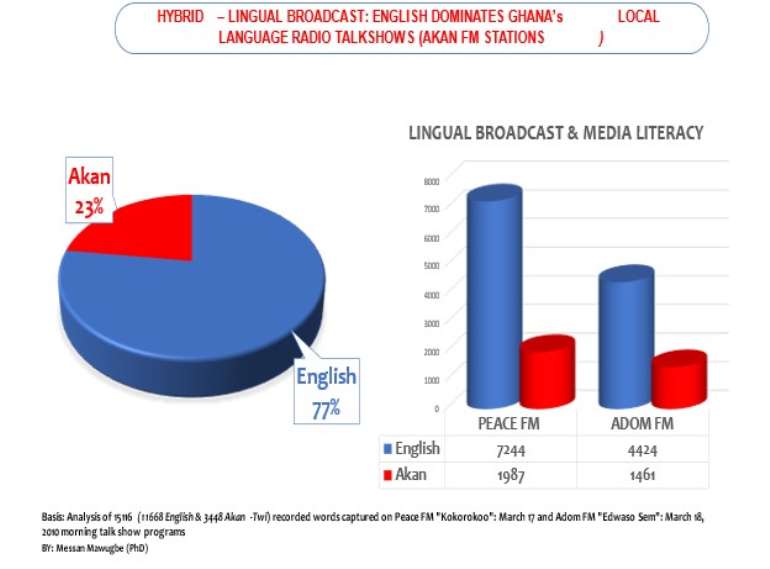
A critical sampling of an Akan-Local Radio Talk-Show revealed something different. A reference to the Fig. B. depicts the extent of such interlaced lingual abuses of English language as it records 77% usage in an Akan language (local Ghanaian language) radio broadcast whilst the Akan language poorly gained only 23%. This format of radio talk-show broadcasting is affront to Ghana National Media Commission’s (NMC) National Media Policy of 6.1.5 where access to radio content hinges on comprehension, and media’s “consumption and participation”. It is therefore very challenging to participate in a media, or narratives with limited lingual efficacy. Furthermore, according to Freedom of Expression Standards for Free and Inclusive Broadcasting “radio must be prescribed with clear and precise language” for its target audience. The experience of lingual hybridity on the Ghanaian Radio Talk-Show programmes is unfortunately not the prescribed and clear language accented by the National Media Commission. Radio content developers remain essential part of the innovative experiences sweeping across the radio spaces and should be empowered to perform their civic responsibilities of public interests. The challenge facing local language radio broadcasters is proficiency in the local language, or perhaps they are suffering from what I termed as Acquire Lingual Deficiency Syndrome (ALDS) deficiency due to over-reliance on lingual hybridity. World Radio Day should continue to promote the link between innovations and content developers’ capacity building for the full realization of radio as a system for safeguarding public interests, freedom of expression, access to public discourses effective interpretation of radio content within the public sphere.
To ensure the effective maximization of the potential that comes with innovation in the radio space, the United Nations Scientific and Cultural Organisations (UNESCO) is therefore encouraged to partner with government agencies across Africa to impact a new set of training on broadcasters in the use of appropriate lingual Franca in their local radio broadcasting spaces. Also, as we celebrate World Radio Day, in the future, this study should spur an attempt in conducting further baseline research to establish the level of interlaced local languages content within the Francophone and Anglophone African local languages Radio Talk-Shows broadcasting spaces.
FIG B: ENGLISH LANGUAGE DOMINATES A LOCAL LANGUAGE RADIO TALK-SHOW
BY: Messan Mawugbe (PhD)
Lecturer at the Communication Studies Department of University of Professional Studies Accra (UPSA, ACCRA) and also Managing Consultant at the Institute of Brand Narratives Analysis (IBNA) Email: [email protected]
 Korle Bu Teaching Hospital to introduce IVF and Corporate Clinic before end of 2...
 Accra West: Sarpeiman, Medie and other areas to experience power outages on Sund...
 Accra West: Faulty transformer causes outage Pokuase Amanfrom and surrounding ar...
 Restoration of Akosombo turbines not automatic solution to current dumsor — Mira...
 We have enough capacity to meet electricity demand — Energy Minister
 May 2: Cedi maintains value, sells at GHS12.15 on forex market, GHS11.20 on BoG ...
 2024 outages not due to transformer overloads — Energy Minister defends past com...
 US to withdraw about 5,000 troops from Germany
 Rebels take key military base in Mali's north
 Middle East war's impact on shipping hitting refugee aid: UNCHR



Comments
Well said Sir.I hate this "twi glish" programs .It's worse in sports shows .