




The Association of Ghana Industries (AGI) expresses serious concern over the dramatic exchange rate volatility and worsening macro-economic situation in the last three months.
It has alarmed that, the sudden drop in the exchange rates also has dire consequences for businesses which operate under a fast depreciating cedi and are holding stocks which need to be re-priced with potential loses. The Bank of Ghana must manage the exchange rate volatility within limits.
“As much as AGI will like to see a strong local currency, the volatility of the cedi as experienced in early July till now, puts transactions denominated in foreign currency at risk.”
The Association indicated that, businesses have been under severe pressure from the cedi depreciation, multiplicity of taxes and the power crisis for the second quarter running in the year 2015.
According to the latest AGI Business Barometer Q2 report,the Association reminds the Bank of Ghana and for that matter Government, of the need for macro-economic stability and therefore calls for immediate institution of measures to stabilize the cedi to save businesses from imminent collapse and help boost business confidence in the economy.
“Indeed, the Private Sector is reeling under uncertainty in the value of the cedi against major foreign currencies as this affects business planning and consequently causing losses to many businesses,” they lamented.
Association of Ghana Industries therefore draws Government’s attention to key issues making the business community still uncertain about current economic direction and states the Association’s position as follows:
Among them is that, the AGI wantgovernment to quickly cut its expenditure and excessive borrowing to save the economy from further deterioration and restore business confidence.
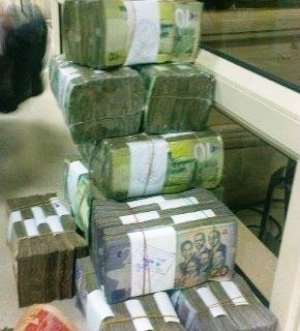
Further explaining their challenges, the association recounted that, the high volatility in the exchange rate in the past months has been of great concern to Industry. Cedi depreciation against the US Dollar at the close of June was about 36%. Within the first two weeks of July, the cedi sharply changed course, appreciating by 21% to the US dollar and has since remained unpredictable.
It said, with the fundamental structure of the economy basically unchanged and weakening terms of trade (lowering commodity prices, cocoa, gold and oil) there is a worry of a further weakening of the local currency in the medium term as the national debt mounts. Clearly, borrowing from the international markets to support a weakening currency without the corresponding increasing dollar revenues is not sustainable.
The captains of businesses are of the view that, this is the reason why every effort should be made to increase exports. The Association is therefore worried about the numerous declines of EDAIF credit applications by its members in the export sector. As a statutory fund, contributed by importers mainly from the Private Sector, AGI is calling for an assessment of the EDAIF fund to enable us have full appreciation of the fund’s support to industry and the export sector.
In ranking the key challenging conditions to business, issues of taxes ranked third among the major challenges businesses experienced in the Quarter 2 business barometer report.
At a time that businesses are reeling under the harsh economic conditions, a 17.5% special tax has been imposed on petroleum products. The situation is worsened by the fact that most businesses are compelled to operate on generators with already high fuel costs even before the introduction of the special tax.
Contrary to Private Sector’s anticipation of the withdrawal of the special levy of 2% on imports including raw materials, the last budget statement saw the extension of this levy to 2017, adding up to the cost of doing business in the country. In order to boost production, therefore, duties on imported raw materials for manufacturing should be zero rated, instead of the current 5% to 10% that applies to raw materials.
The report quoted that, the weakening currency has also had serious impact on our power situation even at a time when oil prices have dropped. Businesses are facing increased costs in fuel usage to run their operations despite a significant drop in oil prices, further making Ghanaian Industries uncompetitive and cost inefficient. On average, industries are paying six times the cost of grid electricity to run on generators and this is not sustainable.
Power supply outlook for the rest of the year looks bleak; with further drop in water level of the Akosombo dam (237.46ft as of August 3, 2015) coupled with the difficulty in sustaining LCO stocks. Any power supply plan for the months ahead should take into consideration the diminishing hydro mix in generation in order to mitigate the prolonged crisis. AGI reiterates its disapproval of electricity tariff structure where industry continues to subsidize residential power users. Efficient operations of the utility companies and effective collection of bills will save industry from rampant utility hikes.
 Site for Adaklu District 24-hour economy market handed over to contractor
 Govt to complete over 1,000MW power expansion in Kumasi — John Jinapor
 Amin Adam made co-chair of Buwumia's Finance and Economy Committee
 NPP appoints Akosua Manu as spokesperson for gender and social protection commit...
 GHS activates national surveillance following hantavirus outbreak on Cape Verde ...
 South Africa denies xenophobia claims as Ghana pushes AU action
 Kennedy Agyapong rejects co-chair appointment by Bawumia
 Police arrest six suspects over alleged child trafficking syndicate in Kasoa
 Former Deputy AG urges GJA to resist return to ‘Culture of Silence’
 Four killed in Savannah Region road crash involving tipper truck


