




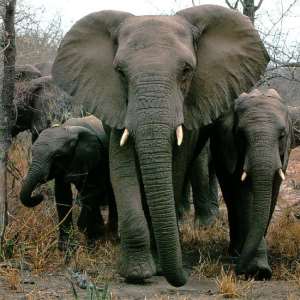
In March of this year, poachers in southwestern Chad killed as many as 86 elephants, including over 30 pregnant females and 15 calves. The killings took place in the Mayo-Kebbi Est region, located along the country's border with Cameroon. While the identity of those involved has not yet been determined, there is little dispute over what motivated their actions, ivory. The growing demands of the ivory trade are likely responsible for a series of elephant massacres that have recently taken place throughout Central Africa and the rest of the continent. In fact, just weeks before, 28 elephant carcasses were discovered in Cameroon's Nki and Lobeke National Parks and an additional 15 in the Central African Republic. Furthermore, roughly one year earlier, the world stood witness to one of the worst mass elephant killings in recent memory, in which 300 to 650 elephants were slaughtered by poachers using military grade weapons such as AK47s and rocket-propelled grenades (RPGs) in Cameroon's Bouba Ndjidah National Park.
Elephants once roamed across much of the African continent, ranging from the arid lands of North Africa to the tropical forests of the interior and the savannah plains of the south. The trading of ivory has had a similarly expansive history in Africa, extending back to prehistoric times. In ancient Egypt, ivory was highly prized by artisans who made use of the material in various religious and decorative items. Likewise, both the Greeks and later the Romans came to value African ivory as a luxury good and tradable commodity. Trade in ivory also proved to be a significant factor in the development of a number of Africa's indigenous empires; for instance, the Kingdom of Aksum grew both in wealth and influence largely through exporting ivory and other exotic goods to Europe and Asia. The increasing economic importance of ivory facilitated the development of a vast trade network, under which a number of African cities such as Timbuktu, Mombasa, and Zanzibar greatly prospered.
This being said, Africa's ivory trade was, historically, limited in terms of both scope and extent by a number of factors; perhaps the most overarching of these being the technological limitations of the period. Before the widespread proliferation of motorized vehicles and firearms in the 19th and 20th centuries, hunting an elephant was a dangerous and potentially lethal undertaking. The lack of infrastructure and an efficient means of transportation in much of Africa also made participation in the ivory trade economically infeasible for many communities of the continent's interior. Nevertheless, overexploitation of localized populations throughout Africa (along with other factors such as habitat loss) had already had a dramatic impact, resulting in the extinction of the North African or Atlas Elephant in the early historical period.
European colonization initially brought little change for Africa's elephants; by and large, the population remained relatively stable, standing at an estimated 26 million elephants in 1800. However, this quickly changed. Growing demand in the West for ivory products, as well as the popularization of big-game hunting, fueled an 'ivory frenzy' in the early 1900s. Ivory, commonly referred to as 'white gold', was seen as a luxury good and was incorporated into many consumer products such as: combs, brush handles, jewelry, piano keys, and billiard balls. In the United States alone, ivory consumption increased to nearly 200 tons per year by 1913. European and Asian markets were similarly voracious in their appetite for ivory products. In a little under two centuries, worldwide demand for ivory had decimated Africa's elephants; bring the population down to 1.3 million in 1979. Despite a decrease in Western demand in the latter part of the 20th century, the elephant population continued to decline and was reduced to a mere 600,000 by 1989.
The precipitous decline of Africa's elephants had not gone unnoticed and growing concern, on the part of the broader international community, eventually led to the adoption of a worldwide ban on ivory sales in 1989. The ban, to be administered by the Convention on International Trade in Endangered Species (CITES), was widely hailed as a major achievement by conservation and wildlife advocacy organizations the world over. In the first decade following the passage of the ivory trade ban, conservationists noted a slow, but steady recovery in the elephant population, to an estimated 1 million. However, the ban was not without its detractors. When the ban went into effect in 1990, a number of countries including Botswana, Malawi, Namibia, South Africa, Zambia, and Zimbabwe expressed formal 'reservations', contending that their elephant populations were of sufficient size to support commercial activity. In 1999, CITES authorized a one-time 'experimental sale', in which Botswana, Namibia, and Zimbabwe sold 55 tons of ivory to Japan. CITES sanctioned a similar sale of ivory in 2008, after approving China's request to purchase ivory; Botswana, Namibia, South Africa, and Zimbabwe sold more than 115 tons of ivory to China and Japan.
Today the ivory trade is experiencing a period of unprecedented growth, fueled largely by increased Asian demand. China, which accounts for more than 50% of world ivory consumption, has emerged as the largest market for the transportation and sale of ivory (both legal and illegal). Between 1989 and 2011, customs agents in China seized nearly 45.3 tons of illegal ivory (representing approximately 4,077 elephants). This number likely only represents a fraction of the actual amount of ivory entering the country illegally. As China's economy has grown, so to has the market for ivory products. Much of this demand originates from the country's growing middle class. For many, ivory holds a material as well as symbolic value. It is not coincidental that many of the ivory products produced in China have some religious, mythological, or cultural connotation.
However, China is not alone. Numerous other Asian nations such as Thailand, Vietnam, the Philippines, Japan, and Malaysia have large and growing illegal ivory markets. In 2009, Filipino authorities seized roughly 5.4 tons of illegal ivory in Manila alone. Additionally, large black markets for ivory products still remain active in Europe and North America.
Furthermore, there is a growing body of evidence indicating that the illegal ivory trade may constitute a threat to international security. With ivory prices reaching record-highs, poaching is increasingly being seen by a number of criminal and terrorist organizations as a viable alternative for financing their activities. For instance, reports indicate that the Lord's Resistance Army (LRA) has been sustaining itself through the poaching of elephant populations in the Democratic Republic of the Congo. Exploiting porous borders in the region, the LRA can easily transport the ivory to the Central African Republic, where it is sold for weapons, ammunition, and other supplies. Other militia groups, such as the Sudanese Janjaweed, are also likely involved in this trade. Similar evidence supports claims by Kenyan officials that the Somali-based terrorist organization, al-Shabaab, is financing its operations, at least in part, through the illegal sale of ivory.
The future for Africa's elephants is uncertain; from an estimated 26 million in 1800 to fewer than 1 million today, elephants continue to face numerous threats including poaching and habitat loss. However, there are signs indicating that the international community recognizes the challenge of elephant conservation and is willing to act. In March 2013, Thailand's prime minister announced plans to end the nation's domestic ivory trade. More recently, the Philippines publicly burned nearly 5 tons of accumulated ivory, demonstrating the country's commitment to fighting the illegal ivory trade. Capitalizing on the surge in eco-tourism, a number of African nations (notably Kenya and Tanzania) have established effective conservation measures and are increasingly cracking down on illegal ivory trade networks. Encouraging as these actions are, widespread poaching and lax regulations throughout the African continent mean that elephant populations as a whole will likely continue to decline. And ultimately, this is where the fate of Africa's elephants will be decided, in Africa, with its people and its policymakers.


 Amenfi Central MP Joana Gyan Cudjoe ends relationship with KECHE
 GSA emerges top performer as 2025 surplus surges from GH¢69.52 million to GH¢258...
 Govt to develop 150-acre air cargo hub at Tamale Airport - Goosie Tanoh
 '10 security recruits dismissed for hiding phones in pillows, making night calls...
 Gold Coast customers to March to Jubilee House over locked-up investments
 Education Ministry reschedules release of 2026/27 SHS placements to September 4
 Ghana to host high-level UN General Assembly side event to advance reparations a...
 Upper East: NPP demands immediate payment of teachers’ promotion arrears
 NPA cracks whip on Sentuo Oil Refinery; Raii, AXSOR deal under regulatory spotli...
 Boako defends Bawumia’s claim on $80m monthly FX intervention cap

