




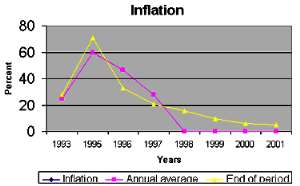
Inflation rate reduced from 29.6 per cent in June to 27.7 per cent in August this year, the Bank of Ghana (BoG) has announced.
This was largely due to appreciable domestic revenue mobilisation as against prudent fiscal policy measures which had resulted in considerable improvement in the key macroeconomic indicators.
Consequently, the BoG has reduced the prime rate from 26 per cent to 24 per cent. This reduction has the potential of reducing the rate at which commercial banks lend to the public.
Addressing newsmen in Accra yesterday, the Governor of the bank, Dr Paul Acquah, said the average monthly increases in the inflation index had diminished steadily, since the spike in February, this year, and that this was indicative that disinflationary measures had started yielding the desired results.
The governor explained that there was a reduction in public sector borrowing, which meant that there were available financial resources for lending to the private sector, saying government revenue was higher than projected and expenditure was kept within budgeted levels.
Dr Acquah quoted provisional figures for government receipts for September as ¢13,014 billion, an increase of 71 per cent above the 2002 levels, while expenditure was ¢12,381 billion, about 40 per cent above the level in 2002.
Gross international reserves had increased from $880 million in July this year to $1 billion by the end of last month. This development, which is the highest in decades, represented about 3.4 months of import cover, the governor stated.
Dr Acquah explained that this feat had been possible due to favourable terms of trade, savings from the Heavily Indebted Poor Countries (HIPC) initiative and the firm implementation of the fiscal and monetary framework.
He said net domestic financing of the budget at the end of September, this year was ¢493 billion compared with a budgeted deficit of ¢122. “This indicates that public sector operations have begun to release resources to be channelled into the private sector,” the governor explained.
He said although interest rates on both the money and interbank markets declined, “commercial bank lending rates have lagged, remaining broadly unchanged”.
Governor Acquah further announced that foreign remittances into the country, covering transfers by NGOs, religious groups, embassies and individuals through the deposit money banks and finance companies, amounted to about $1.4 billion as of August, this year. This was 56 per cent increase over the level recorded over the same period last year.
Dr Acquah described the economic outlook as favourable against the background of increases in cocoa exports and increases in private sector remittances.
The governor indicated, however, that the inflation outlook would be informed by risks such as world oil prices and exchange rates of major international currencies.
That notwithstanding, the governor pointed out that the short and medium term inflationary trend would also be driven by the sustained implementation of the fiscal and monetary framework as well as efforts to bolster productivity and growth.
 Site for Adaklu District 24-hour economy market handed over to contractor
 Govt to complete over 1,000MW power expansion in Kumasi — John Jinapor
 Amin Adam made co-chair of Buwumia's Finance and Economy Committee
 NPP appoints Akosua Manu as spokesperson for gender and social protection commit...
 GHS activates national surveillance following hantavirus outbreak on Cape Verde ...
 South Africa denies xenophobia claims as Ghana pushes AU action
 Kennedy Agyapong rejects co-chair appointment by Bawumia
 Police arrest six suspects over alleged child trafficking syndicate in Kasoa
 Former Deputy AG urges GJA to resist return to ‘Culture of Silence’
 Four killed in Savannah Region road crash involving tipper truck


