




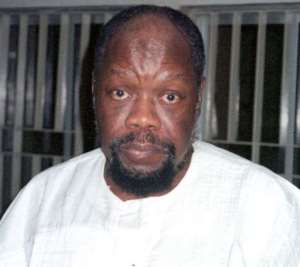
LAGOS (AFP) - The secessionist leader during Nigeria's civil war in the late 1960s and a pivotal figure in the country's history, Chukwuemeka Odumegwu Ojukwu, has died aged 78, the presidency announced on Saturday.
Ojukwu would be "remembered forever as one of the great personalities of his time who stood out easily as a brave, courageous, fearless, erudite and charismatic leader", a statement said.
The former leader died in Britain although no cause of death was given. Local media reported it had occurred overnight. He had been ill and receiving treatment overseas for a number of months.
The Oxford-educated Ojukwu, who had been an army lieutenant colonel, led the campaign for an independent state of Biafra in eastern Nigeria in the 1960s that included a two-and-a-half year civil war from 1967-1970 which left more than a million dead.
He remains a revered figure in eastern Nigeria, where the Igbo people dominate. Ojukwu's 1967 declaration of independence for Biafra came largely in response to the killing of large numbers of Igbos in the country's north.
Control of the country's vast oil resources also played an important role in the war. Many of those killed died from starvation and disease, with a blockade having led to food shortages.
Ojukwu went into exile after the Biafrans surrendered in 1970 and only returned more than a decade later.
"The war was a tragedy, but it was inevitable, unavoidable," he said in an interview in the book "My Nigeria: Five Decades of Independence" by AFP journalist Peter Cunliffe-Jones.
Ojukwu was the son of a multimillionaire who received a private school education in England and rose through the ranks of the Nigerian military.
He was made military governor for eastern Nigeria in 1966 in the midst of events that led to the civil war.
A coup bid by Igbo soldiers in 1966 that eventually failed set the events in motion in the country, which had gained independence from Britain only six years earlier.
The coup had ousted and killed prime minister Abubakar Tafawa Balewa, who was from the mainly Muslim north.
Though the coup was unsuccessful, the military government that took charge was also led by an Igbo, Major General Johnson Aguiyi-Ironsi, further feeding anger in the north.
Widespread killings of Igbos were carried out in the north, causing the Igbo population to flee and return to the east. A northern counter-coup occurred in July 1966, with Ironsi killed.
Ethnic divisions in Nigeria, roughly divided between a mainly Muslim north and predominately Christian south, came strongly into focus, with Hausas dominating the north, Yorubas in the southwest and Igbos in the east.
Talks aimed at holding the country together took place, but the situation began to spiral out of control, with Igbos alleging genocide. Ojukwu declared the independence of the Republic of Biafra in May 1967.
The name Biafra was taken from the Bight of Biafra, the bay off of Nigeria's coast. Britain would support the Nigerian government, while France would back the Biafrans.
The Biafrans managed to gain significant territory despite being overmatched, but the Nigerian military fought back and eventually proved too much.
It turned into a brutal conflict -- on both sides -- and television images of starving children in the east remain seared into the minds of many.
Ojukwu was pardoned in 1982 and found his way back to the country's east.
He ran for president in 2003 elections, but finished far behind the winner, Olusegun Obasanjo, who had also played a key role in the civil war as a Nigerian military officer, including accepting the Biafran surrender.
Ojukwu also ran unsuccessfully in 2007 presidential elections.
Asked whether the war should have ended two years earlier than it had, Ojukwu had said "no, of course not."
"How many people in world history, in Western civilisation, have surrendered just because they were hungry?" he said in the interview in "My Nigeria." "You fight on as long as you can. We fought proudly for as long as we could."
He added that "it was clear from the massacres we faced genocide."
 Massive reactions as woman allegedly snatches her daughter’s boyfriend
 Chinese factory gutted by fire in Prampram
 2026 May Day: I will let the economic growth filter down to your pockets – Maha...
 Police kill 2, arrest 4 in Upper East robbery gang bust
 China opens tariff-free trade to nearly all African countries
 UG, KNUST and UCC lecturers to withdraw services over unpaid promotion arrears
 "24-hour economy markets will transform the economy" — Hon Jerry Ameko
 Mahama begins Eastern Region tour with May Day address and key projects
 Free Zones boss alleges political sabotage in Akosombo sub-station fire
 Akosombo substation fire an opportunity to modernise power infrastructure — Maha...


