




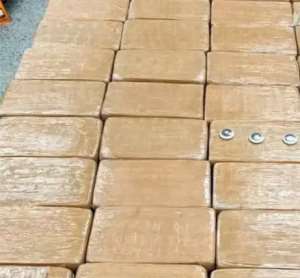
There is a disturbing pattern emerging from a succession of cocaine trafficking incidents connected to Ghana. From large consignments intercepted at the country's ports to shipments traced to Ghana and seized in Europe and the Middle East, the incidents are raising an uncomfortable question: Is Ghana becoming an increasingly attractive transit point for international drug trafficking networks?
The latest development, the arrest of a Syrian national at Beirut's Rafic Hariri International Airport on October 31, 2026, after arriving from Accra with approximately 46.7 kilogrammes of cocaine, should give Ghana's security authorities considerable cause for concern.
Lebanese authorities described the seizure as the largest cocaine interception in the history of Beirut airport. The drugs were reportedly concealed in 40 packages using sophisticated packaging and insulation materials. Electronic tracking devices were also discovered.
More significantly, the operation involved cooperation between Ghanaian and Lebanese drug enforcement authorities. NACOC has confirmed that it is pursuing suspected accomplices in Ghana.
This is not an isolated incident.
A Disturbing Trail Of Incidents
On August 5, 2026, Ghanaian police intercepted 866 parcels of suspected cocaine concealed in sacks of gari at a warehouse within the Tema Harbour enclave. The consignment, estimated to have a street value of US$6.928 million, was reportedly being loaded into a 40-foot container for export. Three suspects, including a Dutch national, were arrested.
The attempt to conceal suspected cocaine in a familiar Ghanaian food commodity demonstrated the lengths to which trafficking networks could go to disguise illicit consignments within legitimate commercial activity
In September, another incident brought domestic distribution networks into focus. Police intercepted a driver's mate at the ESP Bus Station in Wa with 192 compressed wraps of cocaine. The consignment was reportedly being transported from Kumasi through the Bole enclave. A second suspect was subsequently arrested.
But perhaps the most consequential international development was the seizure of nearly four tonnes of cocaine at the Port of Dunkirk in France. The cocaine, estimated to be worth approximately €225 million, was concealed in a 40-foot container declared as carrying plastic waste from Ghana.
The seizure triggered investigations in Ghana, resulting in arrests and court proceedings involving four accused persons. The investigation has also generated allegations of links to Dutch fugitive, Jos Leijdekkers, popularly known as Bolle Jos. These allegations remain subject to judicial determination.
Taken together, the incidents raise serious questions about the possible exploitation of Ghana's ports, airports, commercial infrastructure and domestic transport networks by international drug trafficking organisations.
Ghana's international reputation is at stake
Perhaps the most worrying consequence is the potential damage to Ghana's international reputation. For decades, Ghana has worked to establish itself as a stable democracy and a reliable destination for international business, investment and tourism.
Our ports, airports and commercial infrastructure are important assets in our ambition to become a regional trade and logistics hub. But that ambition could be undermined if international law enforcement agencies increasingly associate Ghana with the movement of large cocaine consignments.
The warning signs are already being articulated publicly. Following the Dunkirk seizure, concerns were raised by political figures, lawyers and civil society organisations about the possibility of Ghana acquiring an international reputation as a cocaine trafficking corridor.
The implications could extend beyond drug enforcement. Legitimate Ghanaian exporters could face increased scrutiny, more intrusive inspections, delays and higher shipping costs. Airlines, logistics companies and international commercial partners could become more cautious in their dealings with Ghana.
Ghanaian travellers could also face additional questioning and scrutiny. These consequences are not inevitable, but they are risks that must be taken seriously. We cannot allow the criminal activities of a few individuals and organised networks to compromise the reputation and economic interests of an entire country.
What must the authorities do?
The response must go beyond issuing statements after every successful drug interception. Ghana needs a coordinated national investigation involving NACOC, the Police Service, National Security, Customs, the Ghana Airports Company and other relevant institutions
Authorities must establish whether these incidents are isolated operations or evidence of interconnected trafficking networks. The security of Tema Port and other major entry and exit points must be independently reviewed. Any official found to have facilitated drug trafficking must face the full consequences of the law.
Ghana must also deepen intelligence-sharing and operational cooperation with international partners, particularly France, the Netherlands and Lebanon.
Crucially, investigations must go beyond couriers and intermediaries. Authorities must identify the financiers, organisers, beneficiaries and networks behind these operations. The money must be followed, illicit assets traced and criminal proceeds recovered in accordance with the law.
The government must also demonstrate to international trading partners, airlines and diplomatic partners that Ghana is confronting the problem with seriousness, transparency and measurable results.
A national response cannot be delayed
This must not become a partisan political contest. It is a national security, economic and reputational issue that requires cooperation across political parties, public institutions, civil society and the private sector.
The Beirut arrest should be a wake-up call. The Tema seizure should have been a wake-up call. The Dunkirk discovery should certainly have been one. How many more such incidents must occur before Ghana treats this as an urgent national priority?
Ghana has too much at stake to allow its international reputation to be compromised by organised criminal networks. Our ports and airports must remain gateways for legitimate commerce, not convenient channels for international drug traffickers
Our ambition to become a major regional centre for trade, aviation, logistics and investment cannot comfortably coexist with a growing international perception that the country is vulnerable to cocaine trafficking.
The authorities must act decisively, investigate thoroughly and prosecute where the evidence supports prosecution.
Ghana must not become known internationally for cocaine when it should be known for its democracy, hospitality, entrepreneurial spirit, culture and economic potential.
The time to protect that reputation is now.
By Kobina Welsing

 NDC's parliamentary seats projected to drop to 154 as NPP rises to 100 in 2028 f...
 NPP to pursue Ablakwa’s removal through Parliament – Jinapor
 I will name and shame anyone who obstructs passage of anti-LGBTQI+ bill – Speake...
 Mahama's government is doing way better than NPP's administration 8 years – Fifi...
 Two bail applications fail as Asante Akyem North MP remains in Dutch custody – D...
 Government imposes 11-hour curfew on Hamile and surrounding communities
 ‘It was a free port under Akufo-Addo; the drugs were coming in’ – Larry Dogbey
 Mahama is displaying weak leadership, pampering corruption and illicit drugs – N...
 Ablakwa is running from accountability despite being an apostle of it in opposit...
 VALCO introduces 1:4:4 shift system to drive 24-hour operations, expand workforc...


