




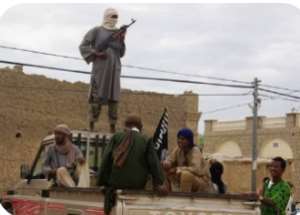
For years, the dominant image of Sahelian terrorism has been one of foreign-armed q roaming the desert in pickup trucks, their weapons flowing in from Libyan arsenals, Middle Eastern patrons or shadowy international networks. It is a compelling story. It is also, according to the most rigorous field investigation yet conducted on the subject, largely wrong.
What eight years of weapons tracing actually found
Conflict Armament Research spent eight years investigating arms flows into Mali, Burkina Faso, Niger and the Lake Chad Basin, examining more thyan 700 weapons recovered between 2015 and 2023. The conclusion overturns much of the conventional narrative: jihadist groups affiliated with al-Qaeda and the Islamic State do not rely on exceptional international supply chains. Instead, at least a fifth of the weapons documented were traced directly to the stockpiles of national armies, seized in attacks on military posts or abandoned during retreats.
Roughly four-fifths of recovered weapons were assault rifles and support weapons manufactured decades ago, chiefly in China, the former Soviet bloc and Eastern Europe not a recent, foreign-driven rearmament. Even the long-assumed Libyan connection, weapons looted from Muammar Gaddafi's collapsed arsenals after 2011, turns out to account for only a modest share of what investigators found on the ground.
The pattern that emerges is one of opportunistic predation rather than sophisticated logistics: attack a post quickly, seize its weapons and vehicles, collect its ammunition, and withdraw before reinforcements arrive. Propaganda videos released after such raids methodically display the spoils, serving a double purpose re-equipping fighters while broadcasting that the state can no longer protect its own forces.
A strategy borrowed from Mao, applied to the Sahel
The deeper explanation for jihadist resilience lies less in weaponry than in method. The approach mirrors the classical guerrilla doctrine articulated by Mao Zedong nearly a century ago: rather than confronting a state army directly, a movement first weakens the state gradually, wins the population's acquiescence if not its loyalty, and only then expands territorial control toward more ambitious objectives.
Groups affiliated with JNIM and the Islamic State in the Sahel have followed a recognizable version of this playbook quiet establishment in a remote area, propaganda and intimidation of officials, construction of a defensible safe haven, control of roads and markets, isolation of small towns, repeated pressure on military outposts, and finally the gradual displacement of local administration. The objective was never a rapid march on Bamako, Ouagadougou or Niamey. It is to make the state functionally absent across vast stretches of territory, exploiting the same porous borders, difficult terrain and thin troop deployments that also constrain coastal states like Ghana along their own northern frontiers.
Governing, not merely terrorising
Mao's dictum that a guerrilla must move among the people "like a fish in water" captures the second pillar of this strategy: no insurgency survives long-term on coercion alone. In parts of central Mali's Mopti and Macina regions, JNIM has established Islamic courts that adjudicate land disputes, inheritance and theft. In Ménaka and Liptako-Gourma, armed group’s position themselves as guarantors of order, suppressing banditry and enforcing their own religious police. Weekly markets in northern Burkina Faso continue operating under jihadist taxation, while these groups also mediate herder-farmer disputes over grazing access and crop damage, and in their most entrenched strongholds go as far as regulating road traffic, tolls and livestock trade. None of this reflects genuine popular support residents largely live under coercion but where the state offers nothing, accommodation with an armed group that offers predictable order becomes, for many, the least bad option.
A war that pays for itself
This territorial embedding funds itself. Cattle theft alone has generated hundreds of millions of CFA francs in profit within a single year, according to the source material reviewed for this column. Market taxation, tolls on commercial convoys, levies on artisanal gold mining, and smuggling of fuel, cigarettes and medicine round out a war economy that researcher’s estimate generates tens of millions of dollars annually across the central Sahel sufficient, analysts note, to pay fighters, buy fuel and sustain informant networks without meaningful reliance on outside patrons.
Why this matters beyond the Sahel's borders
The implication for Ghana and its coastal neighbors is direct. If jihadist power in the Sahel were primarily a function of foreign arms and financing, interdiction and sanctions might blunt it. But a movement that arms itself from captured state stockpiles and finances itself through local taxation is far harder to strangle from outside it must instead be denied the specific governance vacuums it exploits.
As JNIM's networks push toward Ghana's northern approaches, the lesson from Mali, Burkina Faso and Niger is that the decisive terrain is not the battlefield alone, but whether the state maintains a credible, continuous presence in markets, roads and rural administration before an alternative authority moves in to fill the gap.
Mustapha Bature Sallama.
Medical/ Science Communicator,
Private Investigator, Criminal investigation and Intelligence Analysis.
International Conflict Management and Peace Building.USIP
[email protected]
+233-555-275-880
References
Conflict Armament Research, "Les salafistes-djihadistes dans le Sahel central," https://www.conflictarm.com/perspectives/les-salafistes-djihadistes-dans-le-sahel-central-numero-002/
Africa Center for Strategic Studies, "Comment les groupes extrémistes violents exploitent les conflits intercommunautaires au Sahel," https://africacenter.org/fr/spotlight/comment-les-groupes-extremistes-violents-exploitent-les-conflits-intercommunautaires-au-sahel/
Institut Montaigne, "La difficile montée en puissance des armées sahéliennes," https://www.institutmontaigne.org/expressions/la-difficile-montee-en-puissance-des-armees-saheliennes
UN News, June 2026, https://news.un.org/fr/story/2026/06/1158930
Mao Zedong, "On Guerrilla Warfare," Marxists Internet Archive, https://www.marxists.org/reference/archive/mao/works/1937/guerrilla-warfare/
BBC Afrique, "Comment comprendre l'expansion des groupes armés au Sahel," https://www.bbc.com/afrique/articles/c9vg9v3dwr0o
ACLED, "Jama'at Nusrat al-Islam wal-Muslimin (JNIM)," https://acleddata.com/report/jamaat-nusrat-al-islam-wal-muslimin-jnim
International Crisis Group, https://www.crisisgroup.org/


 Court refuses bail for six accused in 3.9-tonne cocaine shipment case
 Philippines to open first-ever embassy in Ghana
 1992 Constitution review: Prof. Atsu Ayee and Dr Osae-Kwapong explain why Consti...
 Bawumia calls for paradigm shift in Ghana’s healthcare policies after meeting GM...
 POWA calls for end to gendered attacks on Lordina Mahama and Samira Bawumia
 This is the best time to develop Volta Region — James Gunu
 “I’m not only contesting for the position, but for the work that defines it” – A...
 DRIP road works stall in Bekwai over fuel shortage as MP intervenes with GH¢30,0...
 “If you can hire people to insult, malign others for your gain, then you must be...
 Iran says it expects US response Tuesday on plan to reopen Strait of Hormuz


