




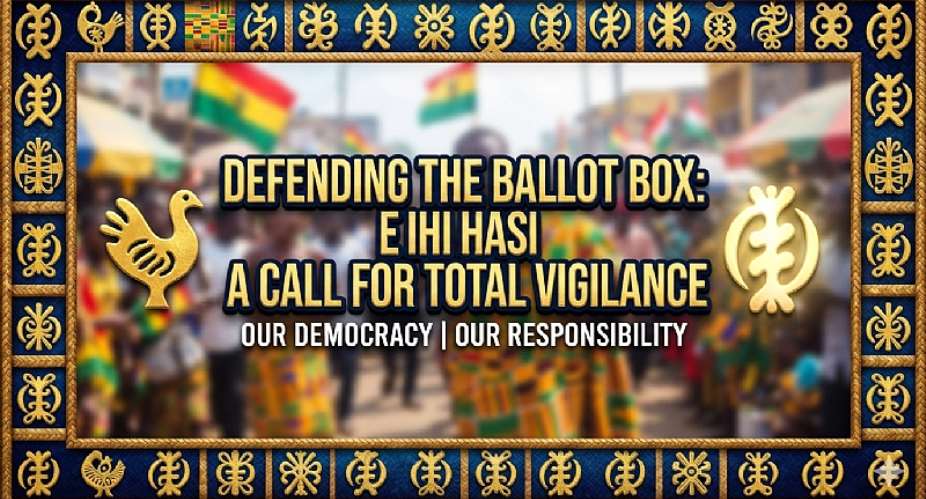
The true metric of a resilient democracy does not lie merely in the peaceful holding of regular elections, but in the absolute, unyielding integrity of the processes that govern them. Recent developments within domestic political spheres have reignited a critical national conversation regarding ballot security and operational vigilance. The high-profile arrest of media figure Okatakyie Afrifa-Mensah during internal executive polls in the Afigya Sekyere East Constituency, alongside lingering public anxiety over unauthorized ballot papers discovered in past primaries like those in Aburaso, has brought a stark reality to the forefront. If internal party processes can be fraught with such deep friction, legal injunction challenges, and physical altercations, the oversight required for national general elections must be elevated to an airtight standard. To guarantee that the will of the Ghanaian electorate remains untampered with, stakeholders must look toward robust institutional tracking mechanisms and the legacy of rigorous monitoring frameworks established by prominent electoral strategists.
Unpacking Internal Poll Vulnerabilities
The disturbances witnessed during localized party primaries offer vital diagnostic data for the broader national electoral architecture. While internal elections are organized under party-specific guidelines rather than direct Electoral Commission management, they expose behavior patterns that demand proactive counter-strategies.
- Procedural Obstruction and Defiance: The outbreak of violence following attempts to serve legal injunctions demonstrates a critical lack of dispute-resolution compliance at the grassroots level, necessitating clearer security protocols.
- Proximity of Unauthorized Materials: Incidents involving unverified or pre-thumbprinted ballot papers in localized environments underscore the persistent risk of logistical leakage when printing and distribution channels lack multi-layered supervision.
- Grassroots Tension Amplification: High stakes in regional and constituency executive positions create hyper-localized friction points that easily escalate into physical confrontations if security deployment is inadequate or reactive rather than preventative.
The Legacy of Vigilance: Implementing Proven Monitoring Frameworks
To systematically counter these administrative vulnerabilities, Ghana’s political landscape has historically relied on cutting-edge tracking strategies. In recent major cycles, comprehensive election security blueprints—such as those introduced by the late Dr. Edward Kofi Omane Boamah during his tenure as Director of Elections and IT—demonstrated how structured surveillance can effectively isolate and expose irregularities.
- Parallel Data Tracking Matrices: Implementing real-time, decentralized digital result-transmission networks that run concurrently with official collation lines, ensuring any discrepancy in numbers is immediately flagged.
- Pre-Polling Serial Number Auditing: Mandating that polling agents physically inspect, record, and verify the serial numbers and validation stamps of every ballot booklet before the first vote is cast.
- Rapid Incident Digital Reporting: Deploying encrypted communication channels for field agents to instantly upload geo-tagged photographic and video evidence of malfeasance directly to central command centers.
- Independent Barcode and Watermark Verification: Training grassroots monitors to recognize covert security features built into authentic ballot materials, allowing fake or self-printed ballots to be instantly identified at the table.
A Call to Action for Grassroots Mobilization
In light of these emerging threats, the leadership of the National Democratic Congress (NDC) must remain relentless and unyielding in reinforcing their grassroots training mechanisms. Protecting the sanctity of the vote requires more than high-level strategy; it demands that every single agent deployed to a polling station is deeply literate in the technicalities of ballot counting, sorting, and the accurate declaration of results. The party must intensify its nationwide workshops to equip its base with the operational resilience needed to defend the ballot box under any circumstances. Vigilance must remain the defining principle—an active, systematic defense where nothing is left to chance, ensuring that the tracking models pioneered by past leadership are executed flawlessly at the polling station floor.
Recommendations for Modernizing Ghana's Electoral Oversight
Moving forward, translating the lessons of internal party structural failures into solid national security measures requires a series of systemic updates. Modern Ghana requires an approach that removes ambiguity and leaves no room for operational manipulation.
- Standardization of Internal Election Printing: Political parties must legally bind their internal elections to strict security printing requirements overseen by independent auditors to eliminate the existence of unauthorized ballot duplicates.
- Stricter Legal Sanctions for Polling Disruptions: Individuals found guilty of introducing unauthorized materials, destroying voting property, or violently obstructing poll officials must face immediate criminal prosecution, independent of party affiliation.
- Comprehensive Multi-Party Liaison Audits: Expanding the collaborative oversight of the Inter-Party Advisory Committee (IPAC) to include unannounced spot-checks of regional storage depots and printing houses.
- Institutionalized Training for Grassroots Agents: Standardizing technical training manuals across all political lines, ensuring every polling assistant is literate in tracking data flows and detecting material tampering.
The sovereign right of the Ghanaian citizen to choose their leadership is a sacred asset that cannot be bartered away through logistical loopholes or partisan overreach. The recent disruptions in internal primaries do not merely serve as partisan ammunition; they act as a profound warning system for the entire republic. By internalizing the high-utility, technology-driven monitoring systems popularized by dedicated strategists, Ghana can build an electoral fortress that effectively neutralizes malfeasance. True democratic transparency is achieved when systems are made so resilient that any attempt to subvert the ballot box is instantly exposed to the light of public scrutiny.
✍️ Retired Senior Citizen
For and on behalf of all Senior Citizens of the Republic of Ghana 🇬🇭
Teshie-Nungua
[email protected]


 NAM1 files witness statements in Menzgold trial, seeks to rely on seven defence ...
 Miracles Aboagye’s wife raises health concerns over husband's detention by EOCO
 GH¢55m investigation: Miracles Aboagye was placed on stop order a week before ai...
 Government mourns Yaa Naa Abukari Mahama II
 Clean-up exercise: 'You can't demean, intimidate our member' — GAB condemns Ther...
 Ghana reaches final stage of external debt restructuring after SADEREA notes exc...
 'He has serious questions to answer' – MP reveals why Miracles Aboaye was arrest...
 'He refused invitation' – Akwatia MP sheds light on Miracles Aboagye arrest
 Current NDC govt Ghana’s most intolerant govt with no respect for anybody – Sala...
 Afia Korankyewaa says NPP has collapsed, calls it Ghana’s current biggest proble...

