




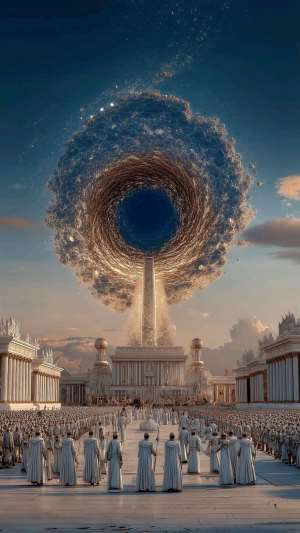
There is a war happening above our heads right now, and most Ghanaians have never looked up long enough to notice it.
No missiles are firing. No armies are marching through our streets. But nations are racing, corporations are colonising, and the very sky that our ancestors once read for rain and season is being quietly fenced off, satellite by satellite, by powers who never once asked our permission. This is not science fiction. This is not a Hollywood plot borrowed from Close Encounters or Gravity. This is documented fact, confirmed in stark and sobering detail by the world's most trusted astrophysicist, Neil deGrasse Tyson, Director of the Hayden Planetarium in New York City, in a conversation that every serious African reader deserves to sit with, slowly, and without distraction.
Let me give it to you straight, the way I always do: with fact, with fire, and with a Ghanaian eye fixed firmly on the horizon.
THE NUMBERS SHOULD FRIGHTEN YOU
In 2025 alone, roughly five thousand new objects were launched into Earth's orbit. That is not a typo, and it is not exaggeration for dramatic effect. Five thousand pieces of metal, in a single calendar year, joining the tens of thousands already circling us at seventeen thousand miles per hour, a velocity so violent that even a fleck of paint travelling at that speed carries the destructive force of a fired rifle bullet. SpaceX's Starlink constellation alone has already surpassed ten thousand active satellites, and by credible current projections, humanity is hurtling toward one hundred thousand active satellites in orbit by the year 2040. That is not some distant, unimaginable future. That is well within the lifetime of many of us reading this column today, and certainly within the lifetime of our children.
Why should this matter to a market woman balancing her wares in Kumasi, or a fisherman casting his net at dawn in Elmina, or a final-year student pulling an all-nighter at Accra Technical University? Because these satellites have quietly become the invisible skeleton beneath everything we now call modern life. There is no mobile money transfer without satellite-assisted positioning. There is no Bolt or Uber ride summoned to your gate without GPS threading silently through space. There is no internet reaching our remote northern communities, where ECG's grid barely stretches and dumsor still dims our evenings, without the very Starlink constellation now crowding our skies. The blessing and the danger, my dear reader, wear the very same face.
Tyson puts it with the precision of a man who has spent a lifetime staring into the dark: the value is never really in the satellites themselves. The value lies in the economies they quietly enable. There is no Uber without GPS. There is no modern military reconnaissance, no modern commerce, no modern communication, without this dense metallic canopy we have built above our own heads in barely two generations.
KESSLER SYNDROME: THE WARNING GHANA HAS NEVER BEEN TAUGHT
In 1978, a physicist named Donald Kessler made a calculation that ought to be taught in every physics lecture hall from Accra to Kumasi, from Tamale to Cape Coast. He warned that there exists a threshold, a tipping point, beyond which the destruction of even a single satellite could trigger a runaway chain reaction. One satellite is struck and breaks into ten pieces. Each of those ten pieces, travelling at orbital speed, can shatter ten more satellites into a hundred fragments. Within just a few orbits, cascading collisions could render entire bands of near-Earth space unusable, not for a season, not for a decade, but potentially for generations to come.
This is not paranoia dressed up as prophecy. Four nations, the United States, China, Russia, and India, have already demonstrated, through direct action, the capacity to destroy satellites deliberately, including satellites belonging to themselves. Tyson makes a chilling observation worth repeating slowly, twice, so it settles properly in the mind: if a nation can destroy its own satellite, it has proven, unmistakably and without ambiguity, that it can destroy anyone else's. That is not a defence posture. That is a loaded weapon pointed permanently at the shared commons of all humanity, and Africa, as usual, has been granted no seat at the table where decisions about triggering it are made.
We have watched this pattern before. We watched it with the carving up of our continent in Berlin in 1885, when African chiefs were not present in the room where their kingdoms were divided by ruler and pencil. We must not now sleepwalk into a second carving, this time not of our land, but of the sky directly above it.
WHO OWNS THE MOON? CERTAINLY NOT US.
Here is where I must be blunt with my elite readers, the policymakers, the diplomats, the young engineers emerging from our polytechnics and universities: space law today is, in Tyson's own candid words, "the Wild West." There exists no settled, universally binding international framework governing who owns lunar territory, who may legally mine an asteroid's minerals, or who ultimately controls the resources believed to lie beneath the Moon's South Pole, where scientists now suspect substantial deposits of water ice are hidden. The prevailing logic, uncomfortable though it is to admit, appears to be simple and brutal: whoever arrives first, claims first.
America's Artemis programme, named for the twin sister of Apollo in Greek mythology, a fitting choice for a mission meant to return humanity to the Moon's ancient face, was not conceived from pure scientific curiosity alone. Tyson is refreshingly honest about this, more honest than most politicians would dare to be: the programme was reignited specifically because China announced its own lunar ambitions, its "taikonauts" set to walk where, for half a century, only American boots had ever trodden. This is geopolitical ego wearing the borrowed costume of scientific exploration, precisely as the original Space Race of the 1960s was Cold War rivalry dressed in the language of discovery. Sputnik's launch by the Soviet Union in 1957 birthed NASA within a single year. History, as our elders remind us in proverb after proverb, has a habit of repeating itself in new agbada.
Consider this too, and consider it carefully: China's landing on the far side of the Moon, a feat no other nation has yet achieved, has already triggered congressional hearings in Washington asking pointed questions about what secrets that lunar hemisphere might hold. Resources are being surveyed. In-situ resource utilisation programmes, technology designed to extract usable material directly from the lunar surface itself, are already well underway at NASA. Water at the South Pole. Silicates that could theoretically be 3D-printed into tools and infrastructure. This is no longer speculative fiction confined to paperback novels. This is active, funded, deliberate planning for permanent human presence, and eventually, permanent human commerce, beyond our own planet's atmosphere.
A STEEL-MAN FOR THE SKEPTICS
Now, in fairness, let me steel-man the counterargument, because a columnist who only preaches comfortably to his own choir is not worth the ink spent printing him. Defenders of this satellite explosion will rightly point out that Starlink has delivered genuine, undeniable miracles: high-speed internet reaching the edges of the Sahara, the frozen expanse of the Arctic, and yes, our own underserved rural communities where fibre cable has never once been laid. For the herdsman in the Upper East or the trader navigating Bawku's dusty roads, a small satellite dish may be the only reliable bridge he will ever have to the modern global economy. These benefits are real. They are immediate. They are measurable in improved livelihoods, not merely theoretical papers.
Furthermore, sceptics of my alarm will note that space remains, for now, mostly empty. A destroyed satellite in a genuinely sparse orbital region will scatter harmlessly, its fragments either burning up on re-entry or drifting indefinitely without consequence. Tyson himself concedes we have not yet crossed Kessler's dreaded threshold. Perhaps, they will argue, this is premature panic over a problem still safely decades away.
But blessings and hazards, my dear reader, frequently share the very same orbit, and prudence has never once been the enemy of progress. The same congestion that connects the previously unconnected also threatens the astronomers tracking asteroids that could one day strike our planet with civilisation-ending force, their telescope images now cluttered with what scientists call "visual noise," bright streaks of satellite light contaminating the very data meant to give humanity advance warning. We are, quite literally, blinding our own early-warning system in the very act of connecting our villages.
WOULD WE EVEN RECOGNISE OUR VISITORS?
Tyson's broader case for extraterrestrial life rests on pure, humbling mathematics rather than mysticism: billions of galaxies, each cradling billions of stars, an untold number hosting planets of their own. To assume Earth is the sole address of intelligence in such staggering, almost incomprehensible vastness would be, in his own words, arrogance of the highest order. And yet he remains admirably disciplined about the evidence at hand, dismissing the great bulk of released UFO footage as inconclusive, low-resolution, and readily explainable by conventional atmospheric or optical phenomena, while conceding that a genuine handful of sightings, the now-famous "Tic Tac" encounter chief among them, continue to resist easy, tidy explanation.
What fascinates the astrophysicist most, however, is not the footage at all, but the pattern. He notes, with characteristic dry wit, that most Hollywood depictions of alien life remain stubbornly humanoid, two eyes, a nose, a mouth, walking upright on two legs, when the overwhelming majority of life even on our own planet, from the oak tree to the earthworm to the deep-sea lobster, bears no such resemblance to ourselves at all. If intelligent life does exist elsewhere in this vast cosmic ocean, Tyson suspects, it would be far stranger, far more alien in the truest sense of the word, than anything our limited cinematic imagination has yet dared to render.
ARE WE LIVING INSIDE SOMEONE ELSE'S SIMULATION?
Perhaps the most provocative thread of Tyson's recent conversation concerns simulation theory, the unsettling proposition, championed publicly by figures such as Elon Musk, that our entire reality might itself be an elaborate computer simulation run by a far more advanced civilisation. Tyson's reasoning here is elegant in its simplicity: if any civilisation ever develops the computing power to create a convincing simulated universe populated with beings who believe they possess free will, that civilisation would likely go on to create many such simulations, and those simulated beings would, in turn, eventually develop the same capability themselves, creating simulations within simulations within simulations.
If this cascading process is real, then any random observer, dropping into this vast tree of nested realities by pure chance, would almost certainly land within one of the simulated branches rather than within the singular original universe. And yet, Tyson notes, humanity has not yet developed the technological capacity to create such a simulation ourselves. This single fact, he argues, dramatically narrows the odds. We must therefore be either the very first, original universe that has not yet birthed its own simulation, or we are among the last in our particular branch, not yet advanced enough to create the next link in the chain. Either way, our odds of being "real" rise considerably from the near-impossible to something closer to a coin flip.
It is a dizzying thought to sit with over a cup of tea on a quiet Accra evening, yet it is precisely this kind of disciplined, rigorous wonder, wonder anchored firmly in mathematics rather than superstition, that our own education system has too often failed to cultivate in our young people.
MY AUTHOR'S NOTE
I write this not as an alarmist but as a Ghanaian son who believes our nation must never again arrive late to history's defining conversations, as we so often have with oil pricing, with cocoa valuation on the world exchange, and now, potentially, with the sky itself. GhanaSat-1 proved in 2017 that we belong among the stars too, launched by our own engineers, carrying our own flag into orbit. The question before us now is whether our leaders will fight, deliberately and urgently, for a genuine seat at the table where space law, satellite rights, and lunar resource claims are actively being written by others, or whether we shall simply inherit, once again, whatever rules the powerful nations decide to leave behind for the rest of us.
The sky above Accra belongs to Ghana every bit as much as it belongs to Washington or to Beijing. It is time, my brothers and sisters, that we started acting like it belongs to us at all.
Chief Tutu Baffour Asare Brownsy Williams is a Ghanaian author, columnist, filmmaker, and founder of Brownsy Silva Company. He writes on geopolitics, science, and African futures for Modern Ghana and international outlets.


 CUTS Raises Cartel Concerns Over Cement Manufacturers’ Uniform GH¢12 Surcharge
 I have not been invited by OSP over fake GH¢70,000 memo — Patricia Appiagyei
 Vetting committee has never taken bribes or gifts from nominees — Bernard Ahiafo...
 Chief Justice Baffoe-Bonnie clarifies controversial remarks
 Dunkwa-Ayanfuri road construction to commence in 2027 – Finance Minister
 PRESEC, St. Augustine’s College and Accra Academy set for NSMQ grand finale on S...
 Appiagyei denies alleged GH¢70,000 vetting payment in memo
 Lawyer challenges GRA’s power to grant passenger baggage tax exemptions
 Agbogbloshie waste heap is as high as 10-storey building – Mahama Ayariga
 'After getting the gold, you will get thirsty' – Kwaku Bonsam explains why galam...

