




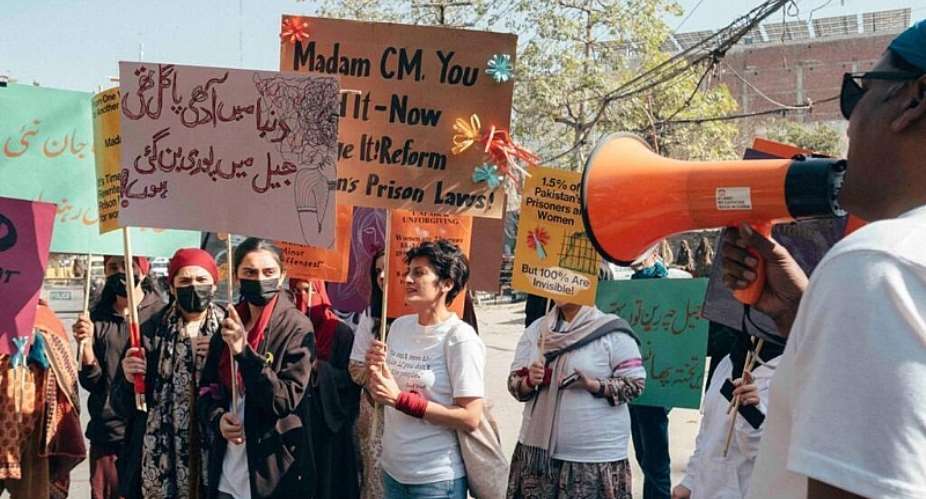
RFI: You are a barrister and the executive director of Justice Project Pakistan. How do you reconcile your work on the abolition of the death penalty while operating in Pakistan, an Islamic state?
Sarah Belal: I don't find the two to be contrary [to each other]. Islam does not promote the death penalty, and it is not banned under international law. It says the death penalty can only be prescribed for the most serious crimes.
Actually, under Islam the Quran only prescribes the death penalty for two offences, which broadly match the international human rights standard – intentional killing and Fasad-Fil-Arz, which covers various violent crimes including crimes against humanity. So, they're not at odds with each other at all. You'll see that international human rights law standards match with the Quranic ones.
Islam's concept of Tazkiyah al-Shahood is a very high evidentiary standard to determine the competency of a witness. Yet, in Pakistan, these standards are never upheld in court where witnesses regularly perjure themselves while never being held accountable.
RFI: Although capital punishment is legal in Pakistan, there hasn't been an execution since 2019. What does this say about the direction the country is taking?
SB: I think it's going in the right direction. This halt in executions shows that the various governments Pakistan [has had since then] have realised that there's a severe lapse in justice in who we are executing, and are trying to correct the system.
If you're going to have the ultimate punishment, you need to have the ultimate justice system. We come from a country that's plagued by a lot of problems.
Paris death penalty congress warns abolition cannot be taken for granted
One of my favourite quotes is from a visiting American professor who worked on the death penalty in the United States.
He said: "This is incredible to me how vibrant and dynamic the Pakistani society is. But, you know, since I've been here, I've seen the electricity go several times [due to load shedding] and I've seen the distrust that people have in paying their taxes because they don't trust the government to use their money in the right way. Yet we have this ultimate faith in the government that they can determine somebody's innocence or guilt to an extent that they can determine who gets to live or not. It seems to be a very paradoxical kind of a view."
RFI: There are 3,646 people on death row in Pakistan, their ages ranging from 16 to 70. What are the most common offences which lead to a death sentence?
SB: It fluctuates over time, but the top two crimes are murder and people convicted under the Anti-Terrorism Act.
Iran drives global executions to highest level since 1981: Amnesty
RFI: What led you to create the Justice Project Pakistan in 2009?
SB: I was one year out of law school in Pakistan when I came across a letter from a death row prisoner. His name was Zulfiqar. He had written saying he was going to be executed in a week, and he was worried about his two girls who were going to grow up without a father. His wife had died while he was in prison.
He had spent nearly 16 years on death row. He educated himself and hundreds of other prisoners. He was actually called Dr. Zulfiqar Ali.
That letter really changed my life. I went on to represent him. He was executed in 2015. It was the first time I ever saw [an execution], and there were hundreds of people there.
What was beautiful was that in his mercy petition, 600 of the prisoners that he had educated wrote letters to the president saying "this man deserves to live". He was a source of inspiration and a guiding light for how and why we are doing this work.
RFI: Among all the prisoners on death row you have met throughout your career, is there one whose story has stayed with you?
SB: All the people we represent are incredibly important to us – the clients that we've lost and the clients that we have now. To me personally, Zulfiqar is important because he was my first client and my entry into this field, and so he remains very close to me.
But there are so many. There are those who were wrongly sentenced to death as juveniles when clearly the law does not allow [it]. So, I'm thinking of Azam and Munawar, who are in prison in Sindh on death row, waiting for decades – 28 years for Azam, 24 years for Munawar – for the Supreme Court to revisit their decision.
They were under 18 at the time that they were convicted of the offence, but because they were incredibly poor and were represented by an inadequate state council, they were never able to bring evidence to prove that they were wrongly convicted. They are waiting for their mercy petitions to be accepted, or for the courts to take their case up again and commute their sentences.
French man cleared of drug charges in Malaysia, avoiding possible death penalty
RFI: When prisoners are being jailed for decades, how does this help their rehabilitation?
SB: It doesn't help. Prison is hyper-violent. Everyone comes out of prison with PTSD. It is not a place built to rehabilitate. It's just designed to punish and forget people.
I don't see any rich people in prison at all. And what does that say about the system? Do rich people not commit crimes?
I work in a country that purports to be a Muslim country, to uphold Muslim values and principles. Criminal justice in Islam focuses on the people and questions the responsibility of the State. Are you providing the social services that are necessary to ensure that your citizens are able to live good and dignified lives? It considers the circumstances when determining culpability and sentence.
When you look at women in prison in Pakistan, most of them are in prison for drug offences. When you do a profile of why these women are selling drugs, these are not high-level traffickers. These are women who, out of desperation, are forced to engage in this activity just so their children and themselves could survive.
Why is that being punished again and again? These are non-violent offenders. And why is our state and our community not looking at how can we better take care of these women and their children. But we spend an insane amount of money on building new prisons.


 Finance Minister approves three quarters of rent allowances for security service...
 NDC cannot be written out of NHIS success story – Dr. Sammy Ayeh
 Mahama to cut sod for new 3,000-seater Accra Convention Centre – Felix Ofosu
 Kojo Bamba denies rift with Nana B, explains absence from NPP executives’ meetin...
 I was never asked to give up NPP 1st National Vice Chair position – Kojo Bamba
 October 7: Cedi sells at GHS12.30 on forex market, GHS11.81 on BoG interbank
 ECOWAS Parliament calls for stronger legislative role in regional integration
 We’ll impose $500m bail on NDC members when NPP returns to power – Abanga
 I have a strategy to win 70 'orphan' parliamentary seats for NPP in 2028 – Abang...
 Yellow fever outbreak kills seven in Sissala East


