




Abstract
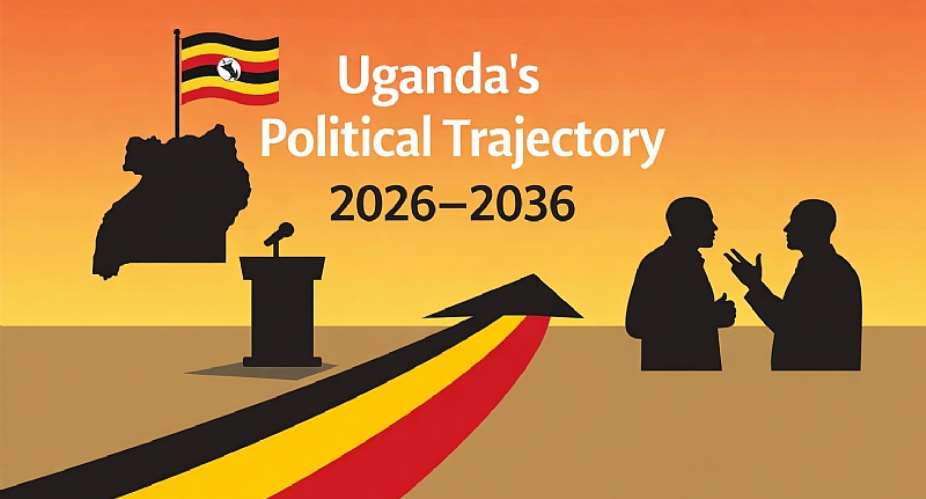
This paper examines Uganda’s precarious political trajectory from 2026 to 2036, arguing that the country is undergoing a slow-motion institutionalization of hereditary military rule. Driven by President Yoweri Museveni’s advanced age, the elevation of his son Gen. Muhoozi Kainerugaba as Chief of Defence Forces, the operationalization of the Patriotic League of Uganda (PLU) as a parallel mobilization structure, and legislative-military fusion through the UPDF Amendment Act, the regime is consolidating a dynastic authoritarian system where elections provide international legitimacy while real power resides within the first family and security elite.
Projecting four scenarios—Managed Succession, Palace Coup/Fracture, Systemic Collapse, and Late Museveni Counter-Purge—the analysis highlights risks of intra-elite fractures, military splits, and popular unrest. While formal opposition faces systematic neutralization through repression and co-optation, under-examined faith institutions offer critical pathways for resilience. The Anglican and Catholic Churches, alongside independent Muslim voices, hold potential as mediators or moral voices for accountability, though co-optation of hierarchies and risks of Muslim youth radicalization complicate their roles.
Ultimately, opposition survival demands a strategic pivot: building parallel grassroots structures, engaging mid-level military officers, and forging deeper alliances with faith communities. Without such adaptation, Uganda risks entrenching a self-perpetuating hereditary military oligarchy through the 2030s.
Keywords: Hereditary military rule, Muhoozi Kainerugaba, Patriotic League of Uganda (PLU), slow-motion coup, dynastic authoritarianism, Museveni succession, UPDF militarization, faith sector role, Anglican Church, Catholic Church, UMSC, Kibuli Muslim group, Muslim radicalization, Muslim marginalisation, opposition resilience, political transition Uganda, palace coup, counter-purge, Uganda diaspora.
Introduction
Over the next decade, Uganda stands at the threshold of one of its most precarious political transitions since independence. Rather than democratic consolidation, the trajectory points toward the institutionalization of a hereditary military oligarchy. This process is driven by President Yoweri Museveni’s advanced age, the elevation of his son Gen. Muhoozi Kainerugaba to Chief of Defence Forces (CDF), the operationalization of the Patriotic League of Uganda (PLU) as a parallel mobilization vehicle, and the legal entrenchment of military authority over civilian institutions. Collectively, these developments constitute a "slow-motion coup" already in progress.
This paper projects the most probable scenario as Contested Dynastic Authoritarianism, in which elections serve primarily as instruments of international legitimacy while substantive power remains contested within the first family and military elite. The formal opposition confronts structural decapitation through repression and co-optation. Yet, under-examined institutions—the Anglican and Catholic Churches, alongside segments of the Ugandan Muslim community—offer potential non-violent pathways for mediation or resistance in the 2030s, tempered by risks of Muslim youth radicalization.
A classic extraconstitutional military coup remains likely even though the regime has tried hard to secure de facto military dominance through promotions, strategic senior officer retirements, amendments, and patronage networks. Whereas the PLU’s grassroots strategies further insulate the transition by cultivating broad loyalty, framing dynastic continuity as patriotic inevitability, risks instead center on intra-elite fractures or palace intrigues should succession falter.
The Current State: Anatomy of a "Slow-Motion Coup"
The regime has transcended personalist autocracy to construct a durable self-perpetuating system. This involves the fusion of military command, political mobilization via the PLU, parliamentary subordination, and kleptocratic control.
The Muhoozi Project, PLU Grassroots Mobilization, and the Militarized State
In 2024, President Museveni delegated extraordinary constitutional authority—including the power to promote high-ranking officers—directly to the CDF position held by his son. This move represents a profound deviation from Uganda's constitutional framework, which envisions a professional, apolitical military subordinate to civilian authority. Gen. Kainerugaba's public posturing, including overt involvement in partisan activities, social media campaigns, and direct interventions (such as the June 2026 closure of Nation Media Group outlets), blurs the lines between military command and political advocacy, violating the spirit of the UPDF Act.
The Patriotic League of Uganda (PLU), rebranded in 2024 from the Muhoozi Project, constitutes a central pillar of this transition. Initially emerging from fan-organized birthday celebrations and community rallies, PLU has developed sophisticated grassroots mobilization tactics. These include hierarchical structures extending to village level, regular community service initiatives (e.g., monthly clean-ups and local development projects in areas like Hima, Kasese), youth-focused rallies, roadshows, and digital campaigns emphasizing patriotism, anti-corruption, and national unity.
Leadership reshuffles, such as the appointment of Hon. Fadil Twaha as Secretary General, signal efforts to professionalize operations and deepen rural and urban outreach. PLU collaborates with the NRM to target high vote shares while offering patronage pathways for activists.
A striking demonstration of PLU influence occurred in the lead-up to the 12th Parliament, when the organization publicly withdrew its earlier endorsement of former Speaker Anita Among and Deputy Thomas Tayebwa amid public scrutiny. The subsequent election of Jacob Marksons Oboth as Speaker and alignment of other leadership illustrates the League’s role in installing loyal parliamentary figures. In the slow-motion coup context, PLU normalizes hereditary succession by blending civic service with political loyalty-building. It reduces incentives for a traditional coup by co-opting potential opponents and embedding loyalists across institutions.
Complementing this is the expansion of the Special Forces Command (SFC) an "army within an army" - and the UPDF (Amendment) Act 2025, which expands military courts' jurisdiction over civilians in "military-related" cases despite Supreme Court rulings. This Act erodes judicial independence, creates a chilling effect on civil liberties, and formalizes military supremacy.
Gen. Kainerugaba’s tenure features documented repression, including SFC-linked abductions and the June 2026 military-ordered closure of Nation Media Group outlets on his directives following critical reporting. Troops besieged the premises and enforced a shutdown, accompanied by public statements rejecting press freedom. Muhoozi directly ordered the arrest of prominent opposition lawyer Erias Lukwago (counsel to Kizza Besigye), and the deportation of Kenyan lawyer Martha Karua, who was ahead of Besigye’s legal team. In his national address on 4th July 2026, President Museveni appeared to justify his son’s actions and placing blame on Besigye for allegedly delaying court processes and creating unnecessary legal complications. These incidents underscore how military and executive power are being used to target not only opposition politicians but also their legal defenders, further shrinking civic space.
The Kleptocratic Nexus
Corruption has evolved from individual graft to systemic state capture. Research indicates that corruption operates within an elite cartel where opaque networks connect state institutions to politically connected non-state actors, extending beyond personal enrichment to become the primary instrument for political survival and regime consolidation. Anti-corruption bodies manage rather than eliminate graft, selectively prosecuting defectors while protecting the core of the first family's financial empire. This financial omnipotence funds the patronage network that keeps the National Resistance Movement (NRM) base compliant.
The Neutralization of Formal Opposition
The incarceration of Dr. Kizza Besigye on treason charges and the apparent exile of Robert Kyagulanyi (Bobi Wine) mark a strategic shift from management to elimination. Critically, the regime does not just suppress the opposition; it simulates it. Museveni has mastered the art of "creating and controlling his own opposition," rendering the formal electoral challenge a charade designed to absorb Western criticism while demobilizing grassroots energy.
The Missing Pillars: The Church and the Mosque
Beyond the barracks and the ballot box, the battle for Uganda's future will be waged from the pulpit and the minbar. The leadership of the two dominant faith communities - Christianity and Islam are currently co-opted, but this co-optation is brittle.
The Christian Dynamic: The Anglican and Catholic Churches
The Anglican Church of Uganda and the Roman Catholic Church represent the most extensive and organized civil society infrastructure in the country. Historically, both institutions have played a dual role: legitimizing state power while occasionally providing sanctuary for dissent.
Current State of Co-optation
The hierarchies of both churches are deeply entangled with State House patronage. Archbishops and Bishops are regular guests at state functions, and the Church has become a powerful vehicle for the regime's social conservative agenda (most notably the Anti-Homosexuality Act). This alignment provides the regime with moral cover and a direct line of communication to the rural peasantry.
Despite this co-optation, Archbishop Stephen Kaziimba Mugalu of the Church of Uganda has, on occasion, issued pastoral letters critical of state-sanctioned violence and corruption. These interventions are carefully calibrated but they establish a precedent: the Church retains the potential to speak truth to power.
The Muhoozi Complication
Gen. Muhoozi Kainerugaba's public persona is steeped in an aggressive, evangelical, and at times messianic Christian nationalism. His public claims of divine visions and a special covenant with Jesus Christ create a specific kind of unease within the established Church hierarchy. While the Bishops support a "Christian nation," they are wary of a political leader who claims a direct, unmediated divine mandate that bypasses the institutional authority of the Church itself. In a post-Museveni scenario, if Muhoozi's rule becomes excessively brutal, the Church is the only institution with the moral authority and physical reach to mediate a non-violent transfer of power or demand accountability.
The Church is likely to remain a stabilizing force for the transition from Museveni to Muhoozi (preventing chaos is a core institutional instinct). However, in the medium-term (2032-2036), if Muhoozi's governance mirrors his erratic public statements, the Church becomes the most likely venue for elite defection from the regime's moral consensus.
The Roman Catholic Church in Uganda's Stance Against Undemocratic Tendencies
The Roman Catholic Church in Uganda has indeed often taken a more outspoken and consistent position on issues of governance, human rights, and democratic backsliding compared to some other religious institutions. This stems from its extensive social infrastructure (schools, hospitals, and parishes reaching deep into rural and urban communities), its historical role in peace-building and social justice, and a theological emphasis on human dignity and the common good.
Following the 2021 general elections, the Uganda Episcopal Conference (UEC), the body representing Catholic bishops, issued strong statements condemning violence, intimidation of voters, and excessive use of force by security agencies. They called for respect for the rule of law and the right to peaceful assembly. Similar statements were issued after the by-elections marred by irregularities.
Catholic leaders have repeatedly advocated for national dialogue on succession and governance. In 2024–2025, bishops criticized the growing militarization of politics and the use of military courts for civilian matters under the UPDF Amendment Act, arguing it undermines constitutionalism and fair trial rights.
Archbishop Paul Ssemogerere (Kampala Archdiocese) and other bishops have issued pastoral letters addressing corruption, land grabbing, youth unemployment, and state-sponsored violence.
These are often more pointed than statements from some Protestant counterparts. For instance, in response to arrests of opposition figures and lawyers (including recent actions against Erias Lukwago’s team), Catholic voices have emphasized the right to legal representation and due process.
Historically, the Catholic Church played a notable role in the 1980s resistance to the Amin and Obote II regimes, providing sanctuary and documenting abuses. This legacy informs its current willingness to speak out, even at the risk of state pressure.
Comparison and Context
While the Anglican Church has also issued occasional critical letters (e.g., under Archbishop Kaziimba), Catholic statements tend to be more systematic, institutionally coordinated through the UEC, and focused on structural issues like judicial independence, poverty, and youth marginalization. This has earned the Catholic Church respect among pro-democracy activists and civil society, though it has also drawn accusations from regime supporters of "meddling in politics."
The Muslim Dynamic: Old Kampala vs. Kibuli
The Muslim community presents a complex, dual-faced asset for the Museveni dynasty. It is simultaneously a pillar of regime support and a chronic source of security anxiety.
Institutional Co-optation: The UMSC Conveyor Belt
The regime's primary mechanism is the Uganda Muslim Supreme Council (UMSC) at Old Kampala, led by Mufti Sheikh Shaban Ramadhan Mubaje. The relationship is transactional and public. The state directly funds Muslim leadership SACCOs and positions the UMSC as a beneficiary of the Parish Development Model (PDM). In political rallies, Muslim leaders explicitly pledge loyalty to President Museveni. This serves a specific purpose: demonstrating to the diplomatic corps and the security apparatus that the Muslim minority is a contented, protected part of the NRM coalition.
The Strategic Fissure: Kibuli Faction
The regime exploits a schism that has never healed. The Kibuli faction (historically associated with the more independent Prince Badru Kakungulu legacy) operates with a degree of autonomy that Old Kampala lacks. The Kibuli-based leadership, represented by Supreme Mufti Sheikh Galabuzi maintains a posture of policy-oriented neutrality. It is telling that opposition figures seeking Muslim legitimacy often pay homage at Kibuli Mosque, not Old Kampala.
The Muslim Dynamic: Beyond UMSC-Kibuli to Risks of Radicalization and Violent Extremism
The Muslim community offers the regime both support and persistent headaches. The UMSC in Old Kampala delivers transactional loyalty and benefits from state programs, while Kibuli maintains greater independence rooted in Buganda traditions.
Yet broader grievances run deep: longstanding feelings of marginalization in politics and the economy, land conflicts, and a string of assassinations of prominent clerics, many linked to anti-terror operations or factional disputes. These killings have bred resentment and conspiracy narratives. Salafi-oriented youth, in particular, face strong radicalization pressures—unemployment and slum conditions, perceptions of state persecution, ideological appeals for purity, and alienation from Muhoozi’s Christian tone. The ADF’s history as a group born from 1990s Muslim discontent adds a dangerous backdrop, even if the group now operates mainly from the DRC.
Under Muhoozi, Christian nationalist posturing could worsen these tensions. What currently functions as managed co-optation might fracture, pushing independent voices toward resistance or, in extreme cases, feeding sporadic violent extremism.
The Muhoozi Complication and Security Memory Gen. Muhoozi's overt Christian nationalism creates a specific trust deficit with the Muslim constituency. While Museveni carefully uses ecumenical language, Muhoozi's messaging is exclusive. Furthermore, the state's memory is long. It recalls the Allied Democratic Forces (ADF) rebellion of the 1990s, which originated from Muslim Tabliq youth. While the ADF is now largely a DRC-based ISIS affiliate, the regime views any independent, un-coopted Muslim youth mobilization—particularly in urban slums like Bwaise or Kisenyi—as a latent security threat.
Scenario Impact Under Museveni, the UMSC deal holds. Under a Muhoozi presidency characterized by Christian nationalist rhetoric, the Muslim leadership at Old Kampala may find their current arrangement to be a depreciating asset. The community could face sharper economic and political marginalisation, transforming independent factions or radicalized fringes into sources of non-violent civil resistance (framed in Islamic economic justice) or, in worst cases, violent extremism that complicates dynastic stability.
Scenario Projections: The Next 10 Years (2026-2036)
Scenario 1: The Managed Succession (Most Likely, 50% Probability) Timeframe: 2026-2031.
Museveni contests and "wins" the 2031 election. The real action occurs in the barracks as Gen. Kainerugaba purges the UPDF of officers loyal to the old NRA ideology rather than the family. Parliament, filled with NRM members who now openly carry the Patriotic League of Uganda (Muhoozi's political vehicle) emblem, ratifies this transition. PLU structures and the UPDF Amendment Act provide legal and mobilization cover.
Faith Sector Role: Both Old Kampala UMSC and the Anglican hierarchy issue statements calling for "calm and continuity," effectively blessing the dynastic transfer—though Muslim radicalization risks may simmer beneath the surface.
Scenario 2: The Palace Coup or Fracture (Likely, 15% Probability) Timeframe: 2028-2034.
This scenario hinges on Gen. Kainerugaba's volatile temperament. A premature push by Muhoozi to oust his father, or a miscalculation in handling internal NRM dissent, could trigger a violent split within the security forces. This is the "Warrior-Mad-King" scenario. In this chaos, the opposition would be a spectator, but the religious institutions would become critical. The Church and independent Muslim voices (including Kibuli) would be the only neutral ground available for emergency dialogue between warring UPDF factions, while Salafi discontent could complicate resolution.
Scenario 3: Systemic Collapse, engendering a combination of anti-Museveni-Muhoozi Military Coup and Popular Uprising (Likely, 15 % Probability) Timeframe: Unpredictable.
This wild card requires economic turmoil to align with a moment of military elite fracture and a specific social trigger (e.g., a sharp currency devaluation combined with a widely condemned act of brutality by SFC guards).
Faith Sector Role: In this scenario, the Church's lower clergy (parish priests) and independent Imams in urban slums, potentially including radicalized Muslim elements, could provide the moral sanction for support to even a precarious military coup, hence increasing its chances of success, civil disobedience; echoing the role of the Church in the 1980s anti-Amin resistance or the 2011 "Walk to Work" protests.
Scenario 4: The Late Museveni Counter-Purge (Likely, high risk- 15-20% Probability) Timeframe: 2027-2030
In this scenario, an aging but still shrewd President Museveni perceives a premature power grab by Gen. Muhoozi Kainerugaba and the Patriotic League of Uganda (PLU). Alarmed by PLU’s expanding influence in Parliament, the NRM, and the UPDF, and fearing his son’s volatile temperament could force a dynastic transition while he is alive, Museveni acts decisively. He demotes Muhoozi from Chief of Defence Forces, initiates targeted purges of PLU-aligned officers and politicians, and elevates anti-Muhoozi elements within the old NRA guard, military intelligence, and NRM veterans. Using his intelligence networks, Museveni identifies and neutralizes key sympathizers through retirements, reshuffles, and selective prosecutions framed as anti-corruption or loyalty drives.
Tactically, Museveni secures quiet support—or at least neutrality—from opposition figures who view Muhoozi as a greater long-term threat, creating a temporary “anyone but Muhoozi” alignment. Parliament ratifies the moves under NRM majorities, while state media portrays them as necessary for stability and party discipline.
Feasibility and Consequences: Museveni’s deep patronage networks and formal authority as Commander-in-Chief give him a strong chance of short-term success. However, risks are substantial. Muhoozi’s loyalists in the Special Forces Command and younger officer corps could resist, triggering limited mutinies or underground sabotage. PLU structures, already embedded in grassroots mobilization, might fuel protests or defections, fracturing the ruling coalition. Economic volatility or a heavy-handed crackdown could spark urban unrest, with lower clergy and independent imams providing moral cover for dissent—echoing historical protest roles.
In the best case, Museveni reasserts dominance and delays succession. In the worst, the purge accelerates elite fractures, pushing the country toward Scenario 2 or 3 dynamics: open military splits, popular uprisings, or chaotic power vacuums. This scenario underscores the regime’s personalization—where one man’s survival instincts could either stabilize or unravel decades of carefully managed authoritarian continuity.
Faith Sector Role- In this scenario, the faith sector would play a complex, dual-edged role shaped by calls for stability versus grassroots discontent. The Anglican hierarchy and Old Kampala UMSC would likely issue measured statements emphasizing "national unity, peace, and constitutional order," effectively providing moral cover for Museveni’s counter-purge as a defense against chaos and dynastic adventurism. Senior religious leaders, many with longstanding ties to the state, would prioritize continuity and quietly endorse the moves as necessary to prevent military fragmentation.
Conversely, lower-level clergy—particularly parish priests in rural areas and independent Imams in urban areas and opposition-leaning communities—could become focal points of dissent. They might frame the purges as evidence of elite infighting and declining legitimacy, offering moral sanction for civil disobedience, prayer vigils, or quiet support for affected officers and politicians.
The Opposition's Strategic Conundrum and Required Pivot
The opposition's current strategy—participating in fraudulent elections, being repressed, and appealing to Western condemnation - is a closed feedback loop. To remain relevant over a 10-year horizon, the opposition must undergo a radical strategic pivot.
Decoupling Legitimacy from the Ballot Box: The focus must shift from vote-counting to power-building. This means prioritizing the development of parallel, informal governance structures in urban slums and rural areas—community-based justice mechanisms, informal savings cooperatives, and alternative media ecosystems that operate below the security radar.
Rebuilding the Civil-Military Bridge: The singular focus on Gen. Muhoozi's brutality should be supplemented with a nuanced, covert effort to engage mid-ranking UPDF officers. These officers are aware of the resentment within the ranks regarding the preferential treatment and impunity of the SFC and the first family. The opposition must craft a narrative of a "Professional UPDF" vs. a "Palace Guard (SFC)."
The Faith-Based Engagement Strategy: The opposition must cease treating the religious community as a monolith. A specific, two-track engagement is required:
Track A (Christian): Direct engagement with Archbishop Kaziimba and the Catholic Bishops. The ask is not for political endorsement but for a pastoral commitment to non-violence and the sanctity of life. Securing a public statement from the Church hierarchy condemning any extra-judicial killings during the transition period would constrain the SFC's operational freedom.
Track B (Muslim): A pivot away from the co-opted UMSC toward Kibuli and independent Muslim Clerics. The opposition's message should pivot from secular democratic theory toward Islamic economic ethics. Framing regime corruption and marginalization as a violation of principles of social justice (riba/interest, land grabbing, wealth concentration) can activate bases while addressing Muslim youth drivers to prevent radicalization.
The Diaspora-to-Ground Pipeline: The diaspora's role must transition from funding election campaigns to funding underground organizational capacity. This includes providing encrypted communication tools, emergency medical and legal aid for detainees, and creating an economic lifeline for Ugandan youth that bypasses state-controlled patronage.
Conclusion
The next decade in Uganda will be defined by the violent consolidation of a family dynasty. The metrics for "success" for the opposition must change. Success is no longer winning the presidency in 2031; it is surviving and maintaining organizational coherence long enough to be the only alternative when the military family fractures.
The faith institutions—the Church and the Mosque—are currently ballast for the regime's ship. However, they are also the only lifeboats on deck. In the turbulent waters of the Muhoozi succession, compounded by risks from Muslim marginalization and Muslim radicalization, the opposition's ability to navigate toward the neutral, moral harbor provided by these institutions will determine whether they are swept away entirely or manage to stay afloat for the long, dark journey ahead.
Without a strategic engagement with the pulpit and the minbar, and proactive addressing of communal drivers of discontent, the opposition risks becoming a permanent, decorative feature of a hereditary military state.

 NPP sets September 19 for national delegates conference to elect national office...
 Here are areas to be affected by ECG's planned maintenance today
 Judicial office is for service, not personal wealth — Justice Kulendi
 Ghana Water to shut down Dodowa booster station for 24-hour maintenance
 Netanyahu warns US could 'destroy' Mideast power balance as Trump floats F-35 je...
 Anyone who uses the Bible to preach is not from God - Osofo Kyiri Abosom
 Police bust 44 suspects supplying narcotic products to University students in Ku...
 IMF appoints Silvana Tenreyro as new Chief Economist
 Interior Minister reveals how some people within the system were involved in met...
 GRA hands over confiscated 18 diverted truckloads of cargo to School Feeding Pro...

