




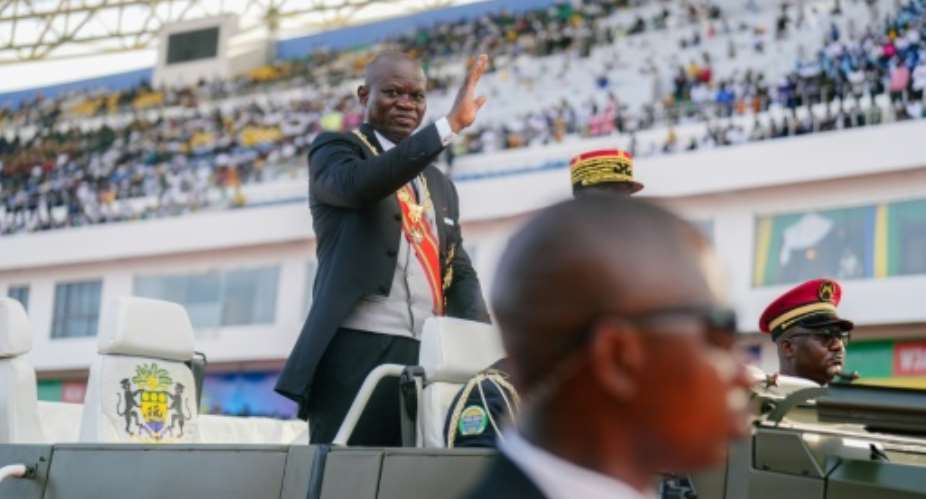
A repressive climate in Gabon is shattering hopes that the rise to power of Brice Clotaire Oligui Nguema would lead to democratic change.
Opposition figures have been imprisoned, critical voices threatened and social media suspended.
One of the first to bear the brunt was Nelly Ngabima, a TikTok star with some 250,000 followers known as Princesse de Souba.
Ngabima, who never pulls punches when it comes to Gabon's elite, told AFP that people close to the president threatened her, so much so that France granted her refugee status.
A close associate of Oligui Nguema also sent her father a threatening voice message.
"Mr Oligui doesn't want to hear from activists or opponents. He doesn't want to have any," she said.
In November, several of Ngabima's social media accounts were suspended after she posted a video of the Bongo family, including former president Ali Bongo Ondimba's wife Sylvia and son, Noureddin, who claimed to have been tortured by the new president's men.
A few days later, the Facebook page of the party of former prime minister and main opposition figure Alain-Claude Bilie-By-Nze also disappeared.
It only came back online six months later.
About-face
The August 2023 coup led by military general Oligui Nguema ended 55 years of rule by the Bongo family and sparked scenes of jubilation on the streets of the capital, Libreville.
Many Gabonese, tired of the waste and corruption of the country's elite, wanted to believe in change.
Gabon, in central Africa, is home to nearly two million people, is rich in hydrocarbons and minerals, but most of the country lives in poverty.
Soon after coming to power, Oligui Nguema promised "more democratic" institutions.
He won presidential elections in April last year with nearly 95 percent of the vote.
Press freedom in Gabon has undoubtedly improved in recent years, jumping from 121st in Reporters Without Borders' annual index in 2020 to 41st in 2025.
But the opening up has been short-lived.
"During the transition, President Oligui was preparing for an election, so he needed to show himself in the best possible light," said Jean-Valentin Leyama, a former opposition lawmaker under former president Omar Bongo and during the military transition.
"Once he was elected, we've all been astonished by this repressive about-face," he told AFP.
The most recent example was the imprisonment of Bilie-By-Nze in mid-April in a case linked to a debt from 2008, when he was in an official position.
For his lawyer, Thierry Nguia, "this affair is nothing more than a pretext to lock up a political opponent and to prevent him from running" in the 2032 presidential election.
"Every Gabonese has to understand that what is happening to Mr Bilie-By-Nze could happen to any of us," added Theophile Makita Niembo, vice-president of the politician's Together for Gabon party.
In a television interview earlier this month, Oligui Nguema denied any intervention by the executive in the case and defended the independence of the judiciary.
Climate of fear
Few people in Gabon now dare to voice their opinions publicly.
In a viral video, one man asked for his opinion on a teachers' strike refuses to answer, saying he feared reprisals.
Some even believe that there was more freedom of expression under the Bongos.
"There's no more freedom of expression," one journalist told AFP on condition of anonymity.
Three journalists from the independent online media were arrested and detained for several days in August, October and January, after publishing content deemed critical of the government.
"When journalists describe things as they are, they run the risk of being arrested at any moment," the journalist added.
The presidency did not respond when contacted by AFP.
During a teachers' strike in January that the government tried to put down, two trade unionists were arrested and held for a week after appearing on videos mostly posted on TikTok.
A month later, the authorities suspended Facebook, WhatsApp, Instagram and TikTok on the grounds that they were "susceptible to stoke social conflict" and "destabilise institutions".
The suspensions are still in place but many get round it by using virtual private network (VPN) software.
The government has proposed outlawing online anonymity, forcing every Gabonese to be clearly identifiable on social networks.
For Leyama, "President Oligui does not like contradiction" and the crackdowns are an attempt to "neutralise critical voices", he added.


 Upper Dixcove: Dumsor is killing our business – Chief Fisherman
 UTAG-UG threatens strike over delayed 2026 book and research allowance from Octo...
 South Africa protests: Ghanaians warned to limit travel in Johannesburg and Durb...
 UN cautions against forced tenant evictions without prior consultation
 UN advises Ghana to strengthen Rent Control Department with requisite logistics
 ECG announces three-day power outages in parts of Accra from Monday
 Ghana’s banking assets rise to GH¢500.2billion
 'In the history of Ghana when has such quantum of Common Fund monies released to...
 Mahama orders improvement of key roads in regional capitals ahead of Ghana’s 70t...
 NDC orders aspirants to remove oversized campaign posters within five days


