




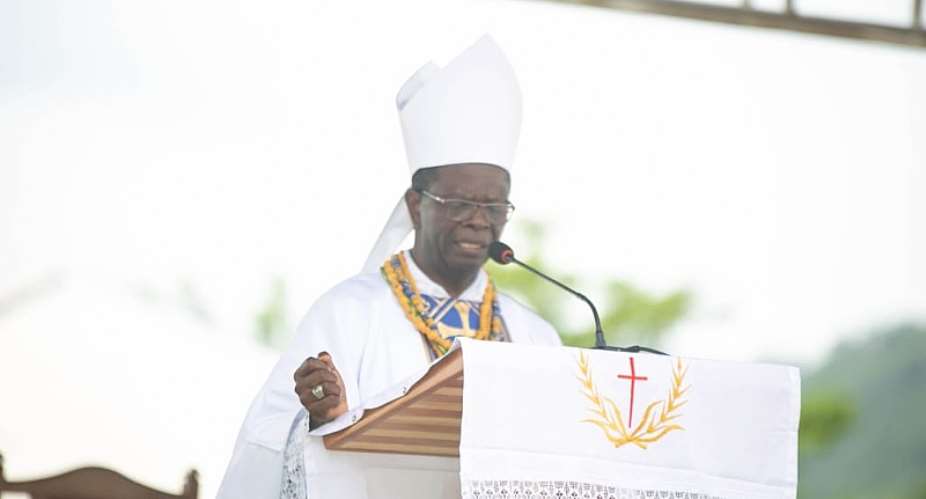
The Catholic Bishop of the Jasikan Diocese, Most Rev. Simon Kofi Appiah, on Friday, June 26, 2026, embarked on a peace mission to several communities affected by the ongoing conflict in Nkwanta South, urging residents to lay down their arms and embrace dialogue.
The Bishop visited Odomi, Gekorong, Keri, Abrewankor and Nyampong, where he met traditional leaders, elders and residents to encourage reconciliation and peaceful coexistence.
As part of the engagement, chiefs, elders and community members were given the opportunity to freely express their grievances, recounting the events that had fuelled the hostilities, the pain they had endured, and the challenges confronting their communities as a result of the violence.
Bishop Appiah and his delegation listened attentively, assuring residents that every concern raised would be carefully considered as part of efforts to facilitate lasting peace. He noted that understanding the perspectives of all affected communities was essential to identifying the root causes of the conflict and guiding the Church’s collaboration with traditional authorities, security agencies and other stakeholders.
Addressing the gatherings, the Bishop stressed that his mission was neither political nor judicial, but purely pastoral and humanitarian.
“We came with peace — the peace of Christ. No one sent me except our Lord Jesus Christ. I came to plead with you to allow peace to prevail,” he said.
He explained that his predecessor, Most Rev. Gabriel Mantey, had initiated efforts to support traditional authorities, security services and community leaders in restoring peace before his retirement. As the new Bishop, he felt compelled to continue that mission.
According to him, the renewed violence has reversed years of development in the municipality, causing needless destruction and loss of lives.
“We are brothers and sisters, yet we are destroying ourselves. If we continue to repay evil with evil, the cycle of violence will never end,” he lamented.
Acknowledging the deep pain and grief suffered by families who have lost loved ones and property, Bishop Appiah said every individual has a right to feel hurt. However, he urged residents not to allow anger and revenge to dictate their actions.
“I know many of you are deeply wounded. I know you are angry. But if we continue to retaliate, there will never be an end to this conflict. Let us allow the anger to fall away and put the guns aside.”
He emphasized that lasting peace cannot be imposed solely by government or security agencies from Accra, but must begin with the affected communities themselves through honest dialogue and reconciliation.
“If we wait for peace to come from Accra, it may arrive too late. We have the responsibility to sit together, talk and tell ourselves that enough is enough.”
Bishop Appiah appealed to all parties to return to the negotiating table, insisting that no dispute is beyond resolution when people choose dialogue over violence.
He also expressed concern about the devastating impact of the conflict on education, agriculture and economic activity in the municipality. He noted that statistical records once projected Nkwanta as one of the fastest‑growing areas in the Oti Region, but persistent violence has caused the municipality to fall significantly behind.
“Our children are unable to attend school, farmers cannot go to their farms, businesses have collapsed and the entire region is suffering because of this conflict.”
Drawing lessons from other longstanding communal conflicts in Ghana, he cautioned against allowing the situation to become a permanent crisis, citing the decades‑long Alavanyo conflict as an example of how unresolved disputes can rob generations of peace and development.
Throughout his address, Bishop Appiah reminded residents that no amount of compensation can replace the life of a loved one.
“If someone loses a father, a mother or a sibling, no amount of money can replace them. Nothing in this world is more valuable than peace.”
He concluded by urging all affected communities to forgive one another, reject revenge and give peace a chance.
“Let us comfort one another. Let us sit together and speak honestly. When peace returns, development will return, our children will go back to school, and together we can rebuild our communities.”
The Bishop’s visit forms part of ongoing efforts by the Catholic Church to support traditional authorities, security agencies and stakeholders in restoring lasting peace to conflict‑affected communities in Nkwanta South.
 Accra floods: GAF, police and other security agencies deployed for rescue missio...
 Remain where you are until conditions improve — Interior Minister advises Ghanai...
 Court hears Wontumi's bid to defer July 3 judgment in Samreboi case today
 Alan Kyerematen offers better alternative to troubled NPP — United Party
 T‑Bill Demand Surges as Government Raises GH¢6bn, Oversubscribes Auction by 31%
 Arthur Kennedy Blasts NPP for “Baseless” Disciplinary Action Against Agyapong
 GCAA Launches Probe Into Alleged Passenger Mistreatment on KLM Amsterdam–Accra F...
 Torrential Rains Flood Accra: Major Roads Submerged, Commuters Stranded in Monda...
 'Don't drive or walk through floods' -- NADMO advises Accra, Tema and Kasoa resi...
 South Africa coach Broos urges squad to savour achievements at 2026 World Cup


