




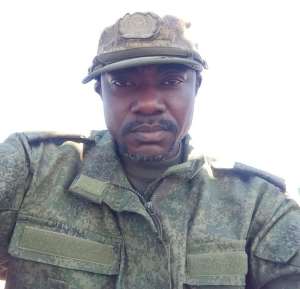
Abdulrashi Seydou does not know what to do with his grief. He picks up the phone. He dials the number the commander gave him from Moscow. No one answers. He tries again. Still nothing. The line is there, somewhere, connected to a country thousands of kilometers away, in the middle of a war that has no meaning for a family from Kumasi. And on the other side, silence.
His brother is dead. That much he knows. A man who identified himself as a commander called the family once to say so. He promised that his superiors would follow up, that there would be information, that the matter would be handled. That call came. No other call has come since. No death certificate. No repatriation of remains. No explanation of the circumstances. No benefits from the contract his brother signed. Nothing.
Seydou Ibrahim, known to those who loved him as Anyas, was born on 26 December 1977. A Ghanaian from Kumasi, he was the eldest in his family, based in Ho in the Volta Region. He had a wife, Mrs Zainab Ibrahim, and three daughters: Sakina, Munira, and Sadiya, the youngest of whom was ten years old when the family last heard his voice. He was, by the account of his brother, a man who carried his responsibilities with seriousness. He was not someone who chased reckless adventures. He was a man trying to build a life.
His story did not begin in Russia. It began in Qatar.
From Qatar to the Russian Frontline: A Familiar Pipeline
Like thousands of West Africans before him, Seydou Ibrahim had made his way to Qatar in search of work. The boom that followed the 2022 FIFA World Cup left many migrant workers stranded after the tournament ended, contracts expired, and the construction sector contracted. Investigators and journalists have since documented how this pool of unemployed, displaced workers became a prime target for Russian military recruiters operating through intermediaries and travel brokers.
It was from Qatar that Ibrahim contacted his brother Abdulrashi with news of an opportunity. He had been offered work, he said, an army job in Russia. The family has confirmed he sent photographs and a video from what appeared to be a training camp inside Russia. In the footage, Ibrahim was in uniform. He was on a military base. He was being prepared to fight.
Abdulrashi did not know at the time whether his brother had been fully informed of what he was signing up for, whether the contract was translated into a language he could read, or whether the reality of frontline combat in Ukraine had been made clear. What is known is that Ibrahim signed a one-year contract with Russian military officials. And that he did not live to complete it.
The Contract That Offered No Protection
Russia's recruitment of African nationals operates through a mechanism designed to afford Moscow plausible deniability. Foreign recruits are presented with contracts that, on paper, constitute voluntary enlistment. These contracts are overwhelmingly written in Cyrillic, a script that the overwhelming majority of West African recruits cannot read. Africans captured on the Ukrainian battlefield have described being rushed through signing procedures they did not understand before being assigned to assault units at the front.
Once the contract is signed, Russia treats the arrangement as a matter of voluntary military service. There is no guaranteed compensation in the event of death. There is no formal mechanism by which families in Ghana, Cameroon, Kenya, or any other African country can lodge claims for benefits, receive official notification, or recover the remains of their loved ones. The Russian government, when pressed on the deaths of African recruits, has denied knowledge of the arrangements altogether. In May 2026, the Kremlin's spokesperson stated that Russia was unaware of any cases of deceptive recruitment of foreign nationals.
For the family of Seydou Ibrahim Anyas, that denial is not an abstraction. It is the wall they are pressing against. The commander who called them said he would escalate the matter to superior officials. Those officials have not called. The family of a man who died in service of the Russian Federation, under a contract with the Russian Federation, cannot get Russia to acknowledge that he existed.
Ghana's Hidden Toll: 55 Confirmed Dead, Hundreds Unaccounted For
The case of Seydou Ibrahim is not isolated. It is the pattern.
Ghana's Foreign Affairs Minister Samuel Okudzeto Ablakwa confirmed in February 2026, following meetings with Ukrainian President Volodymyr Zelensky and Foreign Minister Andrii Sybiha in Kyiv, that at least 55 Ghanaians have been killed in the Russia-Ukraine war, out of an estimated 272 lured into the conflict since 2022. He described the figures as depressing and frightening, and stated that his government could not turn a blind eye to the statistics.
Ukrainian military intelligence, meanwhile, has indicated that more than 1,700 nationals from 36 African countries have been recruited to fight for Russia. Ghana accounts for approximately 16 per cent of all African recruits identified, making it one of the most heavily targeted nations on the continent. Of those confirmed killed across all African nationalities, Ghanaians rank second only to Cameroonians in total confirmed combat deaths.
An investigative report by INPACT, a France-based research organization, drawing on a leaked database of African nationals who signed formal Russian military contracts between January 2023 and September 2025, found that 42 per cent of foreign fighters die within the first four months of their deployment. Africans captured on the Ukrainian front have consistently described being deployed almost immediately to assault positions after minimal training, used as expendable infantry to breach fortified lines.
Ibrahim Anyas was, by his brother's account, the oldest of the Ghanaian recruits he knew of in the cohort that went through the same pipeline. He was 47 years old. He left behind three daughters and a wife.
The Recruitment Architecture: From Qatar to the Frontline
The pathway that took Seydou Ibrahim from Qatar to a Russian training camp mirrors the documented pattern of a sophisticated, multi-layered trafficking network. Investigations by the African Digital Democracy Observatory have identified a recruitment ecosystem that combines freelance African diaspora fixers based in Moscow, travel agencies operating in Accra, Kumasi, Sunyani and other Ghanaian cities, Africa Corps networks across West Africa and the Sahel, and Russian embassy-affiliated civil society groups.
Recruits are typically approached through social media, WhatsApp groups, or personal referral chains, often by other Africans who have already been to Russia. They are offered civilian job descriptions: security work, agricultural employment, construction contracts. The salary figures quoted, ranging from one thousand to two thousand US dollars per month, are dramatically higher than prevailing wages across Ghana and the wider West African region, making the offers nearly irresistible to men facing unemployment.
Once in Russia, passports are confiscated. The civilian job disappears. A military contract in Cyrillic is produced. The recruits are processed into the Russian army and transferred toward Ukrainian frontline positions, often within days of arrival.
For men like Seydou Ibrahim who were already in Qatar, already away from home, already in financial difficulty, the pipeline runs directly from the Gulf to the Russian training camps. The family in Kumasi, based in Ho in the Volta Region, waits for updates that rarely come.
Three Girls, No Father: The Human Cost of Institutional Silence
Abdulrashi Seydou spoke about his brother's death with the weight of a man who has been carrying something he has not been given the tools to put down. He is not simply grieving. He is managing a crisis that did not end when his brother died. He is now part of the support structure for Zainab, Sakina, Munira, and Sadiya. Three daughters, the youngest barely ten years old, now growing up without a father. A wife managing a household without a husband. An extended family absorbing a loss for which they received no warning and from which they have received no redress.
Ibrahim signed a one-year contract. He did not complete it. He died in the line of duty, by the admission of the commander who called. Under any normal contractual framework, his death in service would trigger obligations on the part of the contracting party. Benefits. Compensation. At minimum, formal notification and return of remains. Russia has provided none of these things. There has been no official letter. No formal death notification from Russian authorities. No repatriation of the body. No payment to his widow. No acknowledgement of his children.
This is not an accident of bureaucratic process. It is the predictable consequence of a recruitment model designed to extract military labour from the Global South while bearing no accountability for the human cost. The Russian government's repeated denials that it recruits Africans, in the face of documented contracts, training camp photographs, and commander phone calls to bereaved families in Ghana, constitute an active refusal of accountability.
Accra's Response and Its Limits
The Mahama administration has taken more visible steps on this issue than its predecessor. Foreign Minister Ablakwa's visit to Kyiv in February 2026 marked the first visit by a Ghanaian foreign minister to Ukraine and produced a public commitment to track and dismantle recruitment networks operating in Ghana. The government has pledged public awareness campaigns targeting vulnerable youth, coordination with Ukrainian intelligence, and negotiations for the release of two Ghanaians confirmed to be held as prisoners of war.
By March 2026, Ablakwa had announced that the foreign ministries of Ghana and Russia would cooperate to address the issue of Ghanaian enlistment. The nature and enforceability of that cooperation remains unclear.
What is also clear is what official response cannot deliver for families already bereaved. Awareness campaigns do not help Zainab Ibrahim. Diplomatic agreements about future recruitments do not compensate Sakina, Munira, and Sadiya. The mechanisms of state accountability, where they exist, move on timescales that are irrelevant to three girls who need school fees, food, and a functional household today.
Ghana has not yet followed the example of South Africa, which dismantled a recruitment ring in December 2025 and charged five individuals, or Kenya, which raided recruitment offices and is prosecuting those responsible. No Ghanaian recruiter has faced criminal charges. The travel agency implicated in the INPACT investigation, identified as operating from Accra, Kumasi, and Sunyani, continues to function. The pipelines remain intact.
What Accountability Requires
The death of Seydou Ibrahim Anyas demands a response that is proportionate to what was done to him and to his family.
First, the Government of Ghana must establish a dedicated task force, not merely a diplomatic channel, to investigate the deaths of all 55 confirmed Ghanaian fatalities in the Russia-Ukraine war. That investigation should include formal requests to Russian authorities for death certificates, contract documentation, and information on the circumstances of each death. Where Russia refuses to cooperate, Ghana should document that refusal and make it a matter of public record.
Second, the families of the dead must receive support. The state cannot compel Russia to pay compensation, but it can establish an emergency fund, through the Ministry of Finance or a humanitarian instrument, for the widows and children of Ghanaians who died in service of a foreign military on the basis of a fraudulent recruitment. These are not foreign policy beneficiaries. They are citizens whose family members were trafficked and killed.
Third, prosecution must follow investigation. The trafficking networks that moved Seydou Ibrahim from Qatar to a Russian training camp did not operate in a legal vacuum. They used Ghanaian territory, Ghanaian communication infrastructure, and Ghanaian intermediaries. The individuals who operated those networks are accountable under Ghanaian law.
Fourth, regional coordination is essential. The African Union has not yet issued a unified statement on the recruitment of African nationals for the Russia-Ukraine war. Individual governments negotiating bilaterally with Moscow will always be outmaneuvered by a state that has the leverage of diplomatic and trade relationships. A coordinated African position, treating the trafficking of the continent's youth for proxy warfare as what it is, an assault on African sovereignty and human dignity, would carry substantially more weight.
The Phone Still Rings Unanswered
Abdulrashi Seydou keeps the number the commander gave him. He dials it. No one picks up. The commander said his superiors would call. They have not called. The contract his brother signed promised one year of service and, by implication, the obligations that military service entails. His brother gave his life. Russia has given nothing in return.
Seydou Ibrahim Anyas was born on 26 December 1977. He died somewhere in Ukraine, on a frontline he was never honestly told he was being sent to, fighting a war that had nothing to do with Ghana or the family in Ho, Volta Region, waiting by the phone. He died at 47, older than almost any other Ghanaian in the Russian military pipeline. He left behind three daughters: Sakina, Munira, and ten-year-old Sadiya.
Their names deserve to be known. Their father's death deserves an account. And the system that took him from them deserves to face a reckoning that is, as yet, nowhere near sufficient.
Mustapha Bature Sallama.
Medical/ Science Communicator,
Private Investigator, Criminal investigation and Intelligence Analysis.
International Conflict Management and Peace Building.USIP
[email protected]
+233-555-275-880
References
Graphic Online, "55 Ghanaians killed in Russia-Ukraine war," March 2, 2026.
Kyiv Post, "Ghana Says 55 Citizens Killed Fighting For Russia As Recruitment of
Africans Draws Scrutiny," February 27, 2026.
https://www.kyivpost.com/post/70924
ModernGhana.com, "Ghana's Hidden War Dead: How Russia's Recruitment Machine Is Bleeding The Country's Youth," 2026. https://www.modernghana.com/news/1497992/ghanas-hidden-war-dead-how-russias-recruitment.amp
Africa Center for Strategic Studies, "Russia's Deceptive War Recruitment Scheme Ensnares Thousands of Young Africans," June 2026. https://africacenter.org/spotlight/russia-deceptive-war-recruitment-ensnares-africans/
Foreign Policy Research Institute, "False Promises: Russian Military Trafficking in Africa," April 2, 2026. https://www.fpri.org/article/2026/04/false-promises-russian-military-trafficking-in-africa/
CNN, "'You escape, or you die': African men say Russia duped them into fighting in Ukraine," February 4, 2026. https://edition.cnn.com/2026/02/04/africa/russia-african-recruits-military-ukraine-intl-cmd
Africa Defense Forum, "Russian Recruiting Preys On the Vulnerable," March 24, 2026.https://adf-magazine.com/2026/03/russian-recruiting-preys-on-the-vulnerable/
Foreign Policy, "Russia Is Reportedly Tricking Africans to Join the Front Line in Ukraine," January 21, 2026. https://foreignpolicy.com/2026/01/21/russia-war-ukraine-african-recruits-tricked-front-lines/
ZMINA, "At least 55 Ghanaians killed in Russia-Ukraine war," February 28, 2026. https://zmina.info/en/news-en/at-least-55-ghanaians-killed-in-russia-ukraine-war-ghanas-foreign-affairs-minister/
Business & Human Rights Resource Centre, "Russia: unemployed migrant workers in Qatar allegedly recruited into Russian military," November 2025. https://www.business-humanrights.org/en/latest-news/russia-unemployed-migrant-workers-in-qatar-allegedly-recruited-into-russian-military-via-range-of-intermediaries-incl-travel-agencies-incl-co-non-response/
Personal interview: Abdulrashi Seydou (brother of Seydou Ibrahim Anyas), conducted by Mustapha Bature Sallama, 2026.


 ‘Containment is not prevention’ – National Security boss outlines 18-month maste...
 Wontumi withdraws from NPP Chairman contest
 ‘Who can pay us?’ – KSM denies being on NDC government payroll
 Vigilante groups adopting covert networks, mobilizing through encrypted chats – ...
 ‘We are solidly behind you’ — Christian Council rallies support for Ghana Medica...
 CHRAJ, NCCE and NSS equip university leaders with tools to fight corruption and ...
 Mahama to cut sod for multi-tiered car park, hotels complex at Accra Internation...
 24-hour economy is bigger than ‘three people, one job’ – Rashid Pelpuo
 Ghana much safer this year than even 2025 - Interior Minister
 Ghana’s economic recovery impressive — IMF

