




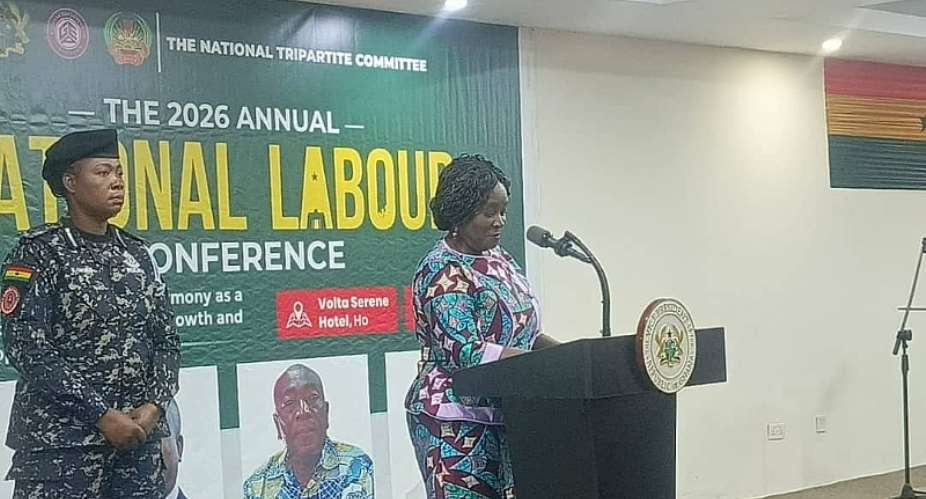
Professor Jane Naana Opoku-Agyemang, the Vice President, has announced that 2026 will not be a year for major renegotiation of conditions of service across the public sector as government focuses on implementing reforms to the country’s remuneration system.
Speaking at the 2026 National Labour Conference in Ho on Friday, held on the theme, “Strengthening Industrial Harmony as a Catalyst for Accelerated Economic Growth and National Development,” she said government had proposed targeted and modest improvements for selected sectors instead of comprehensive salary negotiations.
She explained that the decision was intended as an interim measure while foundational reforms to Ghana’s remuneration framework were being completed.
“Government has proposed that 2026 will not be a year for major renegotiation of conditions of service across the public sector. Instead, targeted and modest improvements in selected areas will be implemented while the foundational reforms to our remuneration systems are completed,” she said.
Prof Opoku-Agyemang noted that organised labour had appreciated the rationale behind the proposal, which was aimed at managing expectations, preserving industrial harmony, and creating the necessary space for the new remuneration framework to take effect.
She stressed that maintaining industrial peace remained critical to sustaining economic recovery and promoting national development.
The Vice President also reaffirmed government’s commitment to protecting the welfare of pensioners through the preservation of pension funds and the timely fulfilment of statutory obligations.
“The provision of decent pensions for retired workers is of utmost importance. Government remains committed to safeguarding the integrity and value of pension fund assets for the benefit of Ghanaian workers,” she said.
She assured contributors that the government would continue to honour its obligations to the Social Security and National Insurance Trust (SSNIT) and other Tier Two pension schemes. 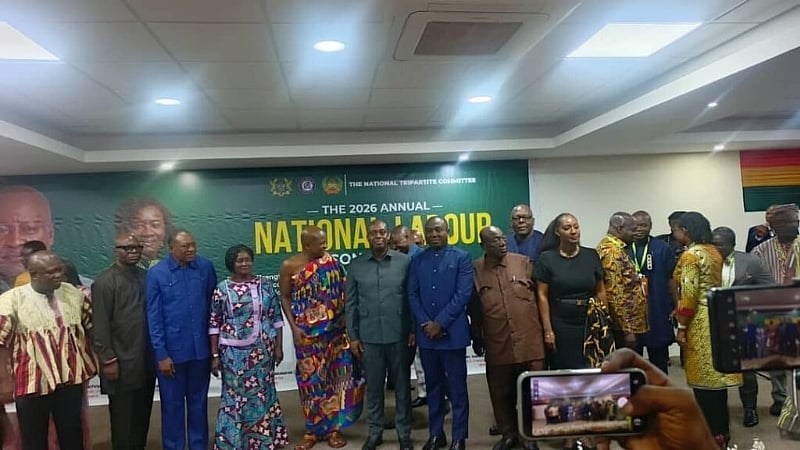
Prof Opoku-Agyemang further underscored the need to accelerate economic growth through strategic initiatives, including government’s proposed 24-hour economy policy.
She said the policy sought to maximise the utilisation of the country’s resources and productive capacity by encouraging businesses, factories and service providers to operate in multiple shifts.
According to her, the initiative would support Ghana’s transition to a fast-growing, export-driven economy, create more employment opportunities and enhance national productivity.
She called on organised labour, employers and all stakeholders to continue collaborating with government to strengthen industrial harmony and build a resilient economy capable of delivering sustainable growth and improved living standards for all Ghanaians.
GNA

 GoldBod’s gains must be weighed against full cost to Ghana – Prof. Bokpin
 ‘Afenyo-Markin’s smear campaign against me is about extortion’ – Sammy Gyamfi
 August 22: Cedi sells at GHS12.30 on forex market, GHS11.13 on BoG interbank
 There is a deliberate smear campaign against GoldBod from Minority – Sammy Gyamf...
 ‘If GoldBod wants credit, it must accept blame for losses’ – Dr Owusu Sarkodie
 Akosombo control system to be restored next month – Energy Minister
 ‘Temporary Akosombo system not very robust’ – Energy Minister on recent power ou...
 Mike Ocquaye Jr reacts to Adwoa Safo’s reported return to NPP Dome-Kwabenya race
 Foreign Affairs Ministry urges Tijjaniya pilgrims to Senegal to travel by air ov...
 Bono Police Arrest 36‑Year‑Old in GH¢1.1M Fake Gold Deal; Hunt for Three Others ...

