




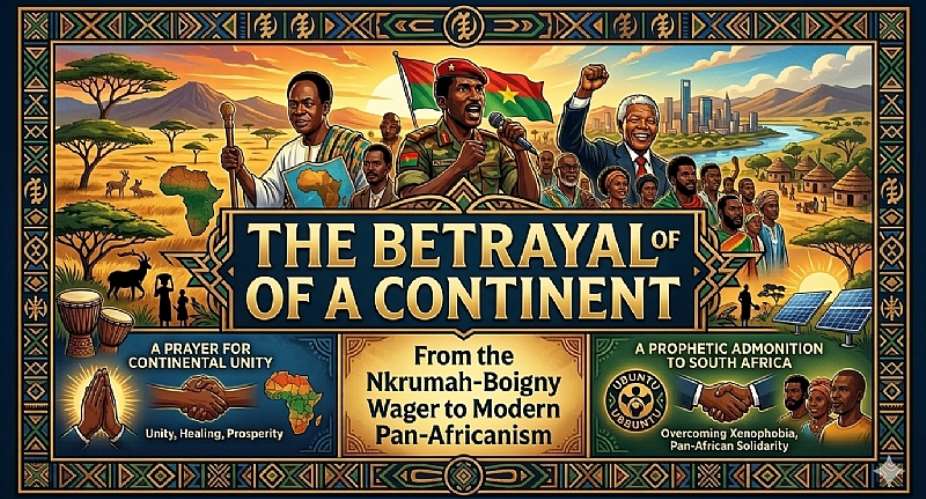
On March 6, 1957, Osagyefo Kwame Nkrumah declared that Ghana’s independence was meaningless unless linked with the total liberation of Africa. One month later, in April 1957, Nkrumah took his radical vision of a unified, socialist "United States of Africa" to Abidjan. There, he met Côte d’Ivoire’s first president, Félix Houphouët-Boigny. Instead of solidarity, Nkrumah was met with a challenge. Houphouët-Boigny, fiercely pro-French and capitalistic, proposed a ten-year "West African Wager" to see whose system would prosper. While Nkrumah built local industries and championed continental governance, Houphouët-Boigny actively worked with Western intelligence to preserve French hegemony (Françafrique).
The 1966 CIA-backed coup that overthrew Nkrumah was not just a tragedy for Ghana; it was a calculated fracture of continental unity. Decades later, Africa still bleeds from these internal divisions. As neo-colonialism mutates into new forms, and self-sabotaging xenophobia threatens the continent, the African youth must understand this history. To fulfill the promise of a truly sovereign continent, the youth must dismantle the borders in their minds and completely reject the divisive politics of the past.
The Historical Clash: Two Divergent Visions
The meeting in Abidjan in April 1957 set two irreconcilable political ideologies against each other:
- The Nkrumah Doctrine: Immediate, uncompromising independence from colonial powers, rapid state-led industrialization, and a centralized African High Command to defend the continent's resources.
- The Houphouët-Boigny Strategy: Maintaining deep neo-colonial economic, military, and political pacts with France, prioritizing localized wealth creation over continental integration.
- The Sabotage: Rather than a passive economic experiment, Houphouët-Boigny’s regime actively collaborated with French networks (led by Jacques Foccart) and the American CIA to isolate Ghana, culminating in the tragic 1966 coup.
- The Legacy of Destabilization: This established a dangerous blueprint where Ivorian soil was repeatedly used to anchor operations against revolutionary, anti-imperialist African leaders, from Thomas Sankara in Burkina Faso to Mathieu Kérékou in Benin.
From 1957 to 2026: The Modern Consequences of Division
The fractures sown by the anti-Pan-Africanist block in the 20th century directly explain Africa’s structural vulnerabilities today:
- The Illusion of Wealth: While Côte d'Ivoire initially boomed on cocoa capital, the Françafrique system left West Africa economically subservient, bound to currencies like the CFA Franc and dependent on foreign military bases.
- Economic Vulnerability: Because African nations chose individual arrangements over Nkrumah's economic bloc, the continent remains a supplier of raw materials rather than a unified manufacturing powerhouse.
- Geopolitical Impotence: Divided into 54 micro-states with artificial colonial borders, Africa struggles to negotiate as an equal on the global stage, vulnerable to modern forms of economic exploitation.
The New Threat: Internal Fractures and Xenophobia
The greatest modern tragedy is that Africans have turned their frustrations inward, embodying the very divisions the colonizers designed:
- The Tragic Irony of South Africa: During apartheid, nations like Ghana spent vast resources, offered passports, and dedicated diplomatic power to free South Africa. Today, systemic xenophobic attacks by some South Africans against fellow African migrants represent a profound betrayal of that pan-African solidarity.
- Scapegoating the Dispossessed: Xenophobia shifts the blame for systemic government failures, poverty, and unemployment away from bad governance and onto vulnerable African brothers and sisters.
- The Border Mental Barrier: The physical borders drawn at the 1884 Berlin Conference have successfully mutated into psychological borders, causing Africans to see neighboring nations as enemies rather than allies.
Strategic Recommendations for the Youth of Africa
The battle for a unified Africa now rests squarely on the shoulders of the digital generation. To honor Nkrumah's vision and defeat the legacy of internal betrayal, the youth must implement these strategies:
- Reject Xenophobic Regressiveness: Actively call out, condemn, and dismantle anti-African rhetoric online and offline; recognize that an injury to one African is an injury to all.
- Champion Intellectual De-bordering: Treat colonial-era national borders as administrative inconveniences rather than true cultural or human boundaries.
- Maximize the AfCFTA: Actively utilize, promote, and build businesses around the African Continental Free Trade Area to realize the economic integration Nkrumah fought for.
- Enforce Political Accountability: Hold local leaders accountable when they sign lopsided foreign security or economic pacts that compromise African sovereignty.
- Build Transnational Coalitions: Leverage social media, pan-African digital spaces, and cultural exchanges to organize cross-border movements for climate, economic, and social justice.
The history of the Nkrumah-Boigny wager teaches us that the greatest threat to African liberation has rarely been external force alone; it is the internal willingness to collaborate with our exploiters. Houphouët-Boigny may have won a temporary, material wager in the 1960s, but history has vindicated Kwame Nkrumah. The current generation of Africans faces a stark choice. We can either continue down the path of hyper-nationalism, internal sabotage, and xenophobic violence, or we can choose the arduous but necessary path toward radical continental unity. Africa will not be saved by foreign aid, nor will it be saved by fragmented, isolated nations fighting over crumbs. The youth must rise, look past the artificial borders of Berlin, and fiercely build the unified, powerful Africa that was stolen from us decades ago.
✍️ Retired Senior Citizen
For and on behalf of all Senior Citizens of the Republic of Ghana 🇬🇭
Teshie‑Nungua
[email protected]

 President Mahama to cut sod for Phase 2 of Sentuo Oil Refinery Project
 EC confirms plans to conduct by-election in Anyako electoral area
 Nima Police arrest truck driver after crash leaves many injured
 Here are NPP MPs seeking action against Ken Agyapong over Afari Hospital comment...
 There is no financial clearance to expand school feeding programme this year — G...
 Government to sanction caterers serving substandard meals under school feeding p...
 Rawlings’s legacy extends beyond political leadership — Vice President
 NACOC arrests key suspect in $296m Australia-linked meth case
 Current anti-LGBTQ bill not robust enough to protect family values — GPCC
 MFWA opens applications for Africa-China relations training for West African jou...


