




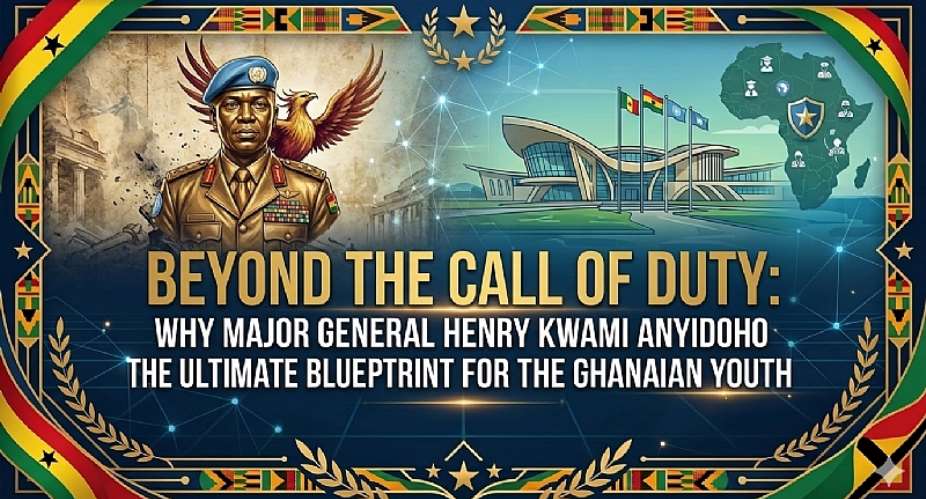
True heroism is not defined by medals pinned to a chest in times of peace, but by the moral decisions made in the absolute depths of human darkness. In 1994, as the international community turned its back on the Republic of Rwanda during the Genocide against the Tutsi, one Ghanaian commander chose humanity over a retreat order. When the United Nations instructed its peacekeepers to pack up and leave Kigali, Major General Henry Kwami Anyidoho looked into the abyss and prioritised human conscience over institutional bureaucracy. By staying behind, he and his courageous Ghanaian contingent saved over 30,000 lives.
Today, as physical monuments rise at Burma Camp and Ashesi University to institutionalise his bravery under the banner of Kwibuka, Ghana must look into the mirror. This article serves as an overdue celebration of an elite African statesman, enriched with direct accounts from his personal memoir, Guns Over Kigali. It is a profound wake-up call to a generation of young Ghanaians searching for a modern blueprint of leadership, integrity, and valor.
The Anatomy of Ghana's Bravest Hour
To truly understand the weight of General Anyidoho's legacy, we must revisit the horrifying landscape of Kigali in April 1994. Following the brutal assassination of Rwandan President Juvénal Habyarimana and ten Belgian peacekeepers, international political will completely collapsed. The UN Security Council issued immediate orders to drastically reduce the United Nations Assistance Mission for Rwanda (UNAMIR) forces.
While Western nations rushed to evacuate their personnel, the Ghanaian contingent—led by General Anyidoho alongside Canadian General Roméo Dallaire—refused to abandon the victims.
- The Brutality of the Reality: In his memoir, General Anyidoho captures the sheer scale of the carnage, writing:
“The militia went on the rampage and massacred in the hundreds and killed in the thousands. That was the period that the Rwandese needed us most.”
- A Choice of Conscience: When confronted with instructions to abandon their posts, Anyidoho made a choice that separated standard soldiers from historic leaders. He later reflected:
“We had to act according to the dictates of our conscience… That we wouldn't die under those circumstances, it could only be an act of God.”
- Turning Headquarters into Sanctuaries: Operating on critically low rations, minimal ammunition, and entirely cut off from global support, the Ghanaian battalion successfully turned their secured zones into impenetrable humanitarian corridors, actively shielding over 30,000 targeted civilians from certain slaughter.
- Continental Gratitude: This singular act of Pan-African solidarity laid the foundation for the deep diplomatic alliance between Ghana and Rwanda. This was permanently cemented when Rwandan President Paul Kagame officially awarded Anyidoho the National Order of Bravery, Rwanda’s highest military honor.
Key Recommendations: What the Ghanaian Youth Can Learn From the General
The modern youth face a different kind of war—one of economic stagnation, institutional rot, and a crisis of moral leadership. The blueprint left behind by General Anyidoho offers invaluable lessons for self-reformation:
- Develop an Unshakable Spine: The General teaches us that doing the right thing will often require standing alone against popular, safer, or easier options.
- Serve Beyond Self: True citizenship is not defined by what you can extract from your country, but by the value and protection you extend to your community when systems fail.
- Reject Mediocrity: In a society content with the bare minimum, the Ghanaian youth must cultivate strict institutional discipline, tactical intelligence, and professional excellence.
- Commit to National and Continental Duty: Young professionals must understand that their actions can dictate the global reputation of their country. Ghana's high reputation in international peacekeeping today was bought by the blood and stubborn resolve of veterans like Anyidoho.
Major General Henry Kwami Anyidoho is a towering testament that true greatness lies in preserving human dignity when it is most dangerous to do so. The permanent "Kwibuka Flame of Hope" monument recently unveiled at Burma Camp by the Ghana Armed Forces (GAF) should serve as more than a physical structure. It must become a moral compass for every young Ghanaian. True heroes do not wait for bureaucratic permission to protect human life; they step up when the rest of the world steps away. It is time for Ghana to actively celebrate its living legends and build a generation that is truly worth dying for.
Historical Footnotes
- UNAMIR Mandate Collapse: Following the April 7, 1994 killings of Belgian soldiers, the UN Security Council passed Resolution 912 on April 21, reducing UNAMIR troops from 2,548 down to a skeletal crew of 270. General Anyidoho's decision to maintain his 454-man Ghanaian battalion directly countered the logistical assumptions of the reduction order.
- Kigali Security Corridors: As detailed in Guns Over Kigali, the Ghanaian troops guarded strategic locations including the King Faisal Hospital and the Amahoro Stadium, which became safe havens for thousands of displaced Tutsis.
- The Rawlings Briefing: Upon his return to Accra, General Anyidoho was strictly questioned by President Jerry John Rawlings regarding the immense safety risks taken. Anyidoho defended the action as a non-negotiable human obligation, a stance President Rawlings later highly commended.
The Irony of the Crab and the Bird 🦀 Versus 🐦
In traditional Ghanaian folklore, the classic Twi proverb, "Okoto nwo anoma" (The crab does not give birth to a bird), reminds us that children naturally mirror the precise traits, quiet demeanor, and specific temperaments of their parents. Yet, human nature often presents us with captivating deviations from this rule.
Enter the fascinating familial contrast between the stoic, historically disciplined Major General Henry Kwami Anyidoho and his highly vocal, politically dramatic son, Samuel Koku Anyidoho.
The contrast between the two generations is as sharp as day and night:
- The Father (The Quiet Anchor): General Anyidoho's entire professional existence has been defined by extreme military reserve, absolute institutional discipline, diplomatic tact, and a lifetime spent evading unnecessary public spotlights. He is a man who let his quiet actions in Kigali do the roaring for him.
- The Son (The Rebel Firebrand): Koku Anyidoho, conversely, carved out a reputation as a fiercely combative political warrior, a passionate media firebrand, and a highly rebellious political operative within Ghana's partisan landscape. Far from a quiet diplomat, Koku leans heavily into public confrontational rhetoric and fierce factional battles.
This stark generational divergence beautifully flips the old proverb on its head. In this peculiar branch of family history, the rigid, structured walk of the military "crab" somehow produced a free-flying, unpredictable, and highly rebellious political "bird." It serves as an amusing yet profound reminder that while our ethical foundations and patriotism can be deeply inherited, our personal expressions of character are uniquely our own.
✍️ Retired Senior Citizen
For and on behalf of all Senior Citizens of the Republic of Ghana 🇬🇭
Teshie‑Nungua
[email protected]

 Kwesi Pratt challenges claims that restrictions on bus preaching is an attack on...
 Here are four steps outlined by Lands Commission for conducting online land sear...
 Appointing NDC’s Emelia Agbenyo to EC part of 'reset' to 'tilt the balance of pa...
 14-year-old JHS student dies after allegedly setting herself ablaze at Mpraeso A...
 Attorney General proposes independent disciplinary framework for lawyers
 Ghana's religious diversity is our most precious possession — Mahama
 Assemblies of God to loan 10,000-seater dome to Foreign Affairs for Ghana at 70 ...
 Ghana is safer now than before — Mahama
 Court dismisses Afenyo-Markin’s GH¢15m defamation suit against Sammy Gyamfi over...
 NDC’s Affi Agbenyo appointment seeks to balance EC’s partisan composition – Hamz...


