




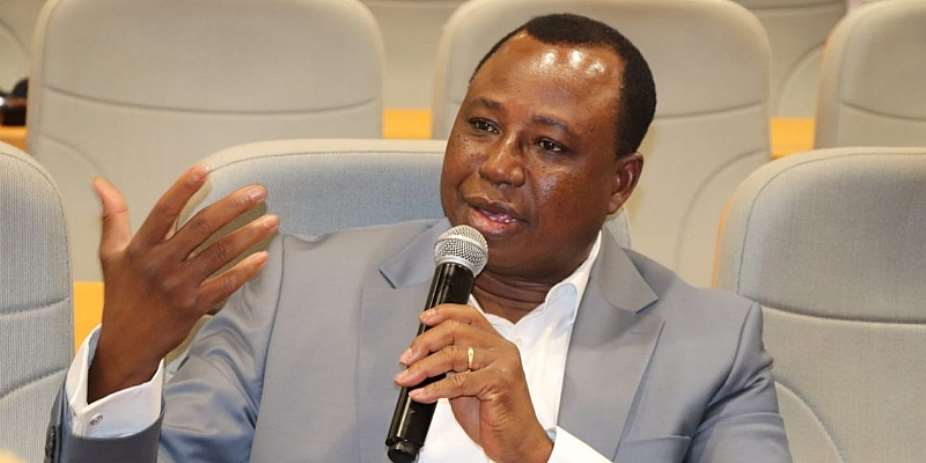
The Commission on Human Rights and Administrative Justice (CHRAJ) receives about 10,000 complaints annually, placing considerable pressure on its investigative capacity.
Financial constraints and the complexity of cases sometimes result in delays in the completion of investigations and the publication of reports.
Dr Joseph Akanjolenur Whittal, Commissioner of CHRAJ, disclosed this in an interview with the Ghana News Agency on the sidelines of a public forum on corruption in Accra.
The forum, organised by the Media Foundation for West Africa (MFWA) in collaboration with CHRAJ, Transparency International Ghana and the National Commission for Civic Education (NCCE), was on the theme: “Restoring Citizens' Trust in the Fight Against Corruption in Ghana: The Role of the Media.”
Dr Whittal said many of the complaints received by the Commission required extensive investigations and evidence gathering across different locations.
“The complaints that come are not small complaints. Your staff must move all over the place to gather evidence. If I don’t have money to give to my investigators to go and carry out over, some complaints will certainly suffer,” he said.
He explained that the Commission’s limited resources, coupled with the volume of complaints, often affected the speed of investigations.
Dr Whittal urged the media to pursue corruption-related stories beyond the initial reports and follow them through to their conclusion.
He also called on journalists to focus on the substance of cases rather than the identities or political affiliations of persons involved.
“We should not be thinking of the name of the person and maybe the political party he or she may belong to. That should not be the case. Every case must be treated with scrutiny and importance,” he stressed.
Mr Sulemana Braimah, Executive Director of the MFWA, said public perceptions played a significant role in the fight against corruption, irrespective of whether they reflected reality.
“What matters, therefore, is that perceptions shape behaviour. When citizens lose trust in institutions, they become less likely to report corruption and support accountability efforts or believe that change is possible,” he said.
“That is a challenge we must all confront because that is perhaps our reality today,” he added.
The event also featured the passing-out ceremony of participants of the Next Generation Investigative Journalism (NGIJ) Fellowship, a three-month training programme for early and mid-career journalists from West Africa.
The fellowship provides advanced training in investigative and data journalism.
GNA
 Residents renew calls for action as flooding worsens along Santasi–Ahenema Kokob...
 Government imposes curfew on Nkwanta South communities after deadly attack
 Three charged in Australia over alleged attempt to import methamphetamine hidden...
 “NPP says I am bitter; If they provoke me, I will spill the beans everywhere” — ...
 A/R: Police arrest suspect linked to car snatching syndicate, two alleged accomp...
 'English-only Parliament censors majority' — Prof Kwesi Yankah warns
 Flood waters submerge parts of Samreboi after heavy rains
 Section 25 of Gold Board Act should be amended to prevent mandate overlap, finan...
 'Lend your influence to NPP’s healing' — Bryan Acheampong appeals to Kennedy Agy...
 Let us lay down the weapons of internal warfare — Bryan Acheampong to NPP member...


