




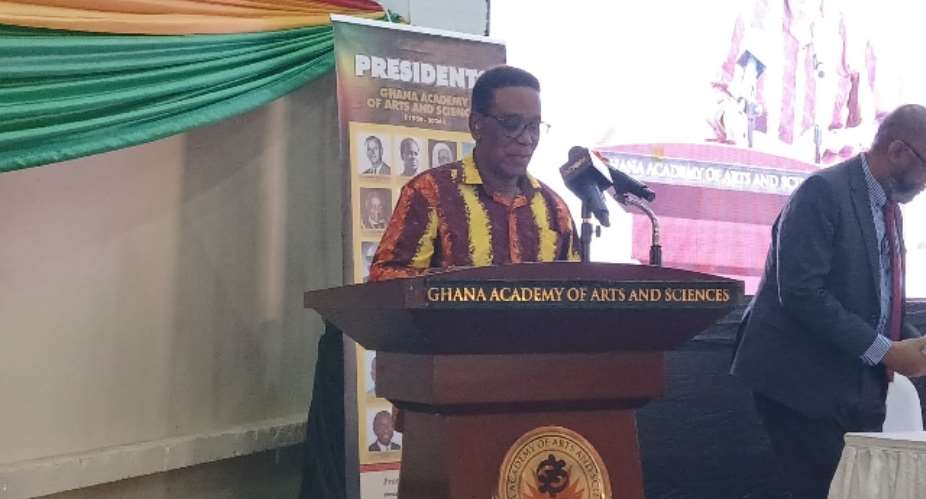
Emeritus Professor Kwesi Yankah has criticised Ghana's continued reliance on English as the dominant language of governance and parliamentary proceedings, arguing that it limits participation in the country's democratic process and excludes many citizens from meaningful engagement.
Speaking at a symposium on Language and Political Participation organised by Indiana University and its local partners, Prof. Yankah said Ghana's democratic progress over the past three decades has largely been assessed through economic indicators, with insufficient attention paid to inclusiveness and citizen participation.
According to him, effective participation in democratic governance depends heavily on language, yet many Ghanaians are disadvantaged because official state institutions continue to operate primarily in English.
“Stakeholder participation is a key ingredient in democracy. But the efficacy of one's participation depends on one's control over linguistic resources,” he stated.
Prof. Yankah observed that English remains the language of the Executive, Legislature and Judiciary, despite the fact that only a small proportion of the population is proficient in it. He argued that this creates a contradiction within a democratic system that is supposed to represent the interests of the majority.
He further noted that the ability to speak English is often wrongly equated with education and intelligence, while those who are not fluent in the language are frequently regarded as illiterate.
“The popular index of education is one's ability to speak English. As long as one lacks proficiency in the colonial language, one is considered illiterate, with all its derogatory connotations,” he said.
The former Minister of State cited Parliament's Standing Orders, which designate English as the official language of parliamentary proceedings and permit the use of local languages only when interpretation facilities are available.
He argued that the arrangement places an unfair burden on Members of Parliament who may wish to contribute in Ghanaian languages, as they are often expected to provide their own translations.
Reflecting on his own experience in Parliament in 2019, Prof. Yankah recounted being challenged over allegations that he was reading a prepared speech. He also praised former Amenfi East MP Mercy Adu-Gyamfi for delivering a memorable parliamentary contribution despite having only a Basic Education Certificate Examination qualification and spending months preparing for her presentation.
He noted that although the majority of MPs in the Seventh Parliament held university degrees, parliamentary procedures can still be intimidating for new members who are unfamiliar with the conventions of legislative debate.
While acknowledging constitutional provisions that protect freedom of expression and provide for interpreters in court proceedings, Prof. Yankah argued that existing frameworks do not adequately guarantee broad participation in governance.
He welcomed what he described as modest progress in the Ninth Parliament, citing an instance in February 2025 when a legislator was permitted to make a contribution in a Ghanaian language.
Prof. Yankah stressed that although formal education remains important, it should not be regarded as the sole measure of knowledge or wisdom.
“The importance of literacy is indispensable. But formal education should not be confused with wisdom,” he said.
He urged policymakers to place greater value on indigenous languages and oral traditions, warning against perceptions that African languages are inferior to colonial languages.
According to him, discussions about language and participation have frequently been raised over the years but have often failed to influence public policy.
He expressed hope that renewed attention to the issue would encourage reforms aimed at making Ghana's democratic institutions more inclusive and accessible to all citizens.
 Residents renew calls for action as flooding worsens along Santasi–Ahenema Kokob...
 Government imposes curfew on Nkwanta South communities after deadly attack
 Three charged in Australia over alleged attempt to import methamphetamine hidden...
 “NPP says I am bitter; If they provoke me, I will spill the beans everywhere” — ...
 A/R: Police arrest suspect linked to car snatching syndicate, two alleged accomp...
 'English-only Parliament censors majority' — Prof Kwesi Yankah warns
 Flood waters submerge parts of Samreboi after heavy rains
 Section 25 of Gold Board Act should be amended to prevent mandate overlap, finan...
 'Lend your influence to NPP’s healing' — Bryan Acheampong appeals to Kennedy Agy...
 Let us lay down the weapons of internal warfare — Bryan Acheampong to NPP member...


