




The panic was audible in the sailor's SOS message shortly after a US missile hit a tanker off the coast of Oman.
“We have fire on board. We have fire on board and vessel is sinking,” began the frantic call of the sailor on board the Marivex.
“Please help. Please help. We have fire on board … All crew Indian, 24 crew. All crew Indian. Please help quickly. Please, we need immediate help.”
The message to Indian authorities was released by an Indian seafarer's union earlier this month, as the US military targeted commercial shipping vessels in the Gulf of Oman while enforcing a US naval blockade.
The Marivex crew were lucky. All 24 sailors were saved by the Omani navy on June 8. But a day later, the US military killed three Indian sailors on board the Settebello in the Gulf of Oman in the third such attack in a week, forcing India's foreign ministry to lodge a “strong protest” with the US.
The US Central Command (CENTCOM) statement on the Settebello attack was brisk and arrived with aerial video of the tanker disappearing in black smoke as powerful munitions hit the vessel.
“U.S. forces disabled an oil tanker in the Gulf of Oman for the second consecutive day after another vessel violated the ongoing blockade by attempting to transport oil from Iran,” said the statement. “A U.S. aircraft fired precision munitions into the ship's engine room after the crew repeatedly failed to comply with directions from American forces.”
As families grieved and Indian media provided wall-to-wall coverage of the latest tragedy on the high seas, the top US diplomat spoke to his Indian counterpart in New Delhi. But the phone call only increased the outrage. During his conversation with Indian Foreign Minister Subrahmanyam Jaishankar, US Secretary of State Marco Rubio “underscored that violations of the U.S. blockade and the illicit transport of Iranian oil will not be tolerated”, noted the State Department readout.
“US offers no regret over Indians killed in strike,” read news headlines as opposition politicians asked why the US military could not use non-lethal means to halt non-compliant commercial vessels.
“How can a 'friend' and strategic partner be so insensitive?” asked Shashi Tharoor, a Congress Party MP and former UN under-secretary-general.
India-US ties have frayed since President Donald Trump returned to the White House. The once-celebrated “bromance” between Indian Prime Minister Narendra Modi and the US leader – highlighted by exuberant “Howdy Modi” and “Namaste Trump” rallies in 2019 and 2020 – has since chilled.
The Iran war, with its blockade of vital shipping lanes, has brought the oil import-dependent nation of more than a billion people to the brink of an energy crisis. Trump has slapped India with punishing 50% tariffs, headlines decry the deportation of Indian students in the US for voicing support for the Palestinian cause, and opposition leaders now call Modi Trump's “obedient servant”.
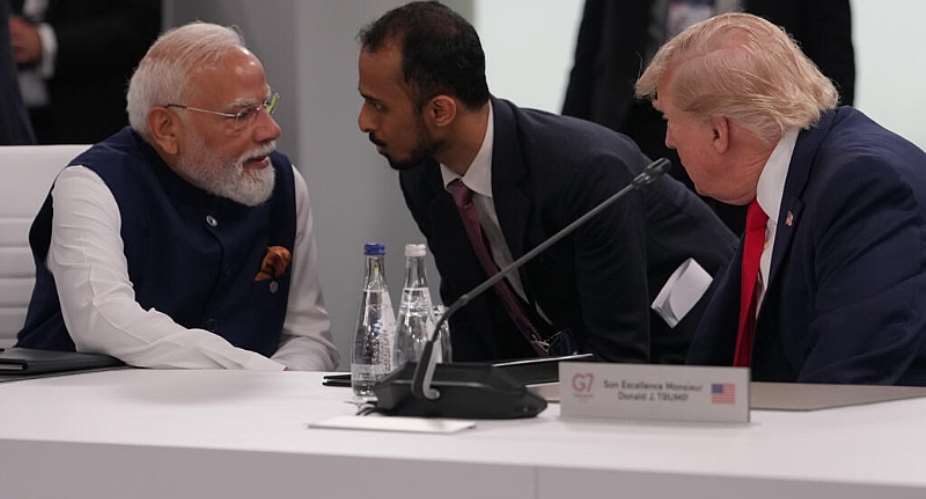
When Modi holds talks with Trump on the sidelines of the G7 summit on Wednesday, the Indian leader arrives with baggage in the form of a host of bilateral issues to be sorted. India is not a member of the G7, but is among the countries invited to join the summit. On Tuesday, the two leaders greeted each other ahead of a plenary session in the first face-to-face interaction between the two leaders since Modi's February 2025 trip to the US to congratulate Trump on his re-election. Much has changed since, and analysts are questioning whether a desire for good optics will obscure the substantive issues at stake when the leaders of the world's most powerful and most populous democracies meet.
Protecting the lives of civilians in conflict zones
India is no stranger to the fallout of conflicts and crises in the Middle East. With its massive workforce, impoverishment, and proximity to oil-rich Arab states, India has a long history of trade and labour ties with the region. In just the six Gulf Cooperation Council (GCC) states – comprising of Bahrain, Kuwait, Oman, Qatar, Saudi Arabia and the UAE – India has more than 9 million workers. The country also accounts for around 12% of the world's maritime workforce, making India among the world's top three suppliers of seafarers.
In the past, wars in the Middle East have triggered huge logistical operations in New Delhi to repatriate Indian nationals trapped in the conflict zone. When Iraq's Saddam Hussein invaded Kuwait in 1990, for instance, India conducted one of the world's largest airlifts, evacuating more than 170,000 nationals in less than two months to safety.
The killings of Indian sailors during the Iran war, however, have raised troubling questions on several fronts.
“The US is a strategic partner of India. The fact that, despite knowing that these vessels are manned by Indian sailors, the US military has targeted these vessels, raises questions about the nature of the India-US relationship,” noted Sushant Singh, a lecturer in South Asian studies at Yale University.
“The second question which it raises is about Mr. Modi's foreign policy, about the whole idea of strategic sovereignty. What does India's policy of strategic sovereignty or independence mean if it cannot really protect the lives of its own citizens,” he added.
Lack of 'political will'
The problem, according to Singh, does not lie in India's logistical capabilities. “The Indian capacity has not been lost,” he noted. “The bigger question is about the political will – and whether the current Indian government has the political will when a superpower like the United States is involved.”
While Foreign Minister Jaishankar summoned the US envoy in New Delhi to register India's “strong protests” about the attacks on its civilians, Modi has not publicly acknowledged or addressed the issue.
Analysts say the sailors' deaths are unlikely to dominate discussions during the Trump-Modi meeting in Evian-les-Bains. Trade is likely to take centre stage as India engages in tough negotiations to get preferential tariff treatment as part of a bilateral trade agreement. Trump also arrives at the meeting after reaching a deal with Iran aimed at ending the war, which will be signed at Switzerland's mountainside Burgenstock resort on Friday.
“I don't think Mr. Modi would want to say anything, including about the killing of these Indian sailors, that would offend President Trump,” noted Singh.
In Israel, Modi chooses a side
India is not alone in having to manage an unpredictable and irascible president in the White House. What distinguishes New Delhi's latest foreign policy bind from the others is that it stems, to a large extent, from Modi's abrupt departure from India's historic diplomatic positions. This rupture was presented to Indian domestic audiences as a personalised, triumphalist outcome of Modi's visionary capacity to engage with the world's strongmen.
But the Iran war has undermined the strongman narrative.
It started back in February, when Modi was warmly welcomed by Prime Minister Benjamin Netanyahu during a visit to Israel. Just days before Israel joined the US in declaring war on Iran, a country with historic ties to India, Modi addressed the Knesset on February 25 and declared that “India stands firmly with Israel”.
Read more Brothers-in-arms: How Modi and Netanyahu are bringing India are Israel closer together
Modi's Knesset address was delivered in the thick of a massive US military buildup in the region amid Trump's promises to protesting Iranians that “help is on its way”.
“It reflected very poorly on the Indian government. Very few leaders have gone to Israel to support Benjamin Netanyahu, who is caught in a lot of controversies, including corruption scandals, and he's also charged with war crimes,” said Singh, referring to the International Criminal Court's November 2024 arrest warrant for the Israeli leader.
Read more 'Bibi Files' reveals Israeli police investigations behind Netanyahu's graft trial
“India under Mr. Modi had chosen a side. They clearly wanted to be seen on the side of Israel and the United States, and the UAE, rather than being seen as taking a more balanced position,” said Singh.
Pakistan in the spotlight, India on the sidelines
In the weeks and months after the visit, the fallout from the Modi administration's break with a decades-old Indian foreign policy position of supporting the Palestinian cause was full display.
As India sat on the sidelines of a major crisis in its neighbourhood, its archenemy Pakistan rose to the challenge, engaging in a high-profile role to find a diplomatic solution to the Iran war.
Read more Pakistan in the middle: Islamabad steps up diplomatic role
“Pakistan seems to have hit a strategic sweet spot with whatever it has been able to achieve because of the very close ties that Field Marshal [Pakistani Defence Chief Asim] Munir has with President Trump, and the fact that the Iranians trusted them enough to go to Pakistan or to invite them to Iran,” Singh said.
The Modi administration's policies have also made Pakistan's diplomatic success difficult for India to digest.
“It reflects poorly on India, because Mr. Modi's government over the last ten years has followed a strategy of diplomatically isolating Pakistan – that Pakistan should be completely isolated diplomatically, that nobody should engage with Pakistan and it should be treated as a kind of a pariah country globally for sponsoring terror, etcetera. And that strategy has clearly failed,” noted Singh.
'Riding the US-Israel bandwagon without a seat belt'
The Iran war has also exposed the weakness of the Modi administration's much-touted “multi-alignment” strategy that replaced New Delhi's old, non-aligned foreign policy, which came to be viewed as a passive position of keeping rival superpowers at arm's length.
Multi-alignment “was a dynamic engagement with nations and groups of nations guided by a transactional notion of the national interest”, explained Indian historian and novelist Mukul Kesavan in a recent op-ed. But “in effect, it implied a decisive re-orientation of Indian foreign policy towards the US and its allies, particularly Israel”, Kesavan noted. “Our predicament in the Gulf and our irrelevance to conflict resolution there are down to India riding the US-Israel bandwagon without a seat belt.”
When India continued to buy Russian oil after Moscow's full-scale invasion of Ukraine, for instance, Jaishankar was a vocal proponent of New Delhi's multi-alignment, swatting away Western remonstrations.
It could work while the going was good, Singh explained. “They were just seeing it as an opportunistic move, that we will take advantage of anything that comes our way without paying a price for it. While the times were good, you could do that. You could take advantage of your ties with Russia at some point in time, your ties with America at another point in time. But when things became bad, and when a situation emerged out of a war between the US and Iran, you could no longer play that game,” he said.
Modi's meeting with Trump in France will be followed by a visit by US Trade Representative Jamieson Greer to India next week. That's when some of the difficult, technical issues of a bilateral trade deal are expected to be tackled. There was a time when diplomacy could ease negotiations during tough trade talks. But times have changed.
“This whole crisis in the Middle East, including the war on Iran, has revealed that there are structural problems between between India and the United States,” said Singh. “The kind of political costs that Mr. Modi is paying for the killing of sailors, the kind of economic crisis that India has faced, the importance of Pakistan, has all clearly showed that the rhetoric of a great strategic partnership is not what it is actually on the ground.”

 Mahama inaugurates five-member Independent Fiscal Council, demands objective ove...
 Trump tells Putin he wants swift end to Ukraine war, Kremlin says
 Poor refereeing destroying Ghana's football — Mahama
 No businessman will sponsor NPP again because of its ‘evil and greedy nature’ – ...
 Failure to jail corrupt NPP officials will haunt NDC in election 2028 – Hopson A...
 Illegal miner who posed as pastor to defile student jailed 15 years
 Mamprugu Youth calls for crackdown on fake Facebook accounts over alleged false ...
 Mahama appoints Dr Abdul-Baasit Aziz-Bamba as Acting Director-General of Value f...
 2024 teacher recruits’ salary arrears processed — GES
 NPP's failure to continue E-blocks projects worsened SHS placement crisis — Tank...

