




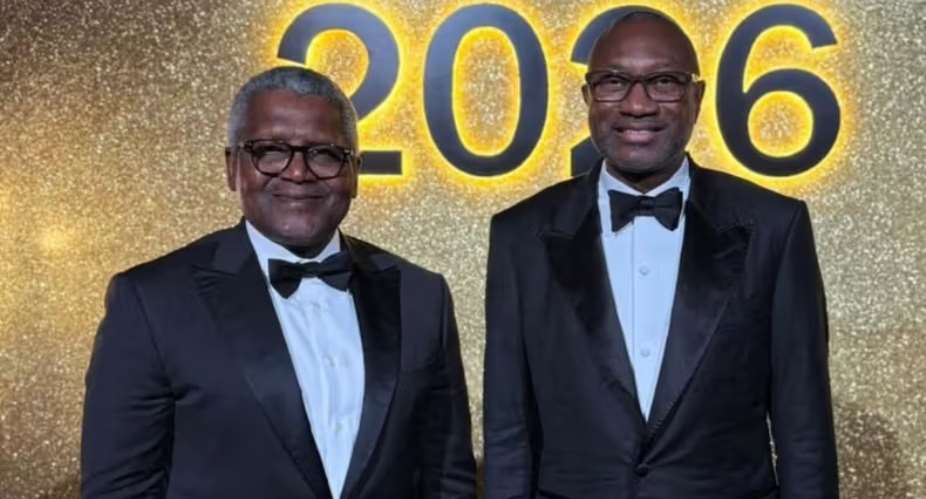
Let me tell you a story about two very rich Nigerians. Their names are Aliko Dangote and Femi Otedola. Between them, they control billions of dollars in assets, employ thousands of people, and shape the economic direction of West Africa. But the way they think about money, about risk, and about the future could not be more different. And if you are a small business owner in Accra, a trader at Kejetia, or someone trying to save a few cedis every month, their choices carry a lesson for you. Because the same questions they are asking about where to put their millions are the questions we should be asking about where to put our thousands.
Let me start with the news that just broke. Femi Otedola, the billionaire chairman of Geregu Power, just increased his stake in First HoldCo Plc, one of Nigeria's largest financial groups. He bought an additional 549.5 million shares, worth about 31.9 million dollars. That is not a typo. Thirty-one point nine million dollars in one single purchase. The transaction happened on May 13, just two days ago, at an average share price of 79 naira. This is his largest single share purchase since he became chairman of the financial institution in January 2024. After this acquisition, his total stake in First HoldCo has risen to 19.36 percent. He now owns 8.6 billion shares of that company. Billion with a B.
Now, this did not happen in isolation. Otedola has been steadily buying more shares for over a year. In September 2025, he acquired another 64.87 million shares worth about 1.48 million dollars. So he is clearly betting big on Nigeria's banking sector. And why not? First HoldCo has been performing well. Strong interest income, solid profits, and a strategic recapitalisation effort that positions it for growth across Africa. Otedola is putting his money where his mouth is.
But here is where the story gets interesting. At the same time that Otedola is buying Nigerian bank shares, he is also buying something else. A luxury mansion in London. According to Bloomberg and Accra Street Journal, he acquired a property in St John's Wood, one of the most exclusive neighbourhoods in the British capital, for about 53 million pounds. That is roughly 70 million dollars. The mansion has ten bedrooms, a private cinema, spa facilities, and even a cigar room. It was originally listed for 75 million pounds in 2020, so he got it at a discount, but still. Seventy million dollars on one house. That is more than the entire annual budget of some Ghanaian government agencies.
Now contrast that with Aliko Dangote, Africa's richest man. Dangote recently told the press that he sees little value in buying expensive overseas mansions. He said he prefers to stay in hotels when he travels. He explained that he sold all his properties in the United States, two big mansions, and a house in the United Kingdom, to focus on his industrial investments in Nigeria. His argument is simple. Why tie up billions of dollars in buildings that just sit there when you can put that money into factories, refineries, and farms that produce things, create jobs, and build the economy? Dangote has invested billions into his cement business, his fertiliser plant, his petrochemical complex, and of course, his massive 20 billion dollar refinery in Lagos. He wants to produce, not just preserve.
So you have two billionaires. One is buying a London mansion and Nigerian bank shares. The other is selling his foreign properties and pouring everything into local industry. One is diversifying into international real estate and financial services. The other is concentrating on manufacturing and infrastructure. Who is right? The answer is not simple, and that is exactly why I am telling you this story.
Here is the lesson for Ghana. These two men are responding to the same economic reality that we all face. Currency volatility, inflation, political risk, and the challenge of protecting wealth over time. Dangote's strategy says, "I will invest in productive assets that generate income and cannot be easily taken away because they are too big and too important." Otedola's strategy says, "I will spread my risk across different countries and different asset classes so that if one market goes down, the others protect me." One is betting on Nigeria's long-term industrial future. The other is hedging his bets with London real estate, which has historically held value even when African currencies have crashed.
Which approach makes more sense for the ordinary Ghanaian? You are not a billionaire. You do not have millions to spread across continents. But you do have savings, maybe in mobile money, maybe in a bank account, maybe in goods that you trade. You are trying to protect your money from the cedi's fluctuations and from inflation that eats away at your purchasing power. The lesson from Dangote and Otedola is that there is no single right answer. It depends on your goals, your risk tolerance, and your time horizon.
If you are a young person with a business idea, Dangote's approach might inspire you. Put your money into something productive. Buy tools, inventory, equipment. Start something that makes things or provides services. Do not just hoard cash or buy things that do not generate income. That is how you grow. But if you are closer to retirement or you have dependents who rely on you, Otedola's approach might make more sense. Diversify. Do not put all your eggs in one basket. Keep some savings in stable assets, maybe even in foreign currency if you can, to protect against the worst shocks. Because the reality is that Ghana's economy, like Nigeria's, still has ups and downs. The cedi still fluctuates. Inflation can still surprise you.
Let me also address the elephant in the room. Some people will read this and say, "These billionaires are just rich men playing games. What does it have to do with me?" But that misses the point. The choices of people like Dangote and Otedola shape the investment climate for everyone. When Dangote builds a refinery, it reduces Nigeria's need to import fuel, which affects regional prices, including in Ghana. When Otedola buys a London mansion, he is moving capital out of Africa, which weakens the naira and by extension affects the cedi because our economies are connected. These are not isolated acts. They are signals. And we ignore them at our own peril.
There is another angle to this that I find fascinating. Dangote recently rejected an offer from the Nigerian National Petroleum Corporation to increase its stake in his refinery ahead of a planned listing per report by The High Street Business. He wants to keep control. He wants to prove that African industry can succeed without government interference. Otedola, meanwhile, is deepening his involvement in Nigeria's banking sector just as the government is pushing for recapitalisation and consolidation. He sees opportunity in finance. Dangote sees opportunity in manufacturing. Both are valid. But both require confidence in the system. Neither man would be investing billions if they thought Nigeria was about to collapse. That is important for Ghanaians to remember. Yes, there are problems. But the people with the most money to lose are still betting on West Africa.
So what should you do? I am not a financial advisor. I cannot tell you exactly where to put your pesewas. But I can tell you this. Pay attention to how wealthy people think about risk. They do not put all their money in one place. They do not panic and sell everything when there is bad news. And they do not ignore the long term. Dangote is thinking about the next twenty years. Otedola is thinking about preserving what he has built. You should do both. Invest in yourself, in your skills, in your business. But also save something for the rainy day. Keep some money in a place where it will not lose value overnight. And never stop learning. Because the economy will keep changing. The cedi will keep moving. And the only way to survive, let alone thrive, is to understand the game and play it with your eyes open.
One final thought. The fact that two Nigerian billionaires can disagree so fundamentally about investment strategy is actually a sign of a healthy economy. It means there are choices. It means the market is not dead. It means people can bet on different outcomes. In Ghana, we need more of that. We need more people willing to invest locally, like Dangote. And we need more people diversifying and bringing global perspectives back home, like Otedola. What we do not need is fear. Fear makes you do nothing. And doing nothing is the surest way to lose. So watch these two men. Learn from their choices. And then make your own. Because your future, like theirs, depends on what you do today.
.

 Ghana's development is first a moral project, not an economic one — Chief Justic...
 National House of Chiefs settles Bunkpurugu chieftaincy dispute, affirms Jamong ...
 Kumasi: KMA directs closure of commercial activities for July 11 metro-wide clea...
 We have set up committee to develop national database on shrines — Ahmed Ibrahim
 9,090 Assembly Members were paid GHS1,300 monthly allowance each in 2025 — Local...
 Mali rebels attack convoy of Russian reinforcements headed to besieged military ...
 NIA, IOM to begin special Ghana Card registration in border communities from Jul...
 Expedite implementation of Community Service law — Samson Anyenini urges gov't
 NACOC arrests 10 in Cape Coast anti-drug operation
 Nkoko Nkitinkiti beneficiaries have been consuming the birds given to them for r...

