




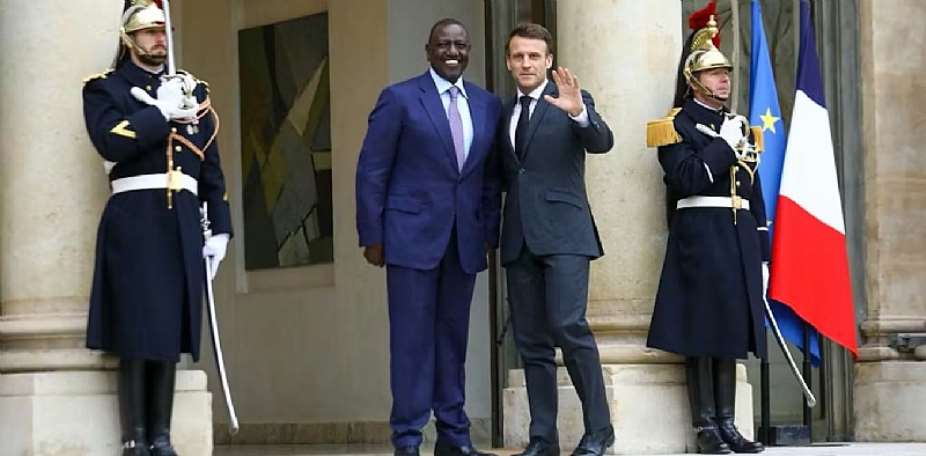
The 2026 Africa-France summit in Nairobi on May 11-12 is the first to be held in an African country that is not a former French colony. It is also the first to be held since the dramatic collapse of relations between France and a number of west African countries – notably Mali, Burkina Faso and Niger.
The 2026 summit can be understood as the latest example of President Emmanuel Macron's new Africa doctrine, which he laid out in Burkina Faso in 2017. The doctrine's three notable messages were:
an apology for colonial wrongs
a neoliberal small-business approach to assistance programmes
the French resolve to develop new alliances outside French Africa.
In keeping with the new doctrine, the French president hesitantly apologised in 2021 for some aspects of French colonial policy in Algeria. These include the torture and assassination of the Algerian nationalist hero Ali Boumendjel.
But mostly, Macron has looked to strengthen the position of Paris as old alliances were becoming weaker.
He has consciously invested time and effort beyond French west Africa. The official visit to Guinea-Bissau, a former Portuguese colony, is a case in point.
Right after his election in 2017, France's development aid agency (AFD) and the Tony Elumelu Foundation signed an agreement in Nigeria to empower a new generation of business leaders. Tony Elumelu Foundation is a Lagos-based non-profit that promotes youth entrepreneurship across Africa.
Macron then promoted entrepreneurship during the New France-Africa Summit in 2021. He sought to inspire the youth of Africa to innovate and set up businesses.
This year's conference is held under the banner: “Africa Forward: Partnerships between Africa and France for innovation and growth”. The business start-up vibe is no coincidence.
Kenya has also stressed the groundbreaking nature of the meeting for its focus on Africa as a major partner for Europe. Europe is looking for new allies in the midst of a war in Ukraine; and the US is unreliable, with Donald Trump imposing tariffs and questioning the North Atlantic Treaty Organisation.
As a historian of global north-global south relations, I see the meeting less as groundbreaking, and more as a continuation of an older, mutually beneficial relationship between Kenya and France.
Kenya hopes its relationship with France will elevate its influence across Africa, allowing it to rival the diplomatic weight of South Africa, which hosted the G20 summit in November 2025.
By transcending the classic divide between French and British Africa, Nairobi can present itself as a continental leader and as a diplomacy city.
History of the relationship between France and Kenya
The economic and diplomatic relationship goes back to the 1960s and 1970s. Back in September 1970 France sent a little-known legal expert called Jaques Mollet to advise the Kenyan Ministry of Industry and Commerce on the newly-formed East African Community.
France also sought cooperation with institutions of the East African Community such as the East African Development Bank. By becoming a close partner of a newly established regional economic bloc in Africa, in which Nairobi played a pivotal role, the French Ministry of Foreign Affairs sought to weaken the British influence of Africa while strengthening its own position within the European Economic Community, now the EU.
Paris somewhat cynically justified its meddling as a way to strengthen continental unity since a French and a British sphere of influence in Africa would lead to unnecessary internal competition between the Commonwealth countries in Africa and Françafrique.
Kenya sought to strengthen its trade relations with France and the EEC in the 1960s. This was partly an attempt to become more independent of the Commonwealth. When negotiating with the EEC in 1963, an east African delegation that included Kenya's Minister of Labour Tom Mboya stressed that maintaining the East African Common Market was key – not the Commonwealth.
Ruto and Macron's shared understanding
The similarities between Kenya's President William Ruto and Macron further strengthen this historical bond between Kenya and France. They share the same diplomatic goals. They are both focusing on climate change funding and security, and they share a preference for neoliberal privatisation as a mode for governance at home and abroad.
Ruto's election campaign in 2022 touted the “hustler nation” – a focus on enabling small businesses. Macron has acted as a businessman-diplomat abroad, pushing small businesses as a solution for underdevelopment.
It's no accident therefore that the 2026 summit will host a business forum and talks will focus on the potential benefits of artificial intelligence. AI, climate initiatives and weapons manufacturing, as well as the small-business ventures that have emerged through these priorities, are areas of cooperation and investment between African countries and the former colonial powers. Politicians like to flaunt this.
Part of the reason is that these are yet unproven ventures with no long history of unequal exchange between the two sides. They are natural common ground for two sides seeking a renewed relationship that is less burdened by the dark history of colonial oppression.
Yet France and Kenya's agreement about the need to address security, climate change and artificial intelligence obscures the fact that both countries often find themselves on opposing sides of these issues.
As the Russian invasion of Ukraine in 2022 has shown, African and European leaders do not necessarily share the same analysis of the global security situation. European countries assumed they would get complete support from African countries but only 28 out of 54 African countries voted in favour of a United Nations resolution that condemned the Russian invasion of Ukraine. Kenya abstained.
On issues like climate change and artificial intelligence, France and Kenya again agree on the broad principle that these issues require urgent action, but disagree on the form the action should take.
For instance, climate change has hit Kenya hard. Extended droughts require genuine climate action. At the same time, France and the EU have been talking about loosening climate regulations to address the energy crisis caused by the US war on Iran. This includes easing emission regulations for cars.
The same problem presents itself in relation to the AI economy, which is being championed by France. It is cheap labourers in Kenya that have been doing much of the legwork to keep AI applications going. Large language models and other applications need to be trained and monitored by humans and they are often trained in Kenya's so-called “AI sweat shops”. Kenyans are doing much of the data labelling and content moderation AI work.
Long term relationship?
In essence, the summit illustrates how climate finance, security and AI are being used to bolster commercial interests in both Africa and France, a strategic attempt to redefine a relationship long shadowed by colonialism.
However, the future of this entrepreneur-led approach remains uncertain. Its success hinges on whether France and Kenya can ensure that the wealth generated by these emerging sectors is distributed broadly, or if it will merely enrich a small circle of tech elites.
Frank Gerits does not work for, consult, own shares in or receive funding from any company or organisation that would benefit from this article, and has disclosed no relevant affiliations beyond their academic appointment.
By Frank Gerits, Research Fellow at the University of the Free State, South Africa and Assistant Professor in the History of International Relations, Utrecht University
 Accra Is Sinking Yet Again — Time to Be Truthful With Ourselves
 Fire guts rubber factory at Circle Odawna as flooding hampers firefighting effor...
 Flooding strands commuters on Winneba Cape Coast Highway
 Three feared dead after electrocution in Alajo flooding incident
 Nine missing after floods hit Awutu Senya East
 'Your mother, I should go to heaven and ask Nebuchadnezzar to stop the rain?' — ...
 Flood victim found dead along Alajo Railway track as rescue operations continue
 GMet warns more rain as flooding disrupts movement across Greater Accra
 'You sit on social media and talk nkwasiasem' — Nigel Gaisie blasts critics over...
 Osahen Afenyo-Markin accuses NDC of using GoldBod to promote illegal mining
