




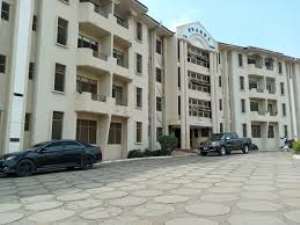
Students and housing advocates are demanding urgent government intervention over rising hostel and rent costs across universities and communities in Ghana, describing the situation as exploitative and increasingly unbearable for many families.
Speaking on Metro TV’s Good Afternoon Ghana on Thursday, May 7, 2026, student leaders and tenant representatives recounted the impact of high accommodation costs on students’ welfare, safety, and access to education.
The discussion followed recent inspections by the Rent Control Department at private hostels around the University of Professional Studies, Accra (UPSA) amid complaints about exorbitant accommodation fees.
Student activist Selma Yoda said many students are being forced to pay huge amounts for accommodation despite poor conditions and inadequate facilities.
“When I was in KNUST, back in KNUST, as you mentioned, you’d be in the traditional hall for just a year. The following years, it’s out, out, out,” she said.
According to her, hostel operators often increase fees arbitrarily without engaging students.
“They just bring a notice that the following year, you’re supposed to pay this amount, and to me, it’s not right,” she stated.
She cited conditions at Brunei Complex in Kumasi, where she said students continue to face water shortages and poor maintenance despite rising accommodation charges.
“It was around GHS4,000 there. Now, 2026, you are paying GHS8,470. You go and they’ve not painted the room. Water issues still stand. We don’t even have elevator,” she said.
Selma Yoda also recounted cases of students struggling to secure accommodation near campus.
“I remember there was a particular lady who approached me. She had been able to pay her school fees by God’s grace, but now accommodation is a problem. She was sleeping in a church which was even far from campus,” she disclosed.
She warned that students commuting long distances, especially at night, are exposed to security risks.
Haruna Osmanu, Chief Clerk of the University of Ghana Parliament House, also described the accommodation situation on the Legon campus as alarming.
“I’m in my second year and I live on campus and also a private hostel,” he said.
He explained that in his first year, four students occupied a room while each paid GH¢6,400 annually.
“Now, I took three in a room, which is GHS9,000. Each person is paying GHS9,000,” he added.
According to him, students often return to school only to discover that accommodation fees have increased without prior notice or consultation.
“They don’t dialogue with you. You come back and you’re told that these are the new prices. So if you can’t afford, you just have to leave,” he lamented.
He added that many students resort to “patching”, where extra students unofficially stay in rooms to reduce accommodation costs despite hostel regulations prohibiting the practice.
The Director of Communications and Corporate Affairs for the National Tenants Union of Ghana, Reindolf Afrifa Oware, described the country’s housing situation as a full blown crisis.
“When it comes to housing, we have moved from this housing challenge in Ghana to housing crisis. It’s a crisis,” he said.
He argued that the Rent Act, 1963 (Act 220), has become ineffective because the institutions mandated to enforce it lack the resources and capacity to function properly.
“The system that has been built, which is the Rent Control Department, that is supposed to control and manage the housing situation, is equally almost incapable,” he stated.
Afrifa Oware said inspections at some university hostels revealed overcrowding and excessive charges.
“We realised that even the room spaces is about eight by four and you have about four people occupying this,” he said. “This is pure exploitation.”
According to him, some hostels charge as much as GH¢8,800 per student in shared rooms while students are still required to pay separate electricity bills.
He also criticised the practice where hostel operators rent out rooms to sandwich students during vacation periods after regular students have already paid for the same spaces for the academic year.
“The space that you have paid for, when the school vacates, you pack out everything and that same space is given out to sandwich students,” he said.
The discussion further highlighted challenges in the broader rental market, including issues involving accommodation agents, advance rent demands, and alleged rental scams.
Host Desmond Okraku Danso disclosed that he once lost GH¢10,000 in a rental arrangement in Accra.
Participants called on government to expand student accommodation infrastructure and strengthen the Rent Control Department to enforce housing regulations effectively.
Selma Yoda warned that rising accommodation costs could eventually deprive many young people of access to education.
“Education is a right, not a privilege. If we don’t do anything about these issues, trust me, education will become a privilege, not a right anymore,” she said.
 Credit Godfred Dame for Ghana's US$393 million tax arbitration victory against T...
 How can EOCO be accused of wanting to kidnap Baffour Awuah in full glare of the ...
 'She is not party operative' – Kwakye Ofosu defends EOCO officer
 Baffour Awuah wanted over alleged financial loss, dissipation of public funds an...
 Brazil is the main source of cocaine in Ghana by sea concealed in sugar containe...
 'The cacophony of noises surrounding my comments were pure mischief' — Chief Jus...
 ‘Judges must not abandon their humanity because of their judicial office’ – Chie...
 GTEC flags over 100 tertiary institutions as unrecognised
 Political protection may be behind decline in visible cocaine trafficking in Gha...
 Ghana identified as source of explosives used in Sahel conflicts — Crime Index r...


