




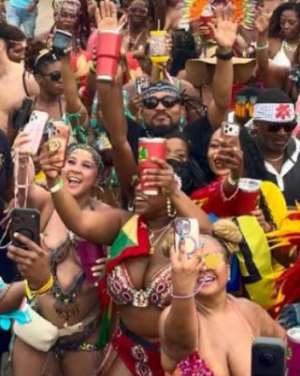
What was billed as a joyful homecoming a Caribbean carnival brought to the African motherland has instead ignited one of Ghana's most heated public debates of 2026. The Karnival Kingdom Festival, held in Accra from April 22 to 28, has left behind a trail of controversy, a demand for criminal investigation, and a fundamental question that goes far beyond one week of music and dancing: whose values govern public space in Ghana?
What Was Karnival Kingdom?
The Karnival Kingdom Festival was promoted as the first major Accra Carnival, featuring Caribbean carnival elements including street parades, soca music, and cultural performances. It was held at the Labadi Beach area in Accra and drew carnival enthusiasts from around the world.
Organizers described it as a bold new premium experience a fusion of soca, dancehall, and Afrobeats framed as a reunion between the African diaspora and the motherland, where carnival culture was being brought back to the place where its spirit was born.
The vision was ambitious and the marketing was powerful. The reality, however, proved deeply controversial.
The Problem: Public Nudity Under Police Protection
The event drew widespread criticism after videos of participants in revealing attire circulated on social media, with reported incidents of public nudity during the festival.
What made the situation far more explosive was not just the nudity itself it was who was present while it happened. The Ghana Catholic Bishops' Conference strongly condemned acts of public nudity recorded during the festival, describing the incident as a violation of Ghanaian laws and a threat to national values and specifically noted that the event took place under police protection.
The Bishops expressed concern that state agencies responsible for protecting public order may have facilitated rather than prevented the misconduct, citing Section 278 of the Criminal Offences Act, 1960 (Act 29).
The central question became unavoidable: why were Ghanaian police officers deployed to protect participants who were allegedly breaking Ghanaian law?
The Church Speaks Out
In a statement signed by Most Rev. Matthew Kwasi Gyamfi, President of the Ghana Catholic Bishops' Conference, the bishops stated: "The event was an eyesore, denigrated our values as a nation and breached the laws of our land."
The Conference did not stop at condemnation. They called for an immediate and thorough investigation into the circumstances surrounding the event, particularly the role of state institutions, and questioned who approved the permits and the deployment of police to protect participants engaged in what they described as unlawful conduct.
The Bishops cautioned that while cultural exchange and international festival influences are welcome, such events must still operate within Ghana's legal framework and respect established public standards. Their position was unambiguous: an imported event does not get to import its own laws.
Parliament Weighs In
The controversy was not confined to the Church. Member of Parliament for Assin South, John Ntim Fordjour, called for investigations into events that occurred during the festival, and was commended by the Catholic Bishops' Conference for raising concerns over the matter.
His intervention widened the debate into Parliament raising questions about permitting processes, government oversight, and whether Ghana's tourism and events licensing framework is adequate to prevent a repeat.
The Deeper Issue: Culture vs. Law
At its core, the Karnival Kingdom controversy is not simply about one festival. It is about a collision that is playing out across Africa wherever diaspora-organized events land on home soil.
The bishops highlighted a growing tension between globalised festival culture and Ghana's legal and cultural framework, stressing that an imported event cannot claim exemption from Ghanaian law and that cultural exchange must respect the host nation's laws and values.
The organizers promoted Karnival Kingdom as a homecoming a return to roots. But many Ghanaians watching the videos that circulated online asked a pointed question: whose roots, exactly? Caribbean carnival has its own history, its own costumes, its own norms of expression. Transplanting it wholesale into Accra, without localizing it to meet Ghana's legal and cultural standards, was always going to be a test. That test was failed.
What Happens Next?
The Ghana Catholic Bishops' Conference urged authorities to conduct an impartial investigation without political interference, and called for a review of event permitting procedures, stricter public decency guidelines, and a national conversation on the limits of cultural expression in public spaces.
The investigations, if conducted thoroughly, will need to answer several hard questions: who approved the permits? Who authorized police deployment? Were the officers present instructed to intervene if the law was broken and if so, why did they not? And what does Ghana's events licensing process look like going forward for large international festivals?
A Public Interest Verdict
Ghana is not against carnival. Ghana is not against the diaspora coming home. Ghana is not against joy. What Ghana is and what this story confirms is a country that takes seriously the tension between global cultural influence and local legal sovereignty.
The Karnival Kingdom Festival raised a mirror to that tension. What Ghana does with the reflection is now a matter of law, governance, and national identity not just entertainment regulation.
The music has stopped. The questions are still playing.
Mustapha Bature Sallama.
Medical/ Science Communicator,
Private Investigator, Criminal investigation and Intelligence Analysis.
International Conflict Management and Peace Building.USIP
[email protected]
+233-555-275-880

 Accra Is Sinking Yet Again — Time to Be Truthful With Ourselves
 Fire guts rubber factory at Circle Odawna as flooding hampers firefighting effor...
 Flooding strands commuters on Winneba Cape Coast Highway
 Three feared dead after electrocution in Alajo flooding incident
 Nine missing after floods hit Awutu Senya East
 'Your mother, I should go to heaven and ask Nebuchadnezzar to stop the rain?' — ...
 Flood victim found dead along Alajo Railway track as rescue operations continue
 GMet warns more rain as flooding disrupts movement across Greater Accra
 'You sit on social media and talk nkwasiasem' — Nigel Gaisie blasts critics over...
 Osahen Afenyo-Markin accuses NDC of using GoldBod to promote illegal mining
