




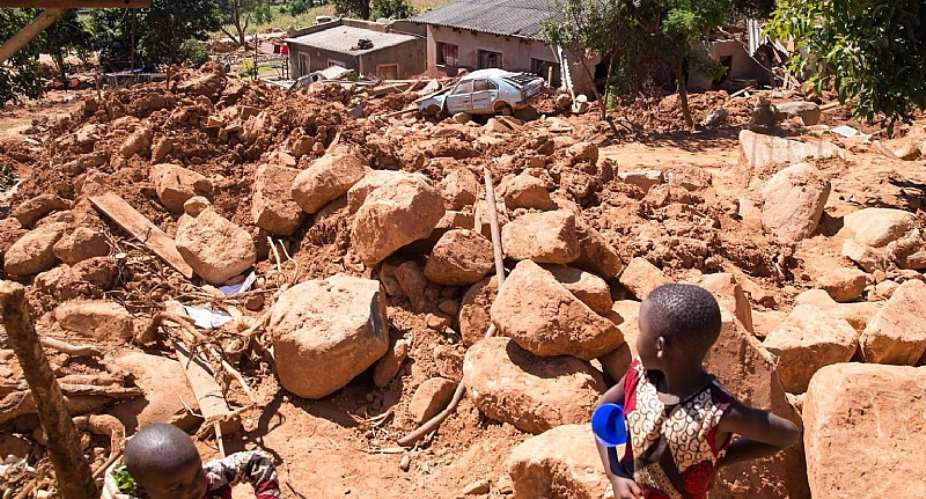
When environmental hazards strike, the damage is usually counted in numbers: how many people died, how many homes were destroyed, how many people were displaced, and how much money it will take to rebuild.
But not all losses and damage can be measured in financial terms. Some of the most profound impacts of climate-induced disasters are emotional, cultural and social, affecting how people feel, relate to each other and think about their world.
We are scientists who research environmental hazards, climate change impacts and development practice. We wanted to find out what recovery meant for survivors of Tropical Cyclone Idai, which hit eastern Zimbabwe's Chimanimani District for five days in 2019, turning mountains into mudslides and leaving hundreds of people dead.
We interviewed community members, including survivors and local leaders, and held discussions with government officials and aid organisations. We also spent time in affected communities, observing daily life and listening to how people spoke about the disaster and its aftermath. This allowed us to capture not just what had happened, but what it meant to those who'd lived through it.
Our research found that survivors of climate disasters didn't only speak of losing their houses and other material goods. They also talked of grief, dislocation, loss of places of cultural significance, and a lingering sense that life would never return to what it once was.
These experiences are harder to quantify, but no less important. If recovery efforts overlook these less visible losses, they leave deep social and emotional wounds unaddressed.
Disaster recovery is not just about rebuilding material objects or infrastructure. It is about rebuilding lives.
The hidden losses
Tropical Cyclone Idai affected over 3 million people across Malawi, Mozambique and Zimbabwe. In many places, it destroyed whole communities. In eastern Zimbabwe's Chimanimani District hundreds died, many people went missing, and thousands were displaced from their ancestral lands. Cyclone Idai, 2019. Al Jazeera.
The cost of the economic losses and damage was more than US$2 billion. This amount does not include the non-economic losses – the damage to people's sense of belonging, identity, relationships and emotional well-being that cannot be measured by money.
Our findings show that Cyclone Idai caused four major types of non-economic loss:
Loss of life and lasting trauma
The cyclone caused floods in the middle of the night, while people were sleeping, leaving them little chance to escape to higher ground before their houses collapsed or were washed away. Many families lost loved ones and said that grief remained a constant presence. A survivor told us:
What changed most is that we were a big family, but we lost two kids due to the cyclone. That alone has changed our lives and has affected us very much. We can hardly move forward because of these bad memories that we still have.
More than two years after the cyclone, some people said they still lived with injuries that prevented them from working or living as they once did. Mental health impacts, including anxiety, insomnia and post-traumatic stress, are widespread yet rarely addressed in formal recovery efforts.
Loss of sense of place and belonging
Displacement was one of the most significant consequences of the tropical cyclone. Families were moved to temporary camps and, later, resettled in new areas that were often very different from their original homes.
For example, people who had survived by farming and selling bananas were moved to a government housing compound (Runyararo village), where low rainfall makes it difficult to grow the fruit.
Their new area also has no tarred roads or electricity, yet people who had lived in urban and peri-urban areas were moved there. For many, this meant more than just relocation. It involved losing connection to ancestral land, familiar environments and ways of life. As one survivor described, it felt like being uprooted not just physically, but emotionally and culturally.
Breakdown of social networks
Before the cyclone, communities in Chimanimani were tightly connected through kinship, shared histories and mutual support systems. The disaster fractured these networks by separating families and neighbours. One survivor said:
We lost our younger daughter to the tropical cyclone. The older one is now living with my parents in another village, as we no longer have space … Since then, we have been helpless.
Well-intentioned aid agencies had various ways of describing the cyclone survivors – as “victims”, “directly affected people” or “beneficiaries or non-beneficiaries of disaster aid”. Our research found that using different labels for the survivors created new social tensions within communities that were already under strain.
Disruption of cultural and spiritual life
Tropical Cyclone Idai also disrupted cultural practices and belief systems. Sacred sites were destroyed, and burial rituals, which are deeply significant in local traditions, could not always be properly observed. Bodies were handled hastily due to damaged mortuaries, the absence of electricity, and acute labour shortages.
Some people were buried in pairs, which is against the Ndau culture of the area. A cultural leader said:
It was not proper to bury people who were not related, who did not share a totem, in one grave.
Breaking with established burial customs created a sense of spiritual unease and disturbed the moral and cultural order that helps people make sense of life and death.
A more human approach to disaster response
Climate change has been shown to intensify extreme weather events like Cyclone Idai, increasing both their severity and impacts. This is why disaster policies matter, including what governments and agencies do after extreme weather catastrophes.
Our research shows that disaster response must go beyond financial compensation and physical reconstruction. It must support survivors with the emotional and non-material dimensions of well-being.
Most importantly, it should involve affected communities in decision-making, ensuring that their experiences and priorities are recognised.
This is also a matter of justice. Whose losses are acknowledged? Whose voices are heard, and who gets support?
The stories from Chimanimani remind us that extreme weather and climate disasters tear apart the very fabric of life. When attention is focused mainly on what can be seen and measured, other forms of suffering remain invisible. But these “invisible” losses shape how people recover.
Emotional trauma can affect livelihoods. Loss of social networks can weaken resilience. Disconnection from place and culture can make it harder to rebuild a meaningful life.
Listening to these experiences is essential for building recovery efforts that are both effective and humane.
The authors do not work for, consult, own shares in or receive funding from any company or organisation that would benefit from this article, and have disclosed no relevant affiliations beyond their academic appointment.
By Denboy Kudejira, Post-doctoral fellow in the African Synthesis Centre for Climate Change, Environment and Development (ASCEND) research centre, University of Cape Town And
Christopher Mabeza, Part-time Lecturer in the Department of Peace, Security and Society and Climate Change Consultant, University of Zimbabwe And
Liboster Mwadzingeni, Research Fellow in the Tugwi-Mukosi Multidisciplinary Research Institute, Midlands State University; University of South Africa
 Accra Is Sinking Yet Again — Time to Be Truthful With Ourselves
 Fire guts rubber factory at Circle Odawna as flooding hampers firefighting effor...
 Flooding strands commuters on Winneba Cape Coast Highway
 Three feared dead after electrocution in Alajo flooding incident
 Nine missing after floods hit Awutu Senya East
 'Your mother, I should go to heaven and ask Nebuchadnezzar to stop the rain?' — ...
 Flood victim found dead along Alajo Railway track as rescue operations continue
 GMet warns more rain as flooding disrupts movement across Greater Accra
 'You sit on social media and talk nkwasiasem' — Nigel Gaisie blasts critics over...
 Osahen Afenyo-Markin accuses NDC of using GoldBod to promote illegal mining
