




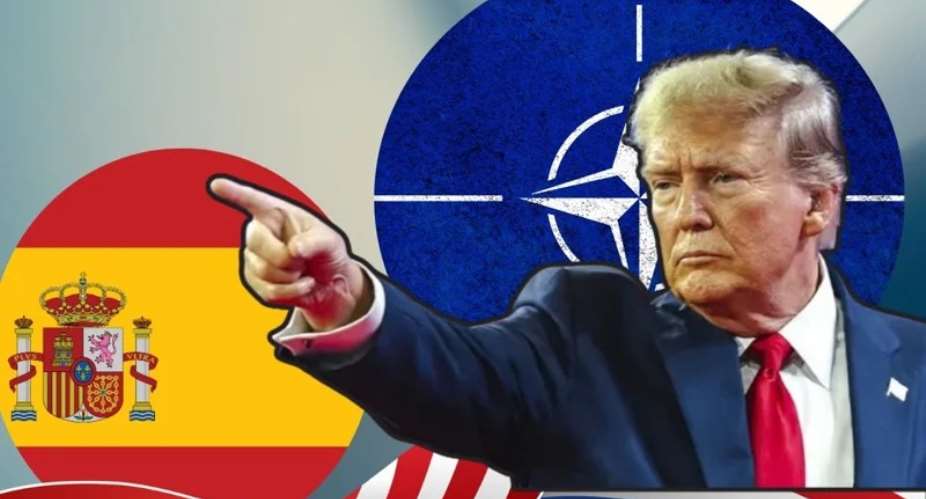
Intellectual giants are in painfully short supply in the Trump administration, but if there was anyone who might lay claim to cerebral weight of any sort, Elbridge Colby might be one of them. Self-styled as a China hawk, the US Under Secretary of War for Policy must privately be bemused by the changeling that has become US foreign policy, one now latched onto, yet again, the issues of the Middle East and the shaking tail that is Israel. President Donald Trump, the man who promised to end wars and terminate the state of permanent conflict the US has found itself in for decades, is sticking to bad habits.
These bad habits have not been appreciated by various allies, notably members of NATO. Spain, France and Italy have shown varying degrees of icy reserve to the use of their bases and airspace by US forces in striking Iran. The UK has been less firm on the issue, though its unpopular Prime Minister Sir Keir Starmer is adamant that no troops will be committed to the operation. These countries have also given the cold shoulder to deploying troops in any forceable operation to open the Strait of Hormuz.
Of all the allies, Spain has proven a model objector, arguing that the pre-emptive war launched by Israel and the US on February 28 was and remains illegal. Spanish Prime Minister Pedro Sánchez has stated at length, both in writing and in the press, that the assault was a chilling reminder about what happened in February 2003, when US Secretary of State, Colin Powell, spun that now all too familiar lie before the UN Security Council that Iraq not only had weapons of mass destruction, but was bound to use them, directly or through some unscrupulous proxy. “Today we face a similar situation,” wrote Sánchez in The Economist, “and my government’s position is the same as that voiced by Spanish society two decades ago: NO TO WAR. No to the unilateral violation of international law. No to repeating the mistakes of the past. No to the idea that the world’s problems can be solved with bombs.”
Spain has also peeved officials in Washington for being the least enthusiastic of the NATO partners in increasing defence spending to 5% of GDP. At the June 2025 NATO summit held at The Hague, Sánchez insisted that all members of the alliance had “the right and the obligation to choose whether or no to assume those sacrifices, and we as a sovereign country choose not to do so.” Spain would, he promised, spend 2.1% of its GDP on defence “to acquire and maintain all the personnel, equipment and infrastructures requested by the alliance to confront these threats with our capabilities.” Spain’s opposition reaped the appropriate concession from NATO Secretary-General Mark Rutte, who confirmed that Madrid be granted “the flexibility to determine its own sovereign path for reaching the Capability Target goal and the annual resources necessary as a share of GDP, and to submit its own annual plans.”
At the time, Trump raged that he would make Spain “pay twice as much” through tariffs if they continued to maintain their more frugal stance on military spending. “Spain is the only country that refuses to pay. They want a free ride – but I won’t let that happen.”
With Trump officials seething at European reluctance to muck in regarding the Iran conflict, options for retaliation are germinating in Washington. Some of these are available in a disciplinary note penned by Colby in considering the reluctance on the part of some allies to grant the US ABO (access, basing and overflight rights). ABO was the “absolute baseline for NATO.”
Spain is particularly important in this regard, given its hosting of two vital US facilities. Naval Station Rota (NAVSTA Rota), located in southern Spain, is described by the Pentagon as offering support for “Naval Forces Europe Africa Central (EURAFCENT), 6th Fleet and Combatant Commander strategic priorities by providing airfield and port facilities, security, force protection, logistical support, administrative support and emergency services to all US and NATO forces.” Morón Air Base, located near Seville, is seminal for operations given its proximity to the Mediterranean, Africa and Middle East.
In the email, Colby, according to a Reuters report, considers policies that are intended to decrease “the sense of entitlement on the part of the Europeans”. Member states deemed “difficult” might be suspended from essential or prestigious positions in the alliance. The claim by Britain to the Falkland Islands might also be reviewed.
Pentagon Press Secretary Kingsley Wilson, when asked about the plausibility of the email, summed up the moody atmosphere without giving much in the way of details. “As President Trump has said, despite everything the United States has done for our NATO allies, they were not there for us.” The Pentagon would “ensure that the President has credible options to ensure that our allies are no longer a paper tiger and instead do their part. We have no further comment on any internal deliberations to that effect.”
Sánchez sees little reason to worry. “We do not work based on emails,” he told reporters in response to Colby’s ruminations. “We work with official documents and official positions taken, in this case, by the government of the United States.” Madrid was all for “full cooperation with its allies, but always within the framework of international law.”
Much blather on suspension or expulsion is likely to remain just that. NATO’s founding treaty does not expressly stipulate the grounds for expelling recalcitrant members. Article 13 notes that, after the Treaty has been in force for two decades, “any Party may cease to be a Party one year after its notice of denunciation has been given to the Government of the United States of America, which will inform the Governments of the Parties of the deposit of each notice of denunciation.”
The removal of any members from the 32 strong club is also likely to create much messy mayhem, given the consensus principle that members tend to follow on issues of significance. Security analyst Jack Buckby, writing in 19FortyFive, proposes a military disincentive as well. “Spain sits on NATO’s southern flank and controls valuable territory along the Atlantic and Mediterranean coasts. It also hosts infrastructure that the alliance already uses, and weakening that position to punish Madrid would carry a cost for NATO.” Yet another notch of distraction in an administration that specialises in the subject.
Dr. Binoy Kampmark was a Commonwealth Scholar at Selwyn College, Cambridge. He currently lectures at RMIT University. Email: [email protected]

 Police arrest two as search intensifies for missing couple
 Three Akosombo units restored after fire incident — Energy Ministry
 'Weep not for rude CEOs, weep for your dying nation' – Kwesi Yankah tells Julius...
 UCC lecturer, TA die in accident
 Malaria deaths fall by 98% since 2011 – GHS
 Two-month salary arrears for newly recruited nurses paid — Health Ministry
 'We'll complete all Big Push projects on schedule' — Roads Minister assures
 Voltaian Basin Project: GNPC Explorco engages Yaa Naa, stakeholders ahead of dri...
 Senyo Hosi praises Ayine’s role in OSP creation, urges broader policy approach t...
 PUWU condemns ECG staff transfers, reassignment


