




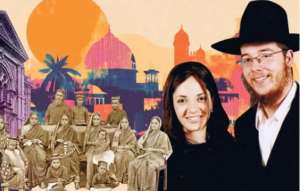
An Ancient People in an Unlikely Land
When most people think of Jewish communities around the world, India rarely comes to mind. Yet the Indian subcontinent is home to one of the oldest, most diverse, and most fascinating chapters in Jewish diaspora history a story stretching back more than two millennia, across several distinct communities, each with its own legends of origin, traditions, and destiny.
India is home to three historically distinct Jewish communities: the Bene Israel ("Sons of Israel"), the Cochin Jews, and the Baghdadi Jews. It is thought that the first Indian Jews were members of the biblical "Lost Tribes of Israel," having settled on the Malabar Coast after the Assyrian conquest of the Kingdom of Israel in the ninth century BCE.
Community One: The Bene Israel "Sons of Israel"
The largest and most storied of India's Jewish communities is the Bene Israel, whose origins are shrouded in both legend and genetic science.
The Founding Legend
The Bene Israel community believes that their ancestors fled Judea during the persecution under Antiochus Epiphanes and are descended from fourteen Jews seven men and seven women who came to India as the only survivors of a shipwreck near the village of Navagaon on the coast about 20 miles south of Mumbai. Some historians have thought their ancestors may have belonged to one of the Lost Tribes of Israel.
They took up the work of oil pressing and running grocery shops but abstained from working on the Sabbath, and hence were called Shanivar Teli meaning "Saturday oil-presser."
What Science Says
Genetic analysis points to the Bene Israel being an admixed population with both Jewish and Indian ancestry, with the genetic contribution of each being substantial. The admixture took place in the last millennium, about 19 to 33 generations ago. It involved Middle Eastern Jews and was sex-biased, with more male Jewish and local female contribution, followed by a population bottleneck and high endogamy.
Isolation, Rediscovery and Revival
The medieval Jewish philosopher Maimonides may have been referring to the Bene Israel when he wrote: "The Jews of India know nothing of the Torah, save for the Sabbath and circumcision." At a point in history which is uncertain, an Indian Jew from Cochin named David Rahabi discovered the Bene Israel in their villages and recognized their vestigial Jewish customs. Rahabi taught the people about normative Judaism, training young men among them to be religious preceptors of the community
Rise Under British Rule
Under British colonial rule, many Bene Israel rose to prominence in India; they were less affected by discriminatory legislation and gained prominent positions within the colonial government and the Indian Army, at a higher rate overall than their non-Jewish counterparts. In the early part of the 20th century, many Bene Israel became active in the Indian film industry as actresses, actors, producers, and directors.
Community Two: The Cochin Jews Keepers of a Royal Covenant
The oldest of the Indian Jewish communities was in the erstwhile Cochin Kingdom. The traditional account is that traders of Judea arrived at Cranganore, an ancient port near Cochin, in 562 BCE, and that more Jews came as exiles from Israel in the year 70 CE, after the destruction of the Second Temple. Many of these Jews' ancestors passed on the account that they settled in India when Hebrew King Solomon was in power.
Cochin Jews settled in southern India, around modern-day Kochi, and quickly earned the favor of regional rulers, receiving copper plates that indicated the assumption of important positions under local leaders. They were allowed to practice Jewish life freely and openly, and were quite successful in maintaining Jewish religious practices while also assimilating into the local culture. The Kerala Jewish community consisted of several sub-groups. The Paradesi Jews came to India from Spain and Portugal in the 15th and 16th centuries following the expulsions from Spain in 1492 and Portugal in 1497. Other Jews also immigrated from Arab countries such as Yemen and Iran, and from Europe, during the 18th and 19th centuries. The city of Cochin has an area known as "Jew town," where the synagogue is located.
Community Three: The Baghdadi Jews Merchants of the Raj
The 19th century saw Baghdadi Jews arrive in India, fleeing religious persecution in Iraq and other Muslim lands including Turkey, Syria, Iran, and Afghanistan. Jewish tradesmen from Baghdad had a long history of travelling to India. This included the influential Sassoon family, who arrived in Bombay in 1832. David Sassoon, the patron of the family, was particularly well-connected in India and became a leader of the Baghdadi Jewish community.
The Baghdadi Jews arrived in the city of Surat from Iraq and other Arab states, Iran and Afghanistan, about 250 years ago, in the mid-18th and 19th centuries. Under British imperial rule, they prospered enormously, building trading empires across Asia.
Communities Four and Five: Bene Menashe & Bene Ephraim the Northeast Tribes
The Bene Efraim and the Bene Menashe are also distinct, small communities with their own separate languages and customs. Bene Menashe are called the "North-East Indian Jews," while the Bene Efraim are known as the "Telugu Jews" after the Telugu language of Andhra Pradesh.
The Bnei Menashe are Mizo and Kuki tribespeople in Manipur and Mizoram who are recent converts to Rabbinic Judaism but claim ancestry reaching back to the Lost Ten Tribes of Israel specifically, one of the sons of Joseph. Similarly, the small Telugu-speaking group, the Bene Ephraim, claim ancestry from Ephraim, one of the sons of Joseph. They have observed Rabbinic Judaism since 1981.
A Nation Without Persecution A Rare Jewish Story
India's Jews carry one of the most unique distinctions in all of Jewish history.
Most Indian Jews immigrated to Israel once the state was established in 1948 not out of fear, or due to anti-Semitism, for persecution and prejudice was not experienced by the Jews of India. They immigrated out of a conviction that Israel was their ultimate homeland and point of origin.
This stands in striking contrast to virtually every other major Jewish diaspora community, most of which fled persecution, pogroms, or genocide.
A Military Giant: General J.F.R. Jacob
Indian Jews also produced one of the most remarkable military figures in modern South Asian history. Lt. Gen. J.F.R. Jacob served as the Chief of Staff of the Indian Army's Eastern Command the highest ranking military role for Indian Jews and was famous for his role in the 1971 Bangladesh Liberation War, negotiating the surrender of more than 90,000 Pakistani soldiers in Dhaka. His actions were instrumental in the creation of an independent Bangladeshi state, and he later served as the Governor of Punjab and Goa from 1999 to 2003.
The Journey to Israel: 80,000 Strong
In 1948, when the State of Israel was founded, waves of Jews from the three major centuries-old Jewish communities in India began to migrate to Israel, gradually forming a population of over 80,000 Jews of Indian origin in Israel today.
Their absorption into Israeli society was not without friction. In 1962, the Indian and international press reported that European-Jewish authorities in Israel had treated the Bene Israel with racism due to their darker skin color. They objected to the Chief Rabbi of Israel ruling that before registering a marriage between Indian Jews and other Jews, the registering rabbi should investigate the lineage of the Indian applicant for possible non-Jewish descent. Between 1962 and 1964, the Bene Israel community staged protests, and in 1964 the Israeli Rabbinate declared that the Bene Israel are "full Jews in every respect."
Today, successive generations have generally assimilated into Israel's diverse populace and contribute in numerous fields including army, intelligence, management, arts, sports and education. The city of Beersheba in Southern Israel has the largest community of Bene Israel. The Cochin Jews form a significant majority in the moshavim (agricultural settlements) of Nevatim, Shahar, Yuval, and Mesilat Zion.
What Remains in India Today
The Jewish population in British India peaked at around 20,000 in the mid-1940s, but the community declined rapidly due to emigration to Israel after 1948. The Indian Jewish community now comprises just 4,429 people according to the latest census.
Today there are still about 18 synagogues in India, remarkably well preserved though mostly not in use. There are currently about 70,000 Indian Jews in Israel, many of whom still preserve the unique customs and culture of their communities.
Conclusion: A Civilization Within a Civilization
The Indian Jews are one of humanity's most extraordinary stories of survival, adaptation, and identity. For over two thousand years, they maintained their faith on the shores of a subcontinent that welcomed rather than persecuted them a haven unlike almost anywhere else in the Jewish diaspora. Their history is not just Jewish history or Indian history. It is a remarkable testament to the possibility of two ancient civilizations living, trading, and thriving together across the centuries.
Mustapha Bature Sallama.
Medical/ Science Communicator,
Private Investigator, Criminal investigation and Intelligence Analysis.
International Conflict Management and Peace Building.USIP
[email protected]
+233-555-275-880

 Partey refused entry to Canada for Ghana's World Cup opener
 BTU in Turmoil: GTEC rejects finance director appointment amid degree verificati...
 Twifo Praso Pra River commuters appeal for govt intervention to stop galamsey
 “Brown is not Ghanaian colour” — Alagumgube criticises Black Stars' World Cup ar...
 Politics Has No Permanent Loyalty: Razak Kojo Opoku warns young politicians amid...
 Mahama will never pardon former MASLOC CEO Sedina Tamakloe — NDC MP
 Attack on forest officers undermines fight against environmental crimes — A Roch...
 Gov't settles bonus arrears, releases over GH¢76 million for Black Stars' World ...
 AI being exploited by criminals to launch more sophisticated operations — CID Bo...
 Nii Lante Vanderpuye resigns as DRIP Coordinator to pursue NDC National Executiv...


