




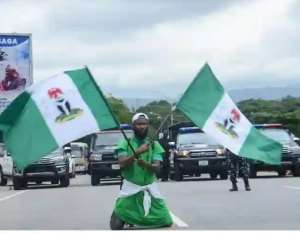
Today, Friday, June 12, 2026, Nigeria observes it’s Democracy Day the annual commemoration of an election that was won overwhelmingly, stolen brazenly, and whose stolen mandate cost the nation six more years of military misrule, the imprisonment and eventual death of its rightful winner, and the assassination of his wife. It is a day of pride and of pain in equal measure. And in 2026, it carries a weight that extends well beyond Nigeria's borders into a West Africa where the democratic project is under its most serious threat in a generation.
The Day That Became a Symbol
The facts of June 12, 1993 are no longer contested. On June 12, 1993, MKO Abiola won the presidential election with 58.36 per cent of 14 million votes, defeating Bashir Tofa of the National Republican Convention. The election was widely regarded as Nigeria's freest and fairest. The victory celebrations lasted only two hours before the military annulled the results.
For three decades, the man who annulled that election General Ibrahim Badamosi Babangida insisted publicly that Abiola had not clearly won. That position finally collapsed in February 2025. In the concluding section of his autobiography, titled A Journey in Service, Babangida acknowledged that the candidate of the Social Democratic Party won the poll and described the annulment as an "accident of history." He admitted: "Although I am on record to have stated after the election that Abiola may not have won the election, upon deeper reflection and a closer examination of all the available facts, particularly the detailed election results, there was no doubt that MKO Abiola won the June 12 election."
Babangida also revealed that the annulment was orchestrated by forces within his administration, led by General Sani Abacha, who was then Chief of Army Staff. While accepting full responsibility for the annulment as Head of State and Commander-in-Chief, Babangida admitted that the military underestimated the consequences of its actions.
The Abiola family was not moved to forgiveness. Hafsat Abiola-Costello, daughter of the late MKO Abiola, stated that Babangida's admission did not erase the pain and injustice suffered by her family and the Nigerian people, noting that whenever June 12 is mentioned, she thinks of her parents MKO and Kudirat Abiola who both paid ultimate prices in the struggle for democracy. (Sahara Reporters) The Afenifere pan-Yoruba group was equally unsparing.
In a statement by its Organizing Secretary, Kole Omololu, it said IBB's public admission did not absolve him and his associates of the irreversible damage the annulment caused, and that the consequences included the assassinations of Kudirat Abiola and Alfred Rewane, among others.
What Babangida's belated confession confirms, however, is something Nigerians have always known: that June 12 was not an administrative error. It was a deliberate political crime, committed by men in uniform against a people who had done everything a democracy asks of its citizens gone to the polls, voted peacefully, and waited for the result. They were answered with the barrel of military contempt.
Nigeria's Democratic Journey: Twenty-Seven Years On
The Federal Government declared June 12, 2026, a public holiday, noting that the day symbolizes the sacrifices and courage of citizens who fought for democratic freedoms, and reaffirming its commitment to the rule of law, transparency, accountability, and inclusive governance. (Nigerian Bulletin) President Bola Tinubu was scheduled to deliver a nationwide broadcast, the latest in a series of annual presidential addresses on this day that have ranged in tone from celebratory to introspective.
Twenty-seven years of civilian rule is not anything. Nigeria has conducted successive general elections imperfectly, noisily, sometimes bloodily, but persistently. Power has transferred between parties. Courts have adjudicated electoral disputes. The press, battered as it sometimes is, continues to function. The very fact that Babangida's autobiography could be published, his confession reported, and Nigerians could argue publicly about whether he should be prosecuted all of this is the texture of a democracy, however imperfect.
But the burden of June 12 is not only commemorative. It is also an opportunity to measure how well civilian authorities have determined to make a difference from when the military was in charge. The answer depends on who is doing the narration.
For millions of Nigerians still waiting for electricity, security, jobs, and justice, the transfer from military to civilian governance has not delivered the quality of life that MKO Abiola's campaign promised. That gap between the democratic form and the democratic substance is precisely what makes the current continental moment so dangerous.
The Sahel Warns: What Happens When Democracy Fails to Deliver
To understand why June 12, 2026 carries a weight beyond Nigerian politics, one must look north and west to Mali, Burkina Faso, and Niger, three countries that held elections, elected governments, and then watched those governments be overthrown by soldiers.
Human Rights Watch documented in its World Report 2026 that leaders of military juntas in the Sahel region ramped up efforts to stifle free speech and other freedoms with little regard for transitioning to promised democratic rule. Authorities in Niger and Mali have recommended extending their transition periods to democratic rule by five years and banned multiparty politics, while Chad abolished presidential term limits.
The logic deployed by these juntas is seductive precisely because it contains a kernel of uncomfortable truth. The governments they overthrew were democratically elected, yes but they were also corrupt, incompetent, and in some cases actively complicit in the suffering of their populations. Military coups that topple democratically elected leaders strike a devastating blow to the very foundations of democracy. But the democratically elected leaders who were overthrown had themselves struck devastating blows to governance, accountability, and the basic social contract.
The results of junta rule, however, have been catastrophic. Political violence resulted in the deaths of over 10,000 people in Burkina Faso, Mali, and Niger in 2025 alone. Militants kidnapped 30 foreign nationals. JNIM and the Islamic State Sahel Province consolidated their influence across much of Mali, Burkina Faso, and Niger, while extending operations into the Benin, Niger, and Nigeria borderlands.
The juntas promised security. They delivered more insecurity. They promised dignity. They delivered censorship, mass displacement, and the execution of critics. In Burkina Faso and Mali, journalists, activists, and critics of the juntas have faced arrest, disappearance, and worse.
The men who came to power on the promise of defending their people against predatory elites have themselves become predatory, wrapped in khaki rather than agbada.
The Contagion Risk: Why Nigeria and Ghana Must Stay Alert
The juntas of the Sahel have not been content to consolidate power within their own borders. Their ideological project a mixture of anti-Western nationalism, pan-African militarism, and Russian patronage is explicitly designed for export. The Alliance of Sahel States, formed by Mali, Burkina Faso, and Niger, represents an institutional alternative to ECOWAS, built on the premise that military governance is not a temporary transitional arrangement but a legitimate and superior form of African self-determination.
This argument finds audiences in Nigeria and Ghana, particularly among young people frustrated by decades of civilian governance that has delivered persistent poverty, corruption, and insecurity. The Afro barometer surveys consistently show that support for democracy in West Africa, while still majority-held, has been eroding. When civilians govern badly, they do not only fail their citizens. They provide the ammunition that those who would end civilian rule use to justify their actions.
That is what makes June 12 relevant not just as a Nigerian commemoration but as a West African warning. Nigeria in 1993 had a military that was willing to cancel democracy when its result was inconvenient. The military was deeply divided into factions some in support of handing over to Abiola, others determined to keep the military in power. The difference between Nigeria in 1993 and Mali in 2020 is not the nature of military ambition. It is the presence or absence of an organized civil society, a free press, and international pressure strong enough to make the cost of coup-making prohibitive.
Those institutional buffers are weaker today than they were. The Trump administration in Washington has retrenched from democracy promotion globally. France has been expelled from the Sahel. ECOWAS, discredited by its failure to reverse the Niger coup in 2023, has lost its credibility as a credible guarantor of constitutional order. Russia's Africa Corps provides juntas with both security guarantees and a narrative that reframes military rule as decolonization.
The Demand of the Moment
What June 12 demands of this generation is not nostalgia for MKO Abiola's courage, real and admirable as that courage was. It demands a serious reckoning with the conditions that make the military option seem attractive to populations that have tried and been disappointed by civilian rule.
Nigeria's Democracy Day should be more than a public holiday and a presidential broadcast. It should be the occasion for a frank national audit: of the quality of governance, of the accountability of elected officials, of the delivery of public goods, of the protection of constitutional rights. Every arrested journalist, every stolen election, every contract inflated into impunity, every community left without security or services is a deposit into the account that military adventurers draw on when they make their move.
The men who annulled June 12 in 1993 believed that Nigerians would accept the cancellation of their expressed democratic will. They were wrong but the resistance cost six years, two lives of historic significance, and a psychic wound that Babangida's thirty-two-year-delayed confession has only partially addressed.
The juntas of the Sahel believe that Africans will accept the permanent cancellation of their democratic futures in exchange for the promise of security that these juntas have consistently failed to deliver. The answer to that proposition must come not from Western capitals or international institutions alone, but from African democrats in Nigeria, in Ghana, in Senegal, in Ivory Coast who understand that June 12 is not a date on a calendar. It is a reminder that the price of democracy is eternal vigilance, and that vigilance cannot be outsourced.
Abiola died for a ballot. The least the living can do is make that ballot count for something.
Mustapha Bature Sallama.
Medical/ Science Communicator,
Private Investigator, Criminal investigation and Intelligence Analysis.
International Conflict Management and Peace Building.USIP
[email protected]
+233-555-275-880

 Samreboi case: AG files objection to stop Appiah Kubi from withdrawing services ...
 Mahama will never pardon former MASLOC CEO Sedina Tamakloe — NDC MP
 Attack on forest officers undermines fight against environmental crimes — A Roch...
 Gov't settles bonus arrears, releases over GH¢76 million for Black Stars' World ...
 AI being exploited by criminals to launch more sophisticated operations — CID Bo...
 Nii Lante Vanderpuye resigns as DRIP Coordinator to pursue NDC National Executiv...
 Stay focused and be faithful — Bishop Dr. Dogbe advises Bawumia
 'Bawumia is a person of great integrity' — Bishop Dr. Hilliard Dogbe
 2026 FIFA World Cup: 'Let’s stop rooting against South Africa' — Michael Blackso...
 NAIMOS hands over 141 seized firearms, nearly 2,000 rounds of ammunition for des...


