




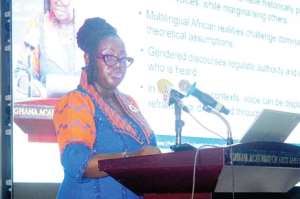
The Vice Chancellor of the University of Ghana, Nana Aba Appiah Amfo, has criticised the use of the term “vernacular” to describe African languages, describing it as demeaning and disrespectful to African identity and culture.
According to her, such labels do not only discourage the use of indigenous languages but also undermine their legitimacy as recognised systems of communication.
She argued that the problem is further entrenched in educational settings where the use of local languages is often restricted, shaping both language use and identity in ways that diminish African heritage.
Prof. Amfo made the remarks while delivering her inaugural lecture as a newly inducted member of the Ghana Academy of Arts and Sciences in Accra. The event attracted a large and diverse audience, including academics, students, and prominent national figures.
Her lecture, themed “Reclaiming voice in the global order: Language, gender and the African academy,” examined how knowledge production continues to be influenced by Eurocentric standards that sideline African perspectives.
She noted that African knowledge systems are often marginalised or dismissed, while ideas framed within Western paradigms receive greater acceptance and recognition.
“This dynamic is not only structural but deeply embedded in the everyday practice of academic knowledge production,” she stated.
Prof. Amfo emphasised that authority in knowledge production is shaped not only by content but also by who produces it, where it is published, and whose work is cited. She stressed that Africa must move beyond being a subject of external theories and assert its own intellectual voice.
On language use, she explained that meaning goes beyond words and is shaped by context, relationships, and intent. Using examples from political communication, she pointed out that statements that appear straightforward can carry layered meanings depending on how they are interpreted.
“Language is rarely transparent,” she said, noting that expressions such as “we are looking into the matter” may signal reassurance, delay, or even deflection depending on context.
She added that public communication often involves multiple layers of clarification, reinterpretation, and reframing, sometimes to adjust meaning or influence public perception.
Addressing gender issues, Prof. Amfo highlighted the persistent challenges faced by women, particularly in male dominated spaces. She observed that ambition in women is often viewed negatively and that their achievements are frequently subjected to scrutiny beyond competence.
“The ambition of a woman is seen as a transgression, equality as risk, and aspiration as something to be disciplined,” she said.
She further noted that women in public life are often judged not only on their abilities but also on appearance and perceived behaviour, a standard rarely applied to men.
Prof. Amfo concluded by urging a shift toward recognising African languages, knowledge systems, and voices as central to global discourse, rather than peripheral.
 PURC increases electricity and water tariffs effective July 1
 GWL charges customer over GH¢74,000 for illegal reconnection
 Interior Ministry suspends Kantanka Security Services licence over Adwoa Safo sh...
 Torrential rains wreak havoc in Central Region as 18 killed, hundreds affected, ...
 Police invite Nana Kwadwo Safo Akofena over Kwabenya shooting incident
 Biakoye NPP Vice Chairman commends Agbodza, demands urgent fixing of deteriorati...
 Pregnant mother of three hospitalised after alleged assault by husband
 Senior student allegedly slaps Junior repeatedly over missing mobile phone at Nc...
 There was no gun in Adwoa Safo’s car, I saw more than 30 bullet holes on her car...
 NPP Bantama Chairman, Vice Chairman arrested after clash over constituency album...



Comments
SHALLOW-MINDED professor, what is the definition of the word "vernacular" according to YOUR dictionary, not according to Oxford Dictionary or Cambridge Dictionary? As far as I am aware, "vernacular" is an English word, not an Akan or Twi word. If you do not want "vernacular" to be used to describe Ghanaian local languages, which word do you want us to use? Do you want us to use the word "dialect" or do you have a special word? Whether we like it or not,...