




Ghana’s financial revolution is unfolding not in bank halls, but in the palms of ordinary citizens. From market women in Tamale to traders in Accra, mobile money has redefined access to finance. Platforms led by MTN Ghana have brought millions into the financial ecosystem, eliminating the traditional barriers of distance, paperwork, and bureaucracy. The Bank of Ghana itself acknowledges this transformation. Its policy direction has consistently emphasized financial inclusion and digital innovation. Yet, as mobile money expands into credit provision, a troubling contradiction is emerging. Easy access is colliding with expensive borrowing.
From Financial Inclusion to Digital Dependence
Mobile money’s success is not accidental. It is the product of deliberate regulatory support. The Bank of Ghana has long pursued a policy of enabling innovation in financial services, aiming to “ensure effective and efficient operation of the banking and credit system”. This strategy has worked. Ghana is widely regarded as one of Africa’s most advanced mobile money markets. But as the ecosystem evolves from payments into digital lending, the regulatory framework is being tested. The critical question now is not whether mobile money works, it clearly does. The question is whether it is working fairly.
The True Cost of Mobile Loans
Mobile lending products typically charge around 8.9% interest over a 30-day period. For many users, this is seen as a small, manageable fee. But the reality is far more serious. Monthly rate is 8.9%, while annualized is over 100% per annum. This places mobile loans in a category that rivals high-risk informal lending, raising fundamental concerns about affordability and ethics. The problem is not just the rate, it is the structure. Short repayment cycles, easy repeat borrowing, and limited understanding of annualized costs. For a borrower taking GH¢1,000, the repayment within a month can exceed GH¢1,089. If rolled over, the debt escalates rapidly.
A Policy Gap: Transparency without Price Control
The Bank of Ghana has not ignored digital finance. In fact, it is actively developing frameworks to guide the sector. A recent policy direction explicitly states that digital financial service providers must operate in a “transparent and fair manner” and disclose all relevant information to consumers. Similarly, the Bank has initiated new efforts to regulate digital lending. It is currently developing guidelines for digital credit delivery, and emphasizes consumer protection and informed decision-making. However, there is a crucial limitation. These guidelines focus on transparency, not affordability. In other words, as long as the cost is disclosed, the pricing itself is largely left to the market.
Do Borrowers Really Understand What They Pay?
This assumption that disclosure equals understanding is deeply flawed in Ghana’s context. Most mobile money users do not calculate Annual Percentage Rates (APR), focus on immediate repayment amounts, and borrow under financial pressure. Even when costs are disclosed, they are often presented in simplified formats that obscure long-term implications. The Bank of Ghana itself recognizes this risk, stating that disclosure is meant to enable consumers to “make informed decisions”. But the reality on the ground suggests otherwise. Information alone does not guarantee informed choice.
Comparing the Lending Landscape
To understand the scale of the issue, it is important to compare lending channels:
- Commercial Banks
--- Average lending rates: 28%–35% per annum
--- Structured repayment plans
--- Collateral often required
- Microfinance Institutions
--- Annual rates: 36%–72%
--- Target small businesses and informal sector
- Mobile Money Loans
--- Annualized rates: 100%+
--- Instant, unsecured, short-term
- Loan Sharks
--- Annualized: 150%–300%+
--- Unregulated and often abusive
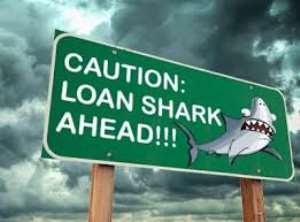
Mobile money loans are closer to loan sharks than to banks in pricing structure, even though they operate within a formal system.
Who Bears the Burden?
The most troubling aspect is who pays these high rates. Mobile lending primarily targets low-income earners, informal sector workers, and individuals excluded from traditional banking. These are not high-risk speculators, they are often people dealing with school fees, medical emergencies, and daily business cash flow. Charging over 100% annualized interest to such groups raises serious ethical and developmental concerns.
The Illusion of Convenience
Mobile money has been marketed, and rightly so, as a tool for empowerment. But convenience can sometimes mask structural problems. The speed and ease of borrowing reduces decision-making time, encourages impulsive borrowing, and masks the true cost of credit. What appears as empowerment can quietly become dependency.
A Regulator Walking a Tightrope
To be fair, the Bank of Ghana is navigating a complex landscape. On one hand, it must promote innovation, encourage financial inclusion, and support digital transformation. On the other hand, it must protect consumers, prevent exploitation, and maintain financial stability. Its current approach reflects this balancing act, favoring market freedom with guided oversight. But the big question remains. Has the balance tilted too far in favor of innovation at the expense of protection?
The Warning Signs Are Already Visible
Across Ghana, anecdotal evidence points to increasing reliance on short-term digital loans, rising repayment pressure, and repeat borrowing cycles. While comprehensive national data on digital debt is still evolving, the pattern is clear. Access to credit is expanding faster than the capacity to manage it.
My Thoughts: A System at a Crossroads
Ghana’s mobile money success story is undeniable. It has brought financial services to millions who were previously excluded. But success brings responsibility. A system that enables borrowing at over 100% annualized rates, especially among vulnerable populations demands urgent scrutiny. The Bank of Ghana has laid the foundation for transparency. The next step is clear. Move from transparency to fairness. Because financial inclusion should not mean inclusion into high-cost debt.
FUSEINI ABDULAI BRAIMAH
+233208282575/+233550558008
[email protected]

 President Mahama to cut sod for Phase 2 of Sentuo Oil Refinery Project
 EC confirms plans to conduct by-election in Anyako electoral area
 Nima Police arrest truck driver after crash leaves many injured
 Here are NPP MPs seeking action against Ken Agyapong over Afari Hospital comment...
 There is no financial clearance to expand school feeding programme this year — G...
 Government to sanction caterers serving substandard meals under school feeding p...
 Rawlings’s legacy extends beyond political leadership — Vice President
 NACOC arrests key suspect in $296m Australia-linked meth case
 Current anti-LGBTQ bill not robust enough to protect family values — GPCC
 MFWA opens applications for Africa-China relations training for West African jou...


