




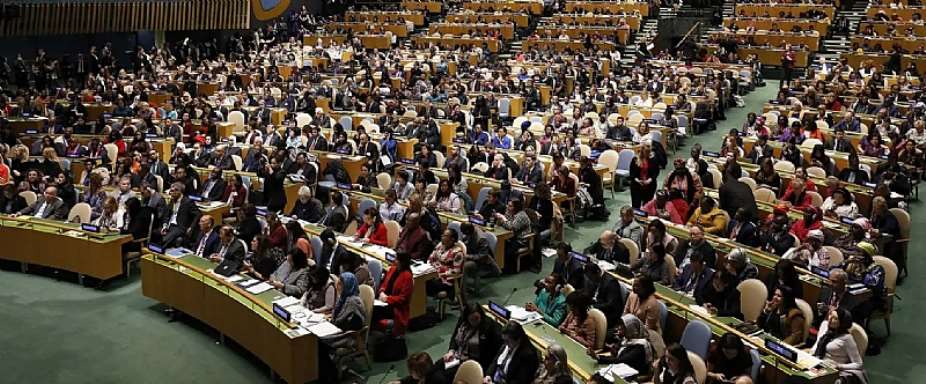
The United Nations (UN) Women and Inter-Parliamentary Union (IPU) 2026 data show women remain far from equal political power, holding just 22.4 per cent of cabinet posts and 27.5 per cent of parliamentary seats worldwide.
Women remain vastly under-represented in political leadership across the globe, with the most powerful decisions still overwhelmingly made by men, UN Women and IPU data released on the fringes of the ongoing 2026 Commission on the Status of Women session in New York stated.
According to the data obtained by the Communication for Development and Advocacy Consult (CDA CONSULT), it indicates that in 2026, only 28 countries are led by a woman Head of State or Government, while 101 countries have never had a woman leader.
According to the data when women are shut out of political leadership, decisions that shape peace, security, and economic priorities are made without half of the world’s experience at the table.
The UN Women and IPU's new global data reveals stagnation and, in some cases, regression in women’s political leadership, particularly in executive government.
Key findings from the data indicate that women hold just 22.4 per cent of cabinet minister positions globally, down from 23.3 per cent in 2024, marking a reversal after years of gradual progress.
Fourteen countries have achieved gender parity in cabinets, demonstrating that equal representation is possible, yet eight countries still have no women ministers at all.
Women hold 27.5 per cent of parliamentary seats worldwide, up slightly from 27.2 per cent in 2025.
According to the data, the increase of just 0.3 percentage points marks the second consecutive year of the slowest growth recorded since 2017, highlighting how slowly women are advancing in political decision-making power.
The UN Women and IPU data also show that women are also losing ground in parliamentary leadership. As of January 2026, 54 women serve as Speakers of Parliament globally, representing 19.9 per cent of all Speakers. This represents a nearly four-percentage-point decline from the previous year and the first drop in women Speakers in 21 years.
According to the data, women in politics face rising hostility and intimidation from the public, both online and offline, and 66 per cent of women parliamentarians surveyed report experiencing intimidation by the public, compared with 68 per cent of men – a trend that deters women from seeking office and slows progress toward equal political power.
It also revealed that even when women reach leadership positions, they are often concentrated in a narrow range of portfolios traditionally linked to social sectors.
However, women lead 90 per cent of gender-equality ministries and 73 per cent of ministries responsible for family and children’s affairs, reinforcing long-standing gender stereotypes in political leadership.
Meanwhile, men continue to lead almost exclusively ministries like defence, home affairs, justice, economic affairs, governance, health, and education.
The UN Women Executive Director Sima Bahous expressed concern that at a time of growing global instability, escalating conflicts and a visible backlash against women’s rights, shutting women out of political leadership weakens societies’ ability to respond to the challenges they face.
She said, 'Women bring perspectives and experience that are essential for making better decisions, preventing conflict and building lasting peace.' When women are fully involved in political leadership, countries are more stable, policies work better for people, and societies are better prepared to face the crises shaping our world today.
The IPU President Tulia Ackson, on her part, noted that parity is a moral imperative because women have an equal right to shape the decisions that govern their lives. But it is also the smart thing to do.
“Institutions make better decisions when they reflect the societies they serve. They are better able to identify bias, design fairer responses, and earn public trust when women from all backgrounds are present and influential at every level,” IPU President stressed.
The IPU Secretary General Martin Chungong, contributing to the discussion, said the IPU has constantly proved that well-designed quotas and strong political will are essential to speed up change and ensure that women’s voices are heard in democratic decision-making.
“At the same time, men and women must work together as equal partners to transform political culture, challenge stereotypes, and build inclusive parliaments that reflect the people they represent,” the IPU Secretary General stated.
According to UN Women and IPU, despite the slow pace of change, women around the world continue to push boundaries and assert their place in political life.
The two entities suggested that removing structural barriers, including discriminatory laws; violence against women in politics; and unequal access to resources, as well as challenging negative social norms, will be critical to ensuring women’s equal political leadership in the years ahead.
The 70th Session of the Commission on the Status of Women – the United Nations’ highest-level intergovernmental body that sets global standards for women’s rights and gender equality – is a once-in-a-generation opportunity to reverse the rollback of women’s rights.
The future of democracy will be stronger, fairer, and more resilient when women are equally represented in decision-making at all levels.
The Ministry of Gender, Children and Social Protection of Ghana is championing the government's accomplishment on the gender front, while representatives from various gender-based civil society organisations, including women's rights activists, are expected to project challenges to gender equality.
Ghana aims to showcase its gender mainstreaming policies and share its progress in combating gender-based violence and hold a side event to project the nation, as well as use the platform to project the various traditional and national wears.





 Korle Bu Teaching Hospital to introduce IVF and Corporate Clinic before end of 2...
 Accra West: Sarpeiman, Medie and other areas to experience power outages on Sund...
 Accra West: Faulty transformer causes outage Pokuase Amanfrom and surrounding ar...
 Restoration of Akosombo turbines not automatic solution to current dumsor — Mira...
 We have enough capacity to meet electricity demand — Energy Minister
 May 2: Cedi maintains value, sells at GHS12.15 on forex market, GHS11.20 on BoG ...
 2024 outages not due to transformer overloads — Energy Minister defends past com...
 US to withdraw about 5,000 troops from Germany
 Rebels take key military base in Mali's north
 Middle East war's impact on shipping hitting refugee aid: UNCHR


