




“If sanctions justify seizures, then security can too.” — Russian Naval Doctrine, 2025
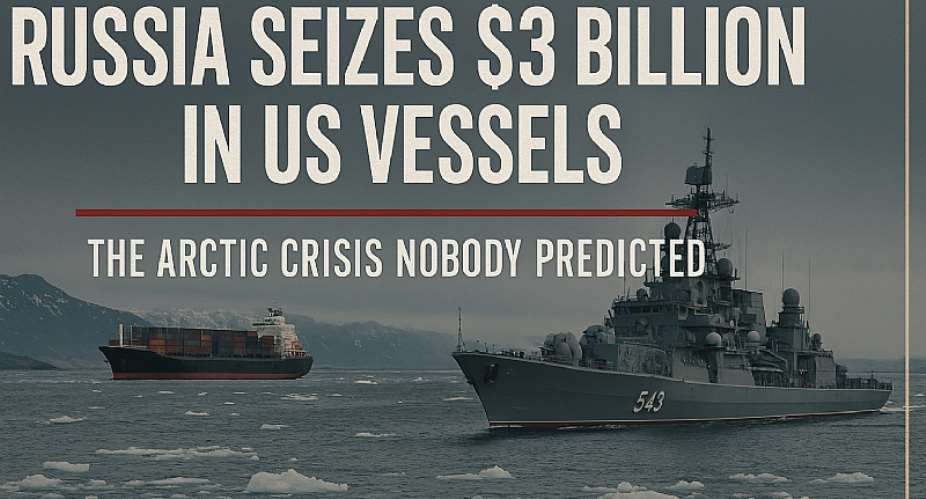
In a stunning escalation that has sent shockwaves through global shipping lanes, Russia has seized twelve U.S.-linked commercial vessels in the Arctic, locking down over $3 billion in assets. With forty naval units deployed across three seas, this was not a rogue act of piracy—it was a calculated geopolitical maneuver. And while the world watches the Arctic, Africa must pay attention. The rules of global trade are shifting, and Ghana cannot afford to be caught off guard.
Why This Matters to Ghana
Though the Arctic may seem distant, the implications of this crisis ripple across oceans. Ghana, like many African nations, depends heavily on maritime trade, foreign investment, and global shipping norms. If powerful nations begin rewriting the rules of the sea, smaller economies could find themselves vulnerable to similar coercive tactics.
Timeline of the Arctic Seizure
- Late December 2025 Russian naval forces begin quietly mobilizing across the Barents, Kara, and Bering Seas. Satellite imagery and maritime tracking suggest a buildup of over 40 vessels, including frigates, patrol ships, and support craft.
- January 2, 2026 In a bold and coordinated operation, twelve commercial vessels with U.S. ownership or financial ties are seized by Russian authorities. The ships are intercepted without violence and redirected to Arctic ports under Russian control.
- January 3, 2026 Russian state media confirms the seizures, framing them as “security enforcement actions” under domestic maritime law. Officials deny any violation of international norms, insisting the vessels were operating in “sensitive zones.”
- January 4, 2026 The U.S. State Department issues a strong condemnation, calling the seizures “a dangerous precedent” and demanding the immediate release of the ships and their crews. Diplomatic channels are activated, but no resolution is reached.
- January 5, 2026 Global shipping insurers react swiftly, raising premiums for Arctic routes and advising caution for vessels operating near Russian waters. NATO convenes an emergency maritime security session to assess the strategic implications.
- January 6, 2026 Russia doubles down on its position. A senior Kremlin spokesperson declares, “The West wrote this playbook. We’re simply applying it.” The statement signals a new era of strategic mirroring and legal ambiguity in global maritime affairs.
Strategic Mirroring: Russia’s Calculated Response
For years, the United States and its allies have enforced sanctions by boarding foreign vessels, freezing assets, and leveraging control over global financial and insurance systems. Russia, long on the receiving end of such tactics, has now flipped the script.
“This isn’t piracy. It’s strategic mirroring,” said a senior analyst at the Moscow Institute for Strategic Studies. “If the West can use law enforcement to seize ships, why can’t we use security enforcement?”
By framing the seizures as legal and non-violent, Russia avoids the label of piracy while achieving maximum geopolitical leverage. The crews are not officially hostages—but their freedom is now a bargaining chip.
The Death of Maritime Neutrality?
This incident signals a dangerous erosion of long-standing maritime norms. For centuries, the high seas were considered neutral ground. But now, with great powers weaponizing trade routes, neutrality is becoming a myth.
“The Arctic is no longer just about ice and oil. It’s about power,” remarked Rear Admiral (Ret.) James Holloway, a former U.S. naval strategist. “And Russia just made that crystal clear.”
The Arctic as a New Frontline
The Northern Sea Route, once frozen and inaccessible, is now a coveted corridor due to climate change. Russia claims it as a sovereign economic zone. The West sees it as international waters. The seizure of ships is a bold assertion of that claim—and a warning to others.
Implications for Ghana and Africa
1. Precedent for Maritime Seizures: If global powers normalize such tactics, African nations could face similar risks in the Gulf of Guinea or Indian Ocean.
2. Insurance and Trade Costs: Rising premiums and rerouted shipping could increase the cost of imports, affecting food and fuel prices.
3. Need for Maritime Sovereignty: Ghana must invest in naval capacity and legal frameworks to protect its waters and trade interests.
4. Diplomatic Vigilance: As global alliances shift, Ghana must navigate carefully to protect its economic and geopolitical interests.
A Call to Action
This Arctic flashpoint is not just a distant drama—it’s a mirror reflecting the fragility of the global order. Ghana must learn, adapt, and prepare. As the world’s oceans become arenas of contest, our sovereignty, economy, and security depend on understanding the tides of change.
Retired Senior Citizen
Teshie-Nungua
[email protected]


 Judiciary must earn public trust, not demand it — Asiedu Nketiah
 Any sod-cutting ceremony at Upper East Airport site this weekend will be 419 — G...
 Mahama must investigate GoldBod over alleged US$1.7bn loss — Abena Osei-Asare
 Attorney General opposes Wontumi’s bail application pending appeal in 20-year se...
 'I will continue to sit until Chief Justice revokes warrant' - High Court judge ...
 August 11: Cedi sells at GHS12.45 on forex market, GHS11.78 on BoG interbank
 Hopeson Adorye eats humble pie, retracts claim linking Ekow Assafuah to Ghana To...
 Legal vacation does not mean lawyers can halt court proceedings – Deputy Attorne...
 Forensic audit reveals how Ghana’s Embassy in the U.S. extorted $19.3 million fr...
 EVIDENCE: How Ghana’s Washington Embassy staff shared money extorted from visa a...


Comments
Didn't happen. AI generated fantasy clickbait.