




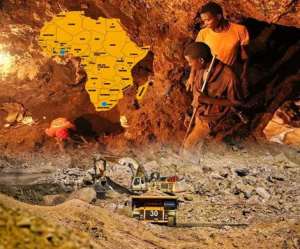
Introduction
Resource Sovereignty is Africa's right to control, exploit and manage its vast mineral wealth for benefit of its nations and its citizens. Sadly, just like the biblical story (Genesis 25: 29-34) where the character Esau lost or was tricked out of his birthright by Jacob...so is Africa, lost or tricked out of it's right... the right to resource sovereignty.
Meaning of Resource Sovereignty
United Nations General Assembly (UNGA) Resolution 1803 of 14 December 1962 defines Resource Sovereignty as a nation's fundamental right to control, manage, and benefit from its own natural resources for its people's development. Resource Sovereignty, at its most fundamental level, refers to the authority a nation or entity holds over its resources. This notion of authority is not merely about physical control, but extends to the right to determine the exploitation, management, and distribution of these resources. In the context of Africa, Resource sovereignty is Africa's right to manage its resources for local development, sustainability and economic independence.
Phenomenon Of Resource Sovereignty
Resource sovereignty is not only about control & exploitation of own natural resources. That is, the right to decide if, how , and for whose benefit resources are used, including setting environmental and labor rules. Resource sovereignty is also about national development. Again resource sovereignity should serve the economic, social, and cultural well-being of the state's people. Resource sovereignity is also about self- determination, a people's right to self-rule and control their destiny.
Why Resource Sovereignty Is Now Critical For Africa?
First and foremost, Africa should pursue economic, mineral and energy sovereignty in order to reduce foreign dependence and fully harvest its mineral wealth. Secondly, resource sovereignty can catapult Africa from a mere producer and exporter of raw materials to a manufacturer or process of value added products. This resource leveraging strategy is key to shifting Africa from a raw material exporter to a value-added industrial hub, strengthening its role in global supply chains.Thirdly, resource sovereignty makes it possible to strategically renegotiate unfair mining contracts and by linking mineral access to reciprocal agreements on technology sharing and industrial investment, the resource leverage strategy can unlock Africa's industrial development. Also, Africa through its own resource sovereignty can emerge as a powerful and influential geopolitical power and player. A well-executed resource leverage strategy positions Africa as a key player in the global energy transition while securing long-term economic and developmental benefits. Last but not least, global economic equality and sustainability is possible when Africa, just like everyone else has resource sovereignty.Therefore a more just,fair, sustainable "Global Village" can be a reality when Africa's resource sovereignty is achieved.
How Africa Lost Its Right (Resource Sovereignty)?
In his book,"Disrupted Development In The Congo", Ben Radley discusses the three (3) stages by which Africa lost & continues loosing its mineral sovereignty.
Stage One (1): Blame The African State
By blaming the African state (internal factors) and failing to weigh the impact of (external shocks & global trends) resulted in a misguided reading of African economic stagnation from the mid-1970s onwards, argues Radley. Therefore, this resulted in economic stagnation in Global South being blamed solely on "African state intervention and government corruption" as the only primary causal explanations, to the exclusion of other external factors, which was inadequate & wrong.Championed largely by Africanists based in North American universities (such as Robert Bates and Eliot Berg, the latter the author of the World Bank’s 1981 report Accelerated Development in Sub-Saharan Africa: A Plan for Action ), this line of thinking was immediately embraced by the International Monetary Fund (IMF) and the World Bank(WB).
Offering a regional perspective, the seminal work of Mkandawire and Soludo on the causes of the mid-1970s decline in African economic performance is worth citing at length:
"Our intention here is not to rationalize, let alone ignore the infamous mismanagement of economies by African governments. Rather, the point is to emphasize that successful adjustment will be elusive unless Africaʼs vulnerability to external factors is recognised.Such a recognition will serve in rethinking the form and content of Africaʼs structural transformation.Failure to account for such factors, even as one corrects for internal policy errors, can frustrate attempts at change and condemn them to involuntary reversal".
By downplaying the role of external and global trends on Africa's mid 1970s onwards economic recession and stagnation, every blame was heaped on the African state.Therefore,the African state had to be excluded from being an economic actor. Hence, when the financially distressed & with limited access to global market African state reached out to the Bretton- Wood Institutions,what followed is history,the infamous Structural Adjustment Programmes, (SAPs). SAPs an infamous set of neo- liberal policies known as the "Washington Consensus". The policy doctrine of privatization, liberalization, and deregulation was implemented across Africa by World Bank and IMF-financed structural adjustment programmes (SAPs). Crucially, most SAPs had a focus on increasing primary commodity exports, but this time around—to correct for the perceived failures of the recent past—under new management,
"the effecient private player, not the perennial mismanager, the government ".
This was the first stage or step towards Africa loosing its mineral sovereignty.
Stage 2: Liberalize and Privatize
It was in this neoliberal political and ideological context that, as Hormeku-Ajei and Goetz have summarized,
"the World Bank told African governments to abandon any notion to use mineral resources to serve social priorities or developmental priorities and give up the running and management of minerals and mineral wealth to transnational companies".
Between 1980 and 2021, the World Bank provided US$1.1 billion in mining sector grants and loans to fifteen of the continent’s seventeen mineral-rich, low-income countries.It is of interest to note that before rise of China as an alternative source of resource-linked finance , and with many African countries still unable to access international capital markets, the World Bank was able to exert significant influence through these grants and loans to implement its strategic vision for how mining should be organized and managed in Africa, as laid out in its 1992 Strategy for African Mining report.
"The *private sector should take the lead. Private investors should own and operate mines…. Existing state mining companies should be privatized at the earliest opportunity to improve productivity of the operations and to give a clear signal to investors with respect to the governmentʼs intention to follow a private-sector-based strategy".
The private player,a Transnational Company or foreign oligarchy took over the "right to minerals" as the African state was systematically bundled out.
Stage 3: Criminalize African Miners
In order for the incoming Transnational Mining Corporations to deal with the reality on the ground on their "so- called mining claims", already for years, occupied by poorly financed, low scale, labour intensive African miners mining...legal instruments & Policy Frameworks had to be enacted to deal with these African miners described by World Bank, African governments and development scholarly literature as,
"primitive’, ‘basic’, ‘inefficient’, ‘rudimentary’, and ‘unproductive’ in contrast to the (‘efficient’, ‘modern’, ‘complex’, and ‘productive’ mining corporation )"
Even despite the fact that, they (small African miners) have been and play a crucial in rural development of African societies.Criminalized by law and policy frameworks unless they submit to a set of procedurally complex, bureaucratically burdensome, and financially costly demands to formalize their activities, and cast as illegally encroaching on a concession once it has been assigned to a Transnational Mining Corporation,(TNC) Hence, African miners have time and time again been forcibly displaced from their sites to make way for the construction of corporate-led industrial mines. Often financed by the incoming corporations themselves, and echoing violent colonial practices of the past displacement has frequently taken place as government military-led ‘sweeps’... writes, Ben Radley.
MARRAKECH DECLARATION 24-26 NOVEMBER 2025- AN ATTEMPT TO RECLAIM AFRICA'S LOST RIGHT (RESOURCE SOVEREIGNTY)
The Marrakech Declaration on Mineral Sovereignty was adopted at the Morocco International Mining Congress (IMC), 24-26 November, 2025. It was attended by African ministers (Morocco, Mauritania, Comoros, Liberia), vice ministers (Saudi Arabia, Liberia), mining officials (Kenya), and leaders from the Africa Minerals Strategy Group (AMSG).The conference was described by observers as more of "a shift in direction " African governments, private sector leaders, technical experts and global partners spoke with clarity.
"Africa is no longer waiting for the world to define the role of its mineral resources. It is building the structures, standards and alliances needed to define that role itself ", (AMSG).
The Marrakech Declaration adopted by Morocco’s International Mining Congress (IMC),marked a strategic milestone in continental resource governance.This was and is an African initiative where Africa is asserting mineral sovereignty especially so in the era where "Critical Rare Metals" have assumed a significant geopolitical signficance. An attempt by Africa to reclaim control over value creation from its natural resources as global demand for critical metals accelerates.
It is a vital African initiative for the establishment of a unified framework for mineral governance. The purpose is to transform Africa from a raw material supplier to a value-added industrial hub, ensuring minerals benefit African people through local processing, responsible ESG standards, and reduced foreign dependency. The Marrakech Declaration, was hailed as a "Founding act" marks Africa’s entry into a new era of mineral sovereignty by formally adopting the African ESG Framework, designed to address limitations of international standards considered poorly adapted to continental realities.The AFRICA principles— Accountability, Equity, Resilience, Inclusion, Cooperation, Added Value—provide foundations for facilitating sustainable financing access, strengthening investor confidence, and directing local transformation.
The clean energy narrative and energy transition narrative long focused on replacing fossil fuels with renewable sources has fundamentally shifted focus to specific periodic table elements including copper, nickel, lithium, and cobalt, essential for low-carbon technologies from electric vehicles to data centers. Critical Rare Metals have become the “nerve center” of energy system transformation, reshaping 21st-century geopolitical balances. Against this backdrop, Morocco’s International Mining Congress and the resulting Marrakech Declaration established political and technical frameworks meant to transform assumed dependency into sovereignty leverage. Moroccan Energy Transition Minister Leila Benali emphasized that;
"Africa, holder of minerals that have become indispensable for energy and digital transition, finds itself at the heart of an industrial challenge that far exceeds its historical role as raw material supplier". (AMSG).
Conclusion
IMC Morocco 2025 is more of a glimpse into the Africa of future, an Africa we want to see. An Africa where its minerals are not just extracted, looted, but transformed, valued and leveraged for its own citizens, for its own development. But for this to happen, Africa needs to organize it's standards, strengthen it's institutions, reintergrate, reconnectand have a continental thrust where Africa speak with one voice and say enough is enough, no raw material shall leave the shores of Africa raw. "Processing should be done here, value addition should be done here also", so as to create employment for Africa and facilitate infrastructural development in Africa.The Marrakech Declaration of November 2025 did not end the work or done much but it initiated it. Africa has and should move towards reclaiming it's lost right, whether Africa will manage to reclaim it (resource sovereignty) remains to be seen.
F. Madondo (African Teacher) [email protected]
Reference
Radley B, 2023, Disrupted Development in the Congo: The Fragile Foundations Of African Mining Consensus in Critical Frontiers Of Theory, Research & Policy In International Development Studies, 16 November 2023, Oxford University Press, Oxford.


 Justice Yonny Kulendi reveals how some lawyers abuse appeals process, wants revi...
 Ibrahim Mahama offers to cover cost of leg amputation for Ghana's tallest man
 Detained Abu Trica reportedly hospitalised, lawyer threatens habeas corpus over ...
 Roads Minister directs contractors to submit work schedules or risk payment dedu...
 GTEC names unaccredited tertiary institutions, lists 50 affected campuses and ce...
 Kenya journalist escapes abduction after criticism of president, says CPJ
 NPP sets September 19 for national delegates conference to elect national office...
 Here are areas to be affected by ECG's planned maintenance today
 Judicial office is for service, not personal wealth — Justice Kulendi
 Ghana Water to shut down Dodowa booster station for 24-hour maintenance

