




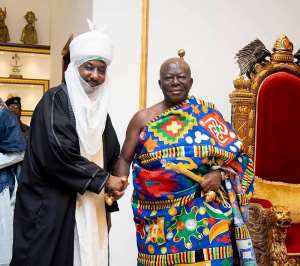
For more than a century, the relationship between the Manhyia Palace and the Hausawa community has stood as a symbol of unity, tradition, and mutual respect between the Asante Kingdom and the Hausa people. Rooted in history, trade, diplomacy, and customary authority, this bond has transcended generations and continues to command relevance in contemporary traditional governance. In recent times, this historic relationship has been reaffirmed and revived through the engagement of the Emir of Kano, Khalifa Muhammad Sanusi Lamido Sanusi, reinforcing ancestral ties that cannot be altered by circumstance or time.
Historical Roots of the Relationship
The settlement of the Hausawa in Kumasi dates back to the late nineteenth and early twentieth centuries, when long-distance trade and Islamic scholarship connected northern savannah societies with the forest states of southern Ghana. The Asantehene, recognizing the importance of the Hausawa as traders, scholars, and cultural intermediaries, granted them land, protection, and recognition under Asante customary authority.
This recognition placed the Hausawa firmly within the traditional governance structure of Asanteman, under the spiritual and political authority of the Manhyia Palace. Their leadership was acknowledged, and their community became an integral part of Kumasi’s social and economic life.
The Sacred Authority of the Black Stool
Central to this enduring relationship is the Black Stool, which in Akan tradition represents ancestral authority, legitimacy, and continuity. The Black Stool associated with the Hausawa symbolizes their recognized status and allegiance to the Asantehene and the Golden Stool.
By customary law, the authority vested in a Black Stool cannot be casually withdrawn or reinterpreted. Therefore, the relationship between the Manhyia Palace and the Hausawa cannot change unless the Black Stool is rightfully taken from the Hausawa through accepted traditional processes. Until such an event occurs, the bond remains intact, valid, and spiritually binding.
Revival Through Traditional Leadership
The renewed relationship, symbolized by the engagement of Emir Khalifa Muhammad Sanusi Lamido Sanusi, is not the creation of a new alliance but the reaffirmation of an existing one. As a respected traditional ruler and Islamic scholar, the Emir’s role highlights the continuity of historical ties between the Hausa traditional institutions and the Asante Kingdom.
This revival serves as a reminder that traditional relationships do not expire; they are preserved through memory, symbols, and mutual respect among custodians of culture.
The Significance of the Handshake: Gama Hannu Lafiya
The handshake between prominent traditional leaders such as Otumfuo Osei Tutu II and Emir Muhammad Sanusi Lamido Sanusi carries deep cultural meaning. In Hausa tradition, such a handshake is described as “Gama hannu lafiya,” meaning a handshake of peace, trust, and good intention. It signifies goodwill, mutual recognition, and the reaffirmation of harmony between peoples and institutions.
This gesture, though simple in appearance, represents a powerful traditional declaration one that acknowledges history, respects authority, and reinforces unity without the need for words.
Tradition Beyond Time
Traditional authority is guided by ancestral customs that are not subject to political trends or modern reinterpretation. As long as the Black Stool remains with the Hausawa, the historical relationship with the Manhyia Palace stands firm. Any attempt to alter this bond without addressing the stool itself would be inconsistent with customary law and tradition.
Conclusion
The revived relationship between the Emir of Kano, Khalifa Muhammad Sanusi Lamido Sanusi, and the Manhyia Palace reflects a century-old alliance grounded in history, spirituality, and cultural legitimacy. The symbolic handshake Gama hannu lafiya between great traditional leaders reaffirms peace, respect, and continuity. Until the Black Stool is lawfully taken from the Hausawa, this relationship remains unchanged, standing as a testament to the enduring power of African traditional institutions.
Mustapha Bature Sallama
Medical Science communicator.
Private Investigator and Criminal
Investigation and Intelligence Analysis,
International Conflict Management and Peace Building. Alumni Gandhi Global Academy United States Institute of Peace.
[email protected]
+233-555-275-880


 Mysterious illness leaves children struggling to walk, hear in Mafi Kope
 ‘We’ve come back to make sure our father's ideas never die’ – Nkrumah family
 Ghana Jollof: Akosua Manu appeals to Naana Jane to use her influence to free Sal...
 Yellow fever confirmed in Sissala East after 21 mysterious deaths
 Kenyasi man allegedly attacked by prison officers and inmates over yam theft cla...
 Germany’s far-right AfD makes strong gains in two state elections
 Savannah Regional Minister, IGP Yohuno visit Gbindabuor following lynching of po...
 Jehovah's Witnesses make blood component decisions a matter of personal conscien...
 Road contractors fed on contracts for years without completing projects – Alhass...
 Ghana Jollof saga: ‘She has no right to do what she’s doing’ – Inusah Fuseini


